
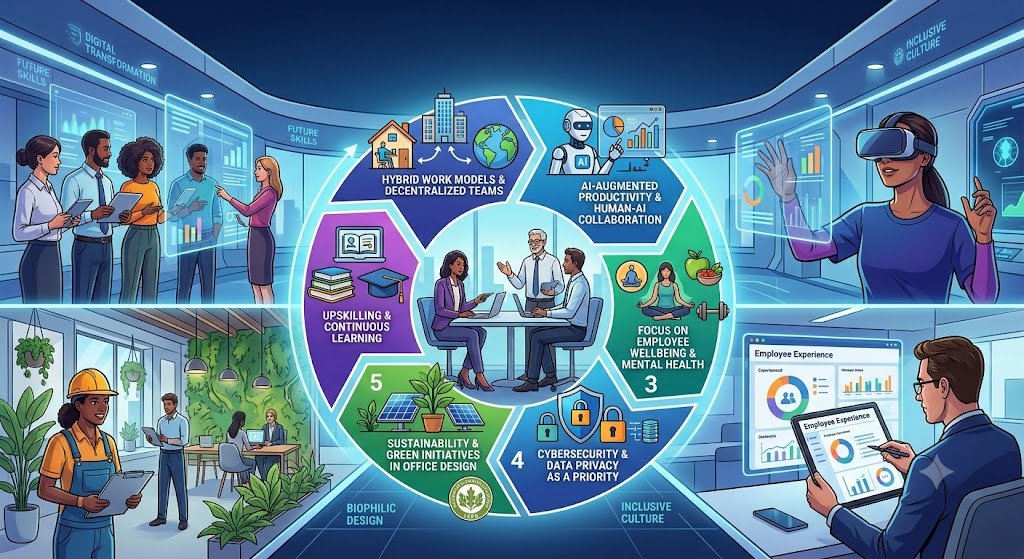

The workplace is undergoing one of the most significant transformations in business history. Rapid advancements in artificial intelligence, automation, demographic shifts, sustainability priorities, and evolving employee expectations are redefining how organizations operate. By 2030, success will no longer be determined solely by market share or technological capabilities—it will depend on how effectively organizations adapt their workforce, leadership, and culture to constant change.
For today’s CXOs, preparing for the future isn’t about predicting every disruption. It’s about building organizations that are agile, resilient, and ready to evolve. The decisions leaders make today will shape their ability to compete in the next decade.
Here are the major workplace trends every CXO should be preparing for.
1. AI Will Become Every Employee’s Co-Worker
Artificial intelligence is rapidly moving beyond automation into everyday decision-making and collaboration. Employees across departments—from finance and HR to sales and operations—will work alongside AI-powered assistants that handle repetitive tasks, generate insights, and accelerate productivity.
Rather than replacing entire jobs, AI will redefine responsibilities. Employees will spend less time on routine activities and more time solving complex problems, building relationships, and driving innovation.
CXO Priority:
Develop an AI strategy that focuses equally on technology adoption, workforce reskilling, governance, and responsible AI usage.
2. Skills Will Replace Job Titles
Traditional job descriptions are becoming less relevant as organizations require employees to work across multiple functions. Hiring and promotions will increasingly be based on verified skills rather than degrees or years of experience.
Companies will invest heavily in internal talent marketplaces, allowing employees to move across projects based on capabilities instead of organizational hierarchy.
CXO Priority:
Shift from role-based workforce planning to skills-based workforce planning supported by continuous learning initiatives.
3. Hybrid Work Will Mature Into Flexible Work
The future workplace isn’t simply about working from home. Employees will expect flexibility regarding when, where, and how they work.
Organizations will move away from attendance-based management toward outcome-based performance measurement. Collaboration tools, virtual workspaces, and digital workflows will become central to daily operations.
CXO Priority:
Build policies that balance employee flexibility with productivity, collaboration, and organizational culture.
4. Employee Experience Will Become a Competitive Advantage
By 2030, organizations will compete not only for customers but also for talent. Employees increasingly evaluate employers based on career development, well-being, purpose, flexibility, and workplace culture.
The employee experience will become as carefully designed as the customer experience.
Organizations that invest in personalized learning, mental wellness, career mobility, and inclusive leadership will attract and retain top talent.
CXO Priority:
Measure employee experience continuously and integrate it into business strategy.
5. Continuous Learning Will Become a Business Necessity
Technology is evolving faster than traditional education systems. Skills acquired today may become outdated within a few years.
Leading organizations will build continuous learning ecosystems where employees regularly acquire new technical and leadership capabilities.
Learning will shift from annual training programs to daily, personalized development embedded into work.
CXO Priority:
Create a culture where learning becomes part of every employee’s job rather than an occasional activity.
6. Leadership Will Become More Human
Technology will continue advancing, but leadership will become increasingly people-centric.
Employees expect leaders who communicate transparently, demonstrate empathy, encourage innovation, and support personal growth.
The most successful executives of 2030 will combine data-driven decision-making with emotional intelligence.
CXO Priority:
Invest in leadership development programs focused on coaching, adaptability, emotional intelligence, and change management.
7. Data-Driven Decision Making Will Expand Across Every Function
Organizations will increasingly rely on predictive analytics to improve workforce planning, customer engagement, financial forecasting, and operational efficiency.
Real-time dashboards will enable executives to make faster and more informed decisions.
However, data quality, cybersecurity, and ethical governance will become equally important.
CXO Priority:
Strengthen enterprise data governance while building analytical capabilities across leadership teams.
8. Sustainability Will Influence Workforce Strategy
Environmental, Social, and Governance (ESG) initiatives will increasingly shape employer branding, investment decisions, and talent acquisition.
Employees—particularly younger generations—prefer organizations whose values align with their own.
Workplace sustainability will extend beyond environmental initiatives to include diversity, inclusion, ethical leadership, and social responsibility.
CXO Priority:
Integrate sustainability into business strategy rather than treating it as a compliance requirement.
9. The Gig Workforce Will Become Mainstream
Organizations will increasingly rely on freelancers, consultants, contract professionals, and project-based specialists to access niche expertise quickly.
The future workforce will be a blend of permanent employees, gig workers, AI agents, and strategic partners.
Managing this ecosystem will require new leadership approaches and digital workforce platforms.
CXO Priority:
Develop workforce strategies that seamlessly integrate internal and external talent.
10. Organizational Agility Will Define Market Leaders
The pace of disruption will continue accelerating. Companies that adapt quickly will outperform those that rely on rigid structures and slow decision-making.
Future-ready organizations will feature flatter hierarchies, faster innovation cycles, empowered teams, and continuous experimentation.
Agility will become a core business capability rather than an operational initiative.
CXO Priority:
Simplify decision-making processes and create organizational structures that encourage rapid adaptation.
Preparing for the Workplace of 2030
The future workplace isn’t a distant vision—it’s already taking shape. Artificial intelligence, evolving employee expectations, flexible work models, and skills-based organizations are transforming how businesses operate. Companies that wait to adapt risk falling behind in both talent and competitiveness.
For CXOs, the challenge is no longer just managing change; it’s leading it. Success in 2030 will belong to organizations that embrace continuous learning, empower people with technology, foster inclusive leadership, and build cultures capable of evolving as quickly as the world around them.
The workplace of the future will not simply be more digital—it will be more human, more intelligent, and more adaptable. The leaders who begin preparing today will be the ones defining tomorrow’s success.