
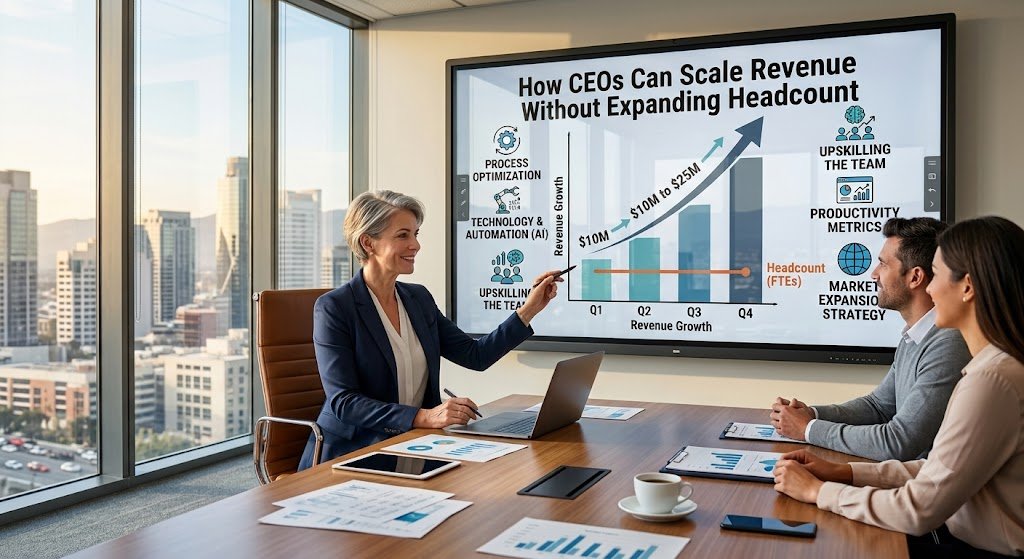

In today’s business landscape, growth is no longer measured by the size of a company’s workforce. Instead, it is increasingly defined by how effectively organizations can generate more value with the resources they already have. Rising labor costs, talent shortages, economic uncertainty, and rapid advances in AI have prompted CEOs to rethink a long-standing assumption: that higher revenue requires more employees.
Leading organizations are proving otherwise. By combining technology, smarter operating models, automation, and workforce optimization, businesses are achieving significant revenue growth without proportionally increasing headcount. This shift isn’t about asking employees to work harder—it’s about enabling them to work smarter.
The CEOs who master this approach will build organizations that are more agile, profitable, and resilient in an increasingly competitive marketplace.
Why Headcount Is No Longer the Best Growth Metric
For decades, business expansion followed a predictable pattern. More customers required more salespeople. More products required more operational staff. More revenue meant larger departments.
Today, that equation has fundamentally changed.
Cloud technology, artificial intelligence, automation platforms, digital collaboration tools, and data analytics have dramatically increased employee productivity. A small, highly skilled team equipped with modern technology can often outperform much larger organizations using traditional processes.
Rather than asking, “How many people do we need?” successful CEOs are asking, “How can we eliminate unnecessary work?”
The result is higher productivity, improved margins, and sustainable growth.
Automate Repetitive Work
One of the fastest ways to increase organizational capacity is by removing repetitive, manual activities.
Across departments, employees still spend countless hours on tasks that software can complete more quickly and accurately.
Examples include:
- Invoice processing
- Report generation
- Customer onboarding
- Employee documentation
- CRM updates
- Procurement approvals
- Routine customer support
Automation doesn’t replace employees—it frees them to focus on work that generates revenue, strengthens customer relationships, and drives innovation.
Every hour saved through automation becomes additional productive capacity without hiring another employee.
Maximize Existing Talent
Many organizations underestimate the potential already inside their workforce.
Instead of recruiting externally for every new capability, forward-thinking CEOs invest in developing existing employees.
Internal mobility offers several advantages:
- Faster role transitions
- Lower recruitment costs
- Higher employee engagement
- Better retention
- Preservation of institutional knowledge
Cross-functional training also creates a more flexible workforce capable of adapting quickly to changing business priorities.
When employees continuously develop new skills, companies gain additional capabilities without expanding their workforce.
Increase Revenue Per Employee
One of the most meaningful executive metrics is revenue generated per employee.
Rather than focusing solely on total revenue, CEOs should measure how effectively each employee contributes to business growth.
Improving this metric often involves:
- Simplifying workflows
- Reducing administrative burden
- Eliminating duplicate processes
- Improving decision-making speed
- Providing better digital tools
Organizations that consistently improve revenue per employee typically outperform competitors in both profitability and operational efficiency.
Build AI-Augmented Teams
Artificial intelligence is changing the way organizations operate.
Rather than replacing entire jobs, AI increasingly functions as a productivity partner.
Marketing teams can create campaigns faster.
Sales teams can personalize outreach at scale.
Finance teams can automate forecasting.
HR teams can streamline recruitment and employee support.
Customer service teams can resolve routine queries instantly while allowing human agents to focus on complex interactions.
This “human + AI” model allows organizations to expand output without expanding payroll.
The competitive advantage comes from empowering every employee with intelligent tools that multiply their effectiveness.
Focus on High-Value Customers
Revenue growth doesn’t always require acquiring more customers.
Often, the greatest opportunity lies in increasing value from existing clients.
CEOs should encourage teams to focus on:
- Customer retention
- Upselling premium offerings
- Cross-selling complementary services
- Personalized customer experiences
- Long-term account relationships
Retaining an existing customer is generally more cost-effective than acquiring a new one, making customer success a powerful growth engine.
A stronger customer lifetime value directly contributes to higher revenue without additional hiring.
Eliminate Organizational Complexity
As companies grow, complexity often grows faster than revenue.
Multiple approval layers, unnecessary meetings, overlapping responsibilities, and outdated processes consume valuable employee time.
High-performing CEOs continuously simplify operations by:
- Reducing unnecessary approvals
- Streamlining reporting structures
- Clarifying decision ownership
- Standardizing workflows
- Eliminating low-value activities
Simpler organizations move faster, make better decisions, and achieve greater productivity with fewer resources.
Leverage Strategic Partnerships
Not every capability needs to exist internally.
Many successful companies scale through partnerships rather than permanent hiring.
Examples include:
- Specialized consulting firms
- Technology providers
- Managed service partners
- Freelance experts
- Contract-based specialists
This flexible operating model provides access to expertise when needed while keeping fixed costs under control.
It also allows businesses to scale up or down quickly as market conditions change.
Measure Productivity, Not Presence
Traditional management often rewards activity rather than outcomes.
Modern CEOs increasingly focus on measurable business results.
Important performance indicators include:
- Revenue per employee
- Customer satisfaction
- Sales conversion rates
- Project delivery speed
- Innovation output
- Profit margins
- Customer retention
When organizations measure outcomes instead of hours worked, employees gain greater autonomy while maintaining accountability.
This shift often leads to higher engagement and stronger business performance.
Create a Culture of Continuous Improvement
Scaling without hiring requires an organization where employees constantly seek better ways of working.
Continuous improvement becomes part of everyday operations rather than an occasional initiative.
Leaders should encourage teams to regularly ask:
- Which processes create unnecessary work?
- Which tasks could be automated?
- Which customer problems remain unsolved?
- Where are decisions slowing us down?
- How can technology improve productivity?
Small operational improvements made consistently across the organization compound into significant long-term growth.
The CEO’s New Growth Strategy
The future belongs to organizations that can generate more value without simply adding more people.
Growth is increasingly driven by productivity, innovation, technology adoption, operational excellence, and employee capability rather than workforce size alone.
The most successful CEOs will build businesses where every employee is empowered by automation, supported by AI, focused on high-value work, and equipped to make faster decisions.
Scaling revenue without expanding headcount isn’t about doing more with less—it is about doing better with what you already have.
As businesses prepare for the next decade of competition, the winners will not necessarily be those with the largest teams. They will be those with the smartest systems, the most empowered people, and the strongest culture of continuous improvement.