
In boardrooms across industries, the rules of leadership are changing. For decades, executive success was measured by decisiveness, predictability, and the ability to maintain control. Leaders were expected to create long-term plans, follow established strategies, and drive organizations with certainty.
Today, certainty itself has become rare.
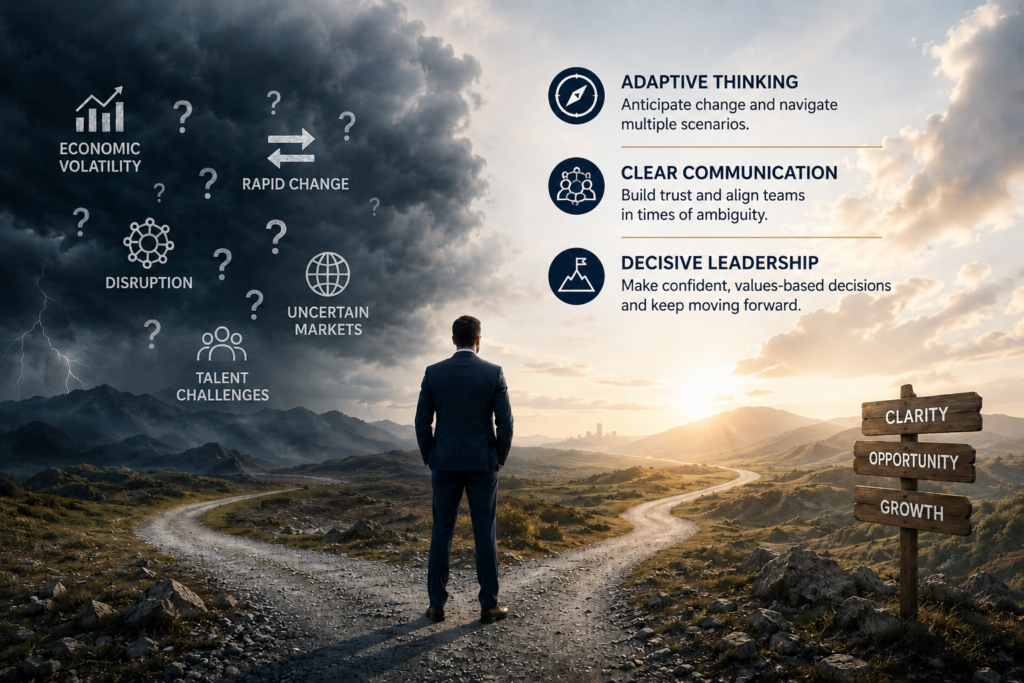
Economic shifts, technological disruption, geopolitical changes, evolving workforce expectations, and the rapid rise of artificial intelligence have transformed the business environment into one defined by constant unpredictability. In this landscape, the most valuable executive skill is no longer simply making decisions — it is leading effectively when the future is unclear.
The leaders who thrive are not those who claim to have all the answers. They are the ones who can navigate ambiguity with confidence, adapt quickly, and help their organizations move forward despite uncertainty.
Why Uncertainty Has Become the New Normal
Organizations today operate in a world where disruption is no longer an occasional event; it has become a permanent condition.
Executives face challenges such as:
- Rapid technological advancements reshaping industries
- Shifting customer behaviors and expectations
- Talent shortages and evolving workforce dynamics
- Economic volatility and market unpredictability
- Increased pressure for innovation and transformation
Traditional leadership models often relied on historical data and predictable trends. However, past success patterns may not always provide reliable guidance for future decisions.
This shift requires leaders to rethink not only their strategies but also their leadership mindset.
The Evolution of Executive Leadership
Historically, executives were expected to project certainty and authority. Leadership often meant appearing confident in every situation.
Today, effective leadership looks different.
Modern executives are expected to:
Adapt quickly instead of relying solely on long-term plans
Make informed decisions despite incomplete information
Create stability without pretending uncertainty does not exist
Build resilient teams capable of handling change
Lead with transparency and trust
Leadership is increasingly about navigating complexity rather than controlling every variable.
Key Skills Executives Need to Lead Through Uncertainty
1. Strategic Agility
Agility is more than reacting quickly. It is the ability to reassess assumptions, identify emerging trends, and adjust direction without losing momentum.
High-performing leaders continuously ask:
- What is changing around us?
- Which assumptions may no longer be valid?
- Where should we pivot?
Organizations that remain flexible often outperform those that resist change.
2. Decision-Making with Imperfect Information
Executives rarely have access to complete information before making critical decisions.
Waiting for perfect certainty often creates delays and missed opportunities.
Strong leaders:
- Gather the best available insights
- Evaluate risks realistically
- Make decisions with confidence
- Adjust based on new information
Progress often depends more on speed and adaptability than perfection.
3. Emotional Intelligence Under Pressure
Periods of uncertainty affect people differently. Teams may experience anxiety, confusion, or reduced confidence.
Leaders who understand and manage emotions create stronger organizational cultures.
This involves:
- Active listening
- Empathy
- Clear communication
- Remaining calm during pressure
Employees often take emotional cues from leadership behavior.
4. Building Organizational Resilience
Resilience is not simply recovering from disruption. It is developing systems and cultures that grow stronger through challenges.
Executives can strengthen resilience by:
- Encouraging innovation and experimentation
- Supporting continuous learning
- Empowering teams to solve problems independently
- Creating a culture that accepts adaptation
Resilient organizations respond faster and recover more effectively.
5. Transparent Communication
During uncertain times, silence creates confusion and assumptions.
Employees do not necessarily expect leaders to know every answer. They do expect honesty and clarity.
Effective communication includes:
- Sharing available information openly
- Acknowledging uncertainty where it exists
- Explaining decisions and priorities
- Providing direction while remaining realistic
Trust becomes one of the most valuable organizational assets.
Leading Forward: The Executive Advantage
The future will likely remain unpredictable. Markets will shift, technologies will evolve, and new challenges will emerge.
The executives who succeed will not be those who eliminate uncertainty; they will be those who know how to lead through it.
Leadership is no longer defined by having perfect answers.
It is defined by the ability to inspire confidence amid complexity, create clarity during change, and move organizations forward even when the path ahead is still unfolding.
Because in today’s world, uncertainty is not the obstacle to leadership.
It is the environment in which leadership is tested and ultimately proven.