
In today’s business environment, procurement leaders are expected to do much more than negotiate better prices. They are responsible for improving profitability, managing supplier risks, ensuring compliance, and supporting organizational growth. Achieving these goals requires one essential capability: complete visibility into organizational spending.
However, many companies still struggle with fragmented procurement data spread across ERP systems, invoices, purchase orders, supplier portals, and finance applications. Traditional spend analysis methods often rely on spreadsheets and manual reporting, making it difficult to generate timely and accurate insights.
This is where Artificial Intelligence (AI) is reshaping procurement.
AI-powered spend analysis transforms raw purchasing data into actionable intelligence, enabling procurement teams to identify savings opportunities, improve supplier performance, predict spending trends, and make better strategic decisions—all in real time.
What Is AI-Powered Spend Analysis?
Spend analysis is the process of collecting, cleansing, classifying, and analyzing procurement data to understand how an organization spends money.
Traditional spend analysis typically answers questions such as:
- Where is the money being spent?
- Which suppliers receive the highest spend?
- Which categories are increasing in cost?
- Are contracts being followed?
AI enhances this process by automatically discovering patterns, identifying anomalies, and generating predictive insights that would be nearly impossible through manual analysis.
Instead of simply reporting what happened, AI helps organizations understand:
- Why it happened
- What is likely to happen next
- What actions should be taken
This shift from descriptive reporting to predictive intelligence significantly improves procurement decision-making.
Why Traditional Spend Analysis Falls Short
Many procurement teams face common challenges:
- Inconsistent supplier names across systems
- Duplicate supplier records
- Poor spend categorization
- Delayed reporting
- Limited visibility into indirect spending
- Manual data cleansing
- Difficulty identifying maverick spending
These issues reduce data accuracy and prevent procurement leaders from making informed decisions.
AI automates these complex processes, improving both speed and accuracy.
How AI Improves Spend Analysis
1. Automatic Data Cleansing
Procurement data is rarely clean.
For example:
- IBM Pvt Ltd
- IBM India
- International Business Machines
These may all represent the same supplier.
AI automatically identifies duplicate records, standardizes supplier names, and cleans inconsistent data formats, creating a single source of truth.
2. Intelligent Spend Classification
Categorizing purchases manually is time-consuming.
Machine learning algorithms classify transactions into procurement categories based on historical purchasing behavior, descriptions, and invoice data.
This provides a more accurate picture of organizational spending across categories such as:
- IT
- Marketing
- HR
- Manufacturing
- Logistics
- Professional Services
3. Detecting Hidden Spending Patterns
AI identifies spending trends that humans often overlook.
Examples include:
- Departments buying similar products from different suppliers
- Repeated purchases outside approved contracts
- Unnecessary supplier duplication
- Seasonal spending spikes
- Unusual purchasing behavior
These insights help procurement teams consolidate spending and negotiate stronger supplier agreements.
4. Predictive Spend Forecasting
Rather than relying solely on historical reports, AI forecasts future spending using variables such as:
- Demand trends
- Supplier pricing
- Market inflation
- Historical purchasing
- Business growth projections
Procurement leaders can prepare budgets more accurately and reduce financial surprises.
5. Identifying Cost-Saving Opportunities
AI continuously scans purchasing data to identify opportunities such as:
- Supplier consolidation
- Contract renegotiation
- Volume discounts
- Price inconsistencies
- Duplicate purchases
- Overstocking
Instead of waiting for quarterly reviews, procurement teams receive ongoing recommendations for savings.
Improving Supplier Decision-Making
Supplier management becomes significantly more effective with AI.
Rather than evaluating suppliers based solely on price, AI considers multiple performance indicators, including:
- Delivery performance
- Quality metrics
- Contract compliance
- Invoice accuracy
- Payment history
- Risk indicators
- ESG performance
- Financial stability
This comprehensive view enables procurement leaders to select suppliers based on long-term value rather than short-term cost.
Reducing Procurement Risk
AI also strengthens risk management.
By continuously monitoring internal and external data sources, AI can identify risks such as:
- Supplier financial distress
- Supply chain disruptions
- Contract violations
- Geopolitical issues
- Regulatory changes
- Unusual purchasing activity
- Fraud indicators
Early detection allows procurement teams to act proactively instead of reacting after problems occur.
Supporting Better Executive Decisions
Procurement leaders frequently present spending insights to executive leadership.
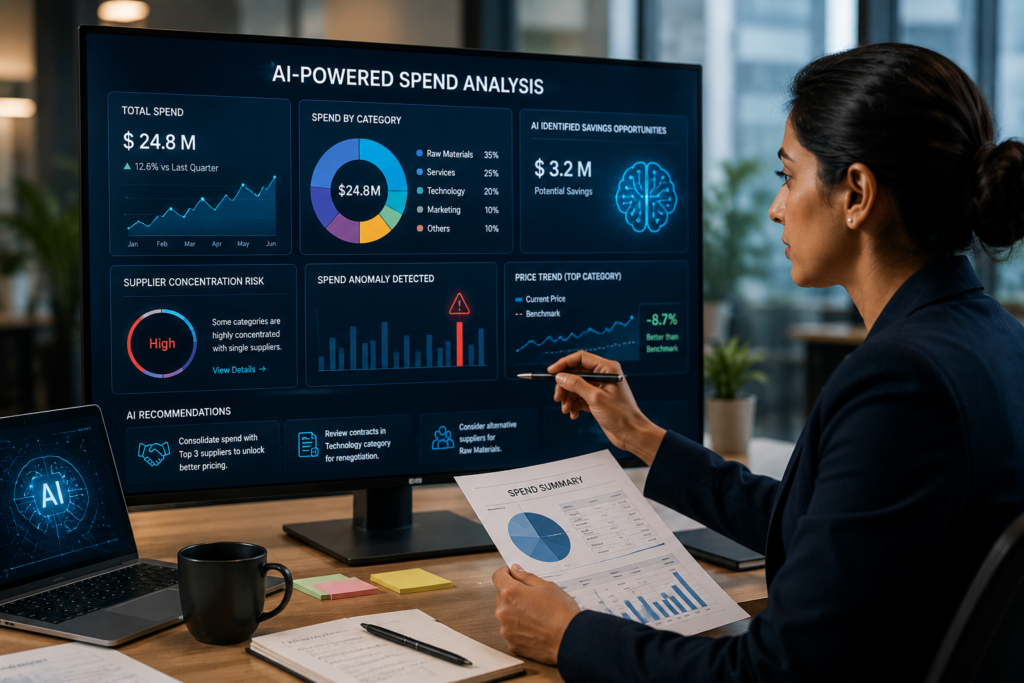
AI-powered dashboards provide real-time visibility into key metrics such as:
- Total spend by category
- Supplier concentration
- Savings achieved
- Budget utilization
- Contract compliance
- Procurement cycle times
- Risk exposure
Executives gain instant access to reliable insights, enabling faster and more confident decision-making.
Real-World Business Benefits
Organizations implementing AI-powered spend analysis often experience measurable improvements, including:
- Increased spend visibility
- Faster reporting
- Better supplier negotiations
- Reduced procurement costs
- Improved contract compliance
- More accurate forecasting
- Lower procurement risk
- Higher procurement productivity
Perhaps most importantly, procurement shifts from being viewed as a cost center to becoming a strategic contributor to business growth.
Challenges to Consider
While AI offers significant advantages, successful implementation requires careful planning.
Common challenges include:
- Poor data quality
- Integration with legacy ERP systems
- Employee adoption
- Data governance
- Privacy and security concerns
- Selecting the right AI platform
Organizations should focus on building a strong data foundation before scaling AI initiatives.
The Future of AI in Spend Analysis
The next generation of AI-powered procurement platforms will go beyond analysis.
Emerging capabilities include:
- Conversational AI for procurement insights
- Autonomous purchasing recommendations
- Real-time supplier risk monitoring
- Generative AI for spend reports
- AI-powered negotiation support
- Digital procurement assistants
Rather than spending hours building reports, procurement professionals will increasingly rely on AI to deliver insights instantly and recommend the best course of action.