
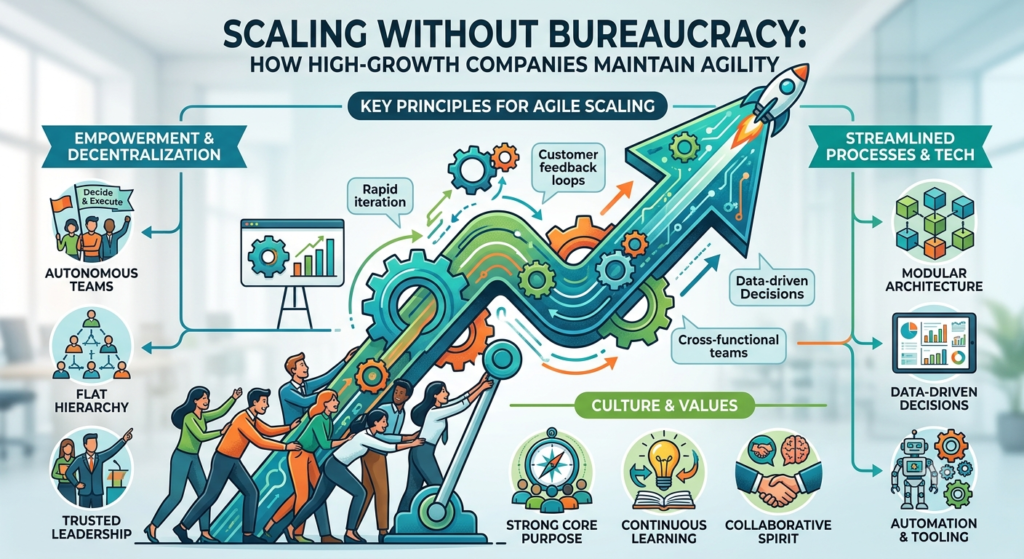

Every successful company dreams of rapid growth. More customers, expanding markets, increasing revenues, and larger teams are all signs of progress. Yet, as organizations scale, they often encounter an unexpected challenge—bureaucracy.
Processes become more complex, approvals multiply, decision-making slows down, and innovation begins to suffer. Teams that were once agile and collaborative become weighed down by layers of management and rigid procedures. Ironically, the very growth that signifies success can become the biggest obstacle to future expansion.
The world’s fastest-growing organizations understand that scaling doesn’t have to mean becoming bureaucratic. Instead, they focus on preserving the agility, speed, and entrepreneurial mindset that fueled their early success. The question for today’s CEOs and business leaders is simple: How can companies grow without losing the flexibility that makes them competitive?
Why Bureaucracy Emerges During Growth
Bureaucracy isn’t created intentionally. It develops as companies attempt to manage increasing complexity.
As organizations hire more employees, enter new markets, launch additional products, and serve larger customer bases, leaders naturally introduce policies and approval systems to reduce risk and improve consistency. While these controls are often necessary, excessive governance can create unintended consequences.
Common symptoms include:
- Longer approval cycles
- Multiple management layers
- Reduced employee autonomy
- Slower product development
- Increased administrative work
- Resistance to experimentation
Instead of enabling growth, bureaucracy gradually limits innovation and responsiveness.
Agility Is More Than Speed
Many organizations confuse agility with simply moving faster. True organizational agility is about responding effectively to change while maintaining operational excellence.
Agile companies demonstrate several characteristics:
- Quick decision-making
- Cross-functional collaboration
- Customer-centric innovation
- Continuous learning
- Empowered employees
- Simplified processes
These qualities enable businesses to adapt rapidly to evolving customer expectations and market disruptions.
Build Small, Empowered Teams
One of the defining characteristics of high-growth companies is their reliance on small, autonomous teams.
Rather than centralizing every decision, successful organizations empower teams with clear ownership and accountability. Teams closest to customers are often best positioned to make informed decisions without waiting for executive approval.
This decentralized model offers several benefits:
- Faster execution
- Greater innovation
- Increased employee engagement
- Improved customer responsiveness
When employees are trusted to solve problems independently, organizations become significantly more adaptive.
Replace Hierarchies with Clear Accountability
Growth often introduces additional management layers, but more managers don’t necessarily lead to better outcomes.
Leading organizations focus on creating clear accountability rather than expanding hierarchy.
Every employee should understand:
- Their objectives
- Decision-making authority
- Performance expectations
- Cross-functional responsibilities
Clear ownership reduces confusion while eliminating unnecessary oversight.
Simplify Decision-Making
As businesses grow, decisions frequently become trapped in approval chains.
Instead of requiring executive sign-off for routine matters, high-growth companies establish decision frameworks.
For example:
- Define which decisions teams can make independently.
- Reserve executive involvement for strategic investments.
- Establish financial approval thresholds.
- Encourage rapid experimentation before seeking large-scale approval.
This approach keeps leadership focused on strategic priorities while allowing operational teams to move quickly.
Maintain a Startup Mindset
Some of the world’s largest technology companies continue to operate with principles established during their startup years.
A startup mindset encourages:
- Continuous experimentation
- Customer obsession
- Calculated risk-taking
- Rapid learning
- Minimal bureaucracy
Rather than asking, “Which process should we create?” agile companies often ask, “Can we eliminate this process altogether?”
This philosophy encourages innovation while preventing unnecessary complexity.
Technology Should Remove Friction
Digital transformation plays a critical role in maintaining agility during periods of rapid expansion.
Automation reduces repetitive administrative tasks that often contribute to bureaucracy.
Examples include:
- Automated workflows
- AI-powered customer support
- Self-service HR platforms
- Digital approvals
- Cloud-based collaboration tools
- Real-time business dashboards
Technology should simplify work—not create additional administrative burdens.
Keep Communication Transparent
Communication often becomes fragmented as organizations expand.
High-growth companies prioritize transparency by ensuring employees have access to information needed to make informed decisions.
Effective communication practices include:
- Regular leadership updates
- Open Q&A sessions
- Company-wide dashboards
- Cross-functional meetings
- Collaborative knowledge-sharing platforms
Transparency reduces unnecessary approvals because employees have greater visibility into organizational priorities.
Measure Outcomes, Not Activity
One major contributor to bureaucracy is the tendency to measure effort instead of results.
Organizations that reward activity often create excessive reporting, meetings, and documentation.
Agile businesses shift the focus toward outcomes such as:
- Customer satisfaction
- Revenue growth
- Product adoption
- Innovation metrics
- Employee engagement
- Operational efficiency
When success is measured by impact rather than process compliance, teams become more empowered to find better ways of working.
Encourage Continuous Feedback
Scaling companies cannot rely solely on annual reviews or top-down communication.
Frequent feedback helps leaders identify emerging bottlenecks before they become organizational obstacles.
Regular employee listening initiatives—including pulse surveys, retrospectives, and open forums—provide valuable insights into where bureaucracy is slowing progress.
Organizations that actively respond to employee feedback continuously refine their operating models.
Hire Leaders Who Enable, Not Control
Leadership philosophy becomes increasingly important as organizations grow.
Managers should act as coaches rather than gatekeepers.
Their responsibilities should include:
- Removing obstacles
- Developing talent
- Aligning priorities
- Supporting innovation
- Facilitating collaboration
Leaders who empower teams create environments where decisions happen closer to the customer, increasing organizational responsiveness.
Create Scalable Systems Without Creating Red Tape
Processes remain essential for consistency, compliance, and quality.
However, scalable systems should be:
- Easy to understand
- Flexible enough to adapt
- Regularly reviewed
- Customer-focused
- Technology-enabled
Every new policy should answer one important question:
Does this help people do their jobs better—or simply create another approval step?
If the answer is the latter, the process likely needs redesign.
The Competitive Advantage of Staying Agile
In today’s business environment, competitive advantage no longer comes solely from size. It comes from the ability to learn, adapt, and execute faster than competitors.
Companies that successfully scale without bureaucracy enjoy several long-term advantages:
- Faster innovation cycles
- Higher employee engagement
- Better customer experiences
- Greater operational efficiency
- Improved resilience during market disruption
- Stronger organizational culture
These organizations understand that agility is not a temporary startup characteristic—it is a strategic capability that must evolve alongside growth.