
The debate over flexible work is no longer about whether it works—it’s about how to make it work effectively. Over the past few years, organizations across industries have experimented with remote work, hybrid schedules, compressed workweeks, and flexible hours. While some companies have embraced flexibility as a competitive advantage, others have struggled with declining collaboration, communication gaps, and inconsistent performance.
The reality is simple: flexibility itself doesn’t increase productivity—well-designed flexible work models do.
Organizations that treat flexibility as a strategic business decision rather than an employee perk are discovering that productivity can improve significantly while enhancing employee engagement, retention, and innovation.
Productivity Isn’t About Presence
For decades, productivity was measured by time spent in the office. Employees who stayed late were often perceived as more committed, regardless of the quality of their output.
Today’s business environment demands a different approach.
Knowledge work depends on creativity, focus, problem-solving, and collaboration—not merely physical presence. Leaders are beginning to recognize that measuring outcomes instead of hours creates a healthier and more productive workplace.
The shift requires organizations to redefine success through clear objectives, measurable outcomes, and accountability.
Choosing the Right Flexible Work Model
There is no universal formula for flexibility. The most successful companies customize work arrangements based on business needs, customer expectations, and team responsibilities.
Hybrid Work
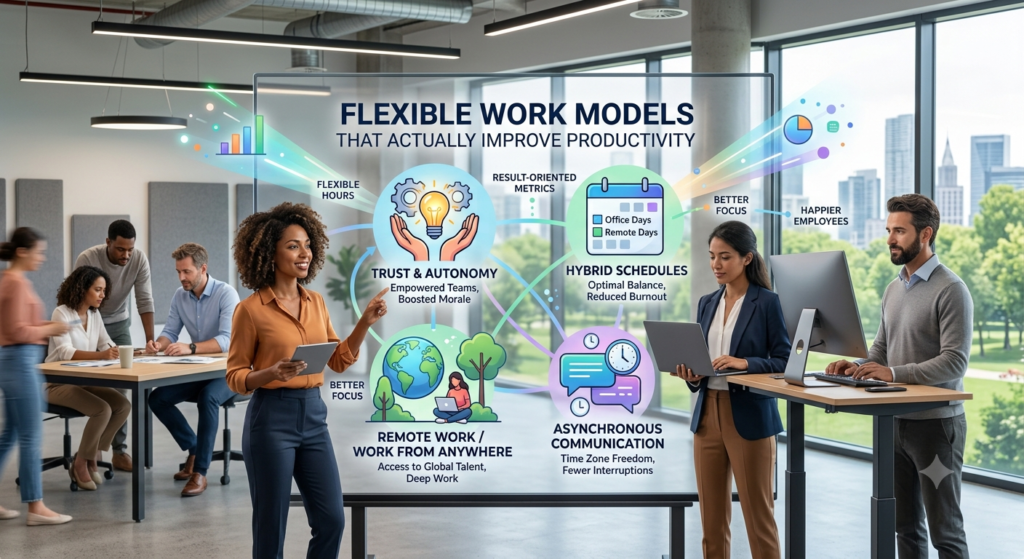
Employees divide their time between home and the office, allowing organizations to balance collaboration with focused individual work.
This model works particularly well for teams that require regular brainstorming, client meetings, or innovation sessions while allowing independent tasks to be completed remotely.
Flexible Working Hours
Instead of enforcing a strict 9-to-5 schedule, employees have the freedom to choose when they work, provided they meet business objectives and collaborate during agreed-upon core hours.
This approach accommodates different productivity patterns and supports employees across multiple time zones.
Remote-First Model
Some organizations operate almost entirely remotely, using digital collaboration tools and virtual workflows to connect distributed teams.
Remote-first companies often gain access to a broader talent pool while reducing infrastructure costs.
Compressed Workweeks
Employees complete their weekly hours over fewer days, such as four 10-hour workdays instead of five eight-hour days.
This model can improve employee satisfaction and reduce burnout when implemented thoughtfully.
What Makes Flexible Work Successful?
Many organizations mistakenly believe that allowing employees to work remotely automatically increases productivity.
In reality, successful flexibility depends on strong operational foundations.
Clear Performance Expectations
Employees need measurable goals that define success.
Instead of monitoring activity, leaders should focus on key performance indicators (KPIs), project milestones, customer satisfaction, and business outcomes.
Outcome-based management encourages ownership while reducing unnecessary micromanagement.
Trust-Based Leadership
Flexible work requires leaders to replace supervision with trust.
Managers who continuously monitor employee activity often create stress without improving performance.
Trust encourages autonomy, faster decision-making, and higher employee engagement.
Strong Digital Collaboration
Technology enables flexible work, but only when used intentionally.
Organizations should establish communication guidelines that clarify:
- Which tools are used for different types of communication
- Expected response times
- Meeting etiquette
- Documentation standards
- Knowledge sharing practices
Clear communication reduces confusion and minimizes unnecessary meetings.
Intentional Office Time
In hybrid organizations, office attendance should have a purpose.
Employees should come together for activities that benefit from face-to-face interaction, including:
- Strategic planning
- Innovation workshops
- Team building
- Client presentations
- Cross-functional collaboration
If employees simply sit in virtual meetings from the office, the value of in-person work is lost.
The Productivity Benefits of Flexibility
When implemented effectively, flexible work models offer several measurable advantages.
Better Focus
Remote work often reduces workplace distractions, enabling employees to complete deep-focus tasks more efficiently.
Many professionals report completing analytical or creative work faster outside traditional office environments.
Higher Employee Engagement
Giving employees greater control over their schedules improves motivation and job satisfaction.
Employees who experience autonomy are generally more committed to organizational goals and less likely to leave.
Reduced Burnout
Long commutes, rigid schedules, and poor work-life balance contribute significantly to employee stress.
Flexible arrangements help individuals better manage personal responsibilities while maintaining professional performance.
Reduced burnout often translates into improved productivity over the long term.
Access to Better Talent
Flexible work allows organizations to recruit skilled professionals regardless of geographical location.
This broader talent pool enables companies to hire specialists who may not relocate while increasing workforce diversity.
Improved Business Continuity
Organizations with mature flexible work capabilities are better prepared for unexpected disruptions, whether caused by natural disasters, transportation issues, or global events.
Operational resilience becomes a competitive advantage.
Common Mistakes That Reduce Productivity
Despite the benefits, many organizations struggle because they approach flexibility without clear planning.
Some common mistakes include:
- Measuring employees based on online availability rather than outcomes.
- Scheduling excessive virtual meetings that consume productive work time.
- Expecting employees to remain constantly accessible outside working hours.
- Applying identical policies to all departments regardless of operational requirements.
- Failing to train managers in leading distributed teams.
Flexibility without structure often creates confusion instead of efficiency.
Building a High-Performance Flexible Culture
Organizations that consistently succeed with flexible work invest in culture as much as technology.
They emphasize:
- Transparent communication
- Accountability at every level
- Psychological safety
- Continuous feedback
- Digital skills development
- Leadership coaching
- Employee well-being
Managers become coaches rather than supervisors, helping teams remove obstacles instead of monitoring every activity.
Employees are empowered to deliver results while maintaining healthy work-life integration.
The Future of Flexible Work
The future of work is unlikely to be entirely remote or entirely office-based.
Instead, organizations will increasingly adopt adaptive work models that align flexibility with business objectives, employee preferences, and customer needs.
Artificial intelligence, workflow automation, and digital collaboration platforms will further enhance distributed work, allowing teams to collaborate seamlessly across locations and time zones.
The companies that thrive will be those that view flexibility as part of their organizational strategy rather than a temporary workplace policy.