

In today’s rapidly evolving business environment, sustainable growth has become the defining challenge for CEOs. The traditional playbook of pursuing aggressive expansion at any cost is giving way to a more balanced approach—one that prioritizes resilience, innovation, operational excellence, and long-term value creation.
Economic uncertainty, technological disruption, changing customer expectations, and growing stakeholder demands require leaders to rethink what sustainable success truly means. Today’s most successful CEOs are not simply chasing quarterly targets; they are building organizations that can adapt, innovate, and thrive for years to come.
Redefining Growth Beyond Revenue
Revenue growth remains essential, but it is no longer the sole indicator of business success. Sustainable organizations measure growth across multiple dimensions, including profitability, customer loyalty, employee engagement, operational efficiency, innovation, and environmental responsibility.
Forward-thinking CEOs understand that healthy growth comes from creating lasting value rather than pursuing short-term gains. Businesses that focus exclusively on rapid expansion often face operational bottlenecks, declining customer satisfaction, and increased employee burnout.
Instead, sustainable leaders ask:
- Is our growth profitable?
- Can our operations support future demand?
- Are we investing in our people?
- Are customers becoming more loyal over time?
These questions help create stronger, more resilient organizations.
Building an Agile Organization
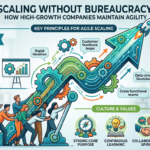
Markets evolve faster than ever before. Companies that succeed are those capable of adapting quickly to changing customer needs and emerging technologies.
Modern CEOs encourage agility by:
- Empowering teams to make faster decisions
- Reducing unnecessary bureaucracy
- Encouraging experimentation and innovation
- Investing in digital transformation
- Creating cross-functional collaboration
An agile organization responds to change instead of reacting to it, allowing businesses to seize opportunities before competitors.
Investing in People as a Growth Strategy
Employees have become one of the strongest competitive advantages. Sustainable growth depends on attracting, developing, and retaining exceptional talent.
Successful CEOs invest in:
- Leadership development programs
- Continuous learning initiatives
- Internal mobility opportunities
- Employee well-being
- Inclusive workplace cultures
Organizations with engaged employees consistently demonstrate higher productivity, stronger innovation, and improved customer experiences.
Rather than viewing workforce development as an expense, leading CEOs recognize it as a strategic investment that fuels long-term growth.
Leveraging Technology with Purpose
Artificial intelligence, automation, data analytics, and cloud technologies are reshaping industries worldwide. However, technology should support business strategy—not replace it.
The new CEO playbook focuses on technologies that:
- Improve customer experiences
- Increase operational efficiency
- Enhance decision-making through data
- Automate repetitive processes
- Enable scalable business models
Companies that combine technology with strong leadership create lasting competitive advantages while remaining adaptable to future disruptions.
Customer-Centric Decision Making
Sustainable businesses never lose sight of their customers.
Today’s CEOs prioritize customer feedback, personalize experiences, and continuously refine products and services based on evolving market demands.
Customer-centric organizations typically experience:
- Higher retention rates
- Increased lifetime customer value
- Stronger brand loyalty
- More referrals
- Greater resilience during economic downturns
Listening to customers is no longer a marketing function—it has become a leadership responsibility.
Making Data-Driven Decisions
The best CEOs combine experience with data-driven insights.
Organizations now generate enormous volumes of information, but competitive advantage comes from converting that data into smarter decisions.
Effective CEOs monitor key performance indicators across areas such as:
- Revenue growth
- Customer acquisition costs
- Employee productivity
- Customer satisfaction
- Operational efficiency
- Innovation performance
Data enables leaders to identify opportunities early, manage risks proactively, and allocate resources more effectively.
Embedding Sustainability into Business Strategy
Environmental, social, and governance (ESG) considerations are increasingly influencing investors, customers, employees, and regulators.
Sustainable growth requires integrating responsible business practices into everyday operations rather than treating sustainability as a standalone initiative.
Leading CEOs focus on:
- Responsible supply chains
- Energy efficiency
- Ethical governance
- Diversity and inclusion
- Community engagement
- Transparent reporting
Organizations that embrace sustainability strengthen their reputation while improving long-term business resilience.
Strengthening Financial Discipline
Growth without financial discipline can quickly become unsustainable.
Modern CEOs maintain a careful balance between investing for the future and preserving financial health.
Key priorities include:
- Maintaining healthy cash flow
- Improving operational margins
- Optimizing capital allocation
- Managing debt responsibly
- Building reserves for economic uncertainty
Financial resilience enables businesses to continue investing during market downturns while competitors scale back.
Creating a Culture of Continuous Innovation
Innovation is no longer confined to research and development teams. Sustainable organizations encourage every employee to contribute ideas that improve products, services, and internal processes.
CEOs foster innovation by:
- Rewarding creative thinking
- Accepting calculated risks
- Learning from failures
- Encouraging collaboration
- Investing in research and emerging technologies
Companies that innovate consistently remain relevant despite changing market conditions.
Leading with Purpose and Transparency
Stakeholders increasingly expect leaders to communicate openly and act with integrity.
Purpose-driven organizations often experience stronger employee engagement, deeper customer trust, and improved investor confidence.
Today’s CEOs build credibility by:
- Communicating transparently
- Making ethical decisions
- Demonstrating accountability
- Supporting social responsibility
- Aligning business goals with long-term stakeholder value
Purpose has become a strategic advantage rather than simply a corporate value statement.
The Future CEO
The role of the CEO continues to evolve beyond traditional management responsibilities. Tomorrow’s business leaders must be strategists, innovators, talent champions, technology advocates, and sustainability leaders—all at once.
The organizations that achieve sustainable growth will be those led by CEOs who embrace adaptability, invest in people, leverage technology wisely, maintain financial discipline, and create long-term value for every stakeholder.
Sustainable growth is not about growing the fastest—it is about growing the smartest. The new CEO playbook prioritizes resilience over short-term wins, innovation over complacency, and purpose over profits alone. Leaders who embrace this mindset will be better positioned to navigate uncertainty, capitalize on emerging opportunities, and build organizations that thrive for decades to come.