
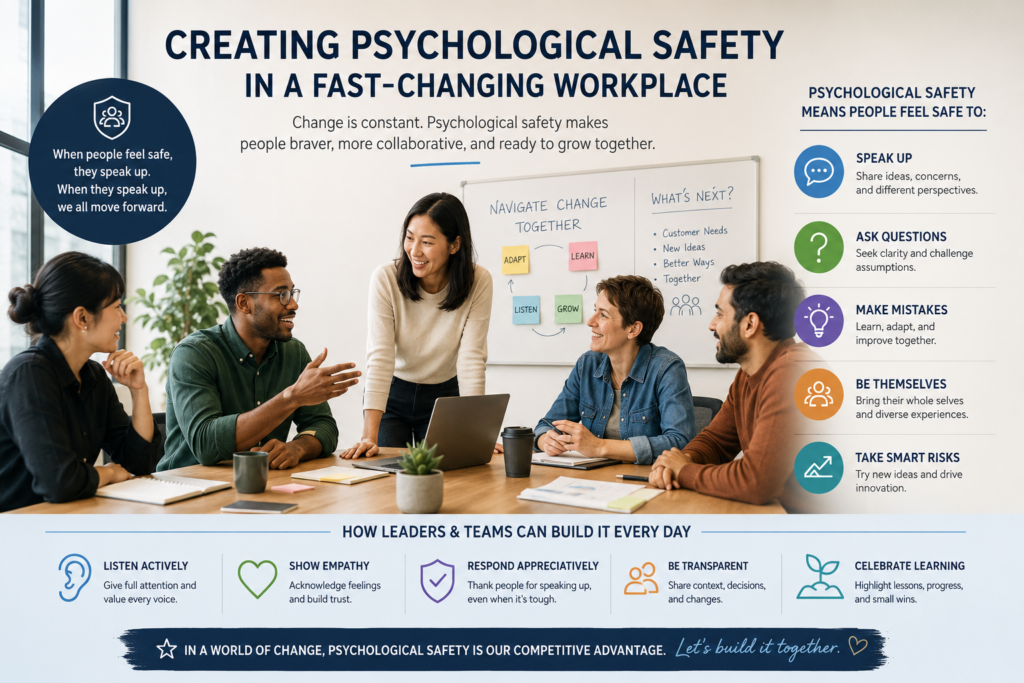

Change has become the defining characteristic of today’s workplace. Organizations are navigating AI adoption, digital transformation, hybrid work, economic uncertainty, evolving employee expectations, and constant business reinvention—all at the same time.
While companies invest heavily in new technologies and agile operating models, many overlook the one factor that determines whether change succeeds or fails: psychological safety.
Employees cannot innovate, collaborate, or adapt effectively if they fear being judged, ignored, or punished for speaking up. In an environment where change is constant, psychological safety is no longer a “nice-to-have” cultural initiative—it is a strategic business necessity.
For CHROs and business leaders, the challenge is clear: create workplaces where people feel safe enough to question, experiment, learn, and occasionally fail without fear.
What Is Psychological Safety?
Psychological safety refers to an environment where employees feel comfortable expressing ideas, asking questions, admitting mistakes, and challenging assumptions without worrying about embarrassment or negative consequences.
It does not mean avoiding accountability or lowering performance standards. Instead, it creates the conditions where people can perform at their best because they are free to contribute openly.
Organizations with high psychological safety often experience:
- Greater innovation
- Faster problem-solving
- Better collaboration
- Higher employee engagement
- Stronger resilience during change
Simply put, when employees feel safe, they participate more fully.
Why It Matters More Than Ever
Today’s workplace asks employees to do things they’ve never done before.
They’re expected to:
- Learn new technologies rapidly
- Collaborate across geographies and time zones
- Adapt to changing business priorities
- Make decisions with incomplete information
- Experiment with AI-powered tools
- Continuously reskill themselves
These expectations naturally create uncertainty.
If employees believe that every mistake will be criticized, they become cautious. Instead of sharing ideas, they stay silent. Instead of experimenting, they play it safe.
Ironically, organizations pursuing innovation often unintentionally create cultures where people are afraid to innovate.
The Cost of Silence
Many organizations measure employee engagement but overlook employee silence.
When psychological safety is low:
- Valuable ideas never get shared.
- Small issues become major problems.
- Employees hesitate to ask for help.
- Teams avoid healthy disagreements.
- Innovation slows dramatically.
- Burnout increases because people hide struggles.
Employees don’t leave because they lack ideas—they leave because they feel their voices don’t matter.
Silence is expensive, even when it appears as stability.
Why Fast-Changing Organizations Face Greater Risk
Transformation projects often create pressure.
Leaders focus on deadlines, implementation, KPIs, and execution. Communication becomes more top-down. Employees receive instructions rather than invitations for dialogue.
This creates an unintended message:
“Deliver results. Don’t create problems.”
Over time, employees stop asking difficult questions.
Yet these questions are exactly what organizations need during transformation.
Psychological safety enables organizations to detect risks early, adapt quickly, and continuously improve.
Building Psychological Safety Starts with Leaders
Employees closely observe leadership behavior.
Leaders who admit uncertainty send a powerful message.
Instead of saying:
“I have all the answers.”
They say:
“Let’s figure this out together.”
Simple leadership behaviors make a significant difference:
- Admit mistakes openly.
- Invite diverse opinions.
- Listen without interrupting.
- Reward constructive disagreement.
- Respond with curiosity instead of criticism.
- Thank employees for raising concerns.
Employees remember how leaders respond when someone speaks up.
That moment defines culture more than any policy document.
Make Feedback a Daily Habit
Many organizations treat feedback as an annual event.
Psychological safety requires continuous conversation.
Instead of asking:
“Any questions?”
Leaders can ask:
- “What are we missing?”
- “What concerns you?”
- “What assumptions should we challenge?”
- “If you were leading this project, what would you do differently?”
These questions encourage participation rather than compliance.
Over time, employees become more confident in contributing honestly.
Normalize Learning Instead of Perfection
Rapid change means mistakes are inevitable.
Organizations that punish every failure discourage experimentation.
High-performing teams distinguish between:
- Careless mistakes
- Intelligent risks
- Learning opportunities
When projects don’t succeed, leaders should ask:
- What did we learn?
- What should we repeat?
- What should we improve?
This shifts the focus from blame to growth.
Learning organizations consistently outperform organizations obsessed with perfection.
Psychological Safety Is Essential for AI Adoption
As AI transforms work, employees face new concerns:
- Will my role change?
- Will my skills become outdated?
- Can I admit I don’t understand AI?
- Is it safe to experiment with new tools?
If these concerns remain unspoken, resistance increases.
Organizations introducing AI should create open discussions rather than expecting immediate acceptance.
Employees who feel psychologically safe are more likely to:
- Learn AI tools faster
- Share successful use cases
- Identify risks early
- Collaborate on responsible AI adoption
Technology adoption succeeds when employees trust both the technology and the organization introducing it.
Hybrid Work Makes Psychological Safety Even More Important
Remote and hybrid teams often miss the informal conversations that build trust.
Virtual meetings can unintentionally amplify hierarchy.
Some employees hesitate to interrupt, ask questions, or express disagreement online.
Leaders can strengthen psychological safety by:
- Giving everyone an opportunity to contribute.
- Encouraging quieter voices.
- Rotating meeting facilitators.
- Following up individually after discussions.
- Celebrating questions as much as answers.
In hybrid workplaces, inclusion requires intentional effort.
The CHRO’s Strategic Role
Creating psychological safety is not solely a leadership development initiative—it is an organizational capability.
CHROs play a critical role by embedding psychological safety into:
- Leadership development programs
- Performance management
- Employee listening strategies
- Manager capability building
- Learning and development
- Change management initiatives
- Team effectiveness assessments
Rather than measuring only engagement, organizations should also assess whether employees genuinely feel comfortable speaking up.
Because employees who feel heard are more likely to stay, grow, and contribute.
Final Thoughts
The future of work will demand faster learning, greater collaboration, and continuous innovation. None of these thrive in environments where employees fear making mistakes or voicing concerns.
Psychological safety is not about making work easier—it is about making people confident enough to tackle difficult challenges together.
Organizations that cultivate trust, encourage open dialogue, and value diverse perspectives will be better equipped to navigate uncertainty and sustain high performance.