

Artificial Intelligence has become one of the most significant business priorities of the decade. From automating workflows and enhancing customer experiences to improving decision-making and driving innovation, AI is reshaping virtually every industry.
According to industry reports, enterprises worldwide are increasing investments in AI faster than any other emerging technology. Yet despite substantial spending, many organizations continue to struggle with fragmented AI initiatives, governance challenges, ethical concerns, and unclear business outcomes.
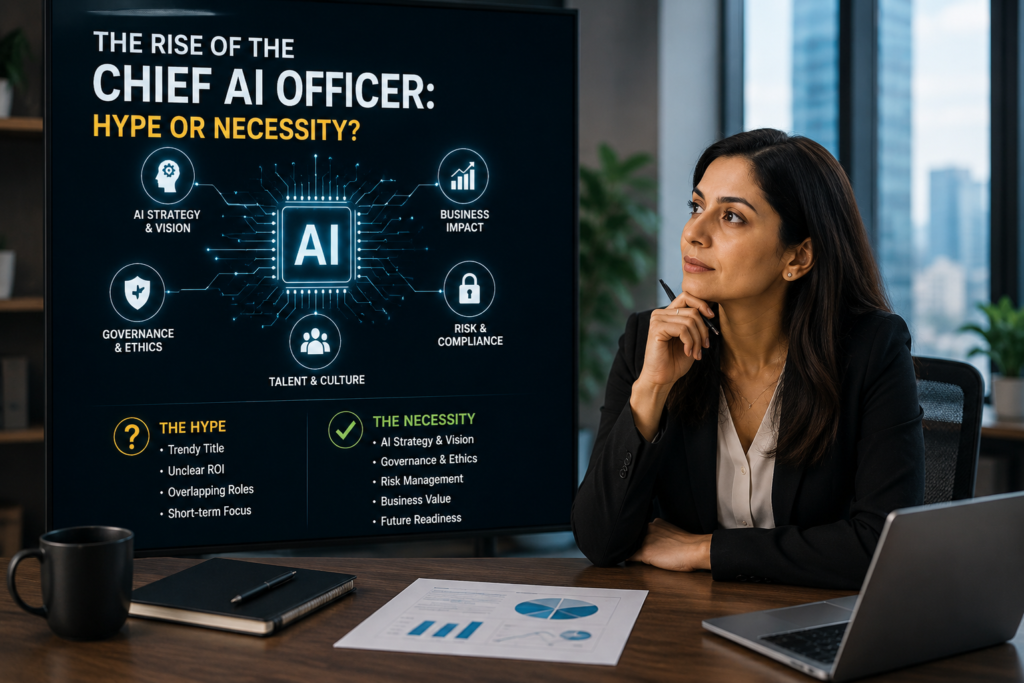
This growing complexity has given rise to a new C-suite position: the Chief AI Officer (CAIO).
The question many business leaders are asking is simple: Is this role essential for sustainable AI adoption, or merely another executive title created by the excitement surrounding artificial intelligence?
Why AI Requires Executive Leadership
Unlike previous technology waves, AI impacts nearly every function within an organization.
Its influence extends across:
- Operations
- Human Resources
- Finance
- Procurement
- Customer Service
- Marketing
- Product Development
- Risk Management
- Compliance
Without centralized leadership, organizations often face:
- Duplicate AI projects
- Inconsistent governance
- Security vulnerabilities
- Data quality issues
- Ethical concerns
- Low employee adoption
- Unclear ROI
A Chief AI Officer provides strategic direction that aligns AI investments with overall business objectives rather than allowing individual departments to pursue disconnected initiatives.
What Does a Chief AI Officer Actually Do?
The CAIO is far more than a technology leader.
Their primary responsibility is to bridge business strategy, technology, governance, and innovation.
Typical responsibilities include:
Developing an Enterprise AI Strategy
The CAIO identifies where AI creates measurable business value instead of deploying technology simply because it is available.
Every initiative should answer questions like:
- What business problem does AI solve?
- How will success be measured?
- What operational improvements are expected?
- What risks must be managed?
Establishing AI Governance
Responsible AI is becoming a board-level priority.
A Chief AI Officer oversees:
- AI ethics
- Data privacy
- Regulatory compliance
- Model governance
- Bias monitoring
- Transparency
- Risk management
As governments introduce AI regulations, governance is becoming just as important as innovation.
Driving Cross-Functional Collaboration
AI rarely belongs to a single department.
The CAIO works closely with:
- CIO
- CTO
- CHRO
- CFO
- CMO
- Business unit leaders
This collaboration ensures AI initiatives support broader organizational goals rather than isolated technology projects.
Building AI Capabilities
Technology alone cannot deliver transformation.
The CAIO also focuses on:
- AI talent acquisition
- Employee upskilling
- AI literacy
- Change management
- Internal AI communities
- Innovation culture
Successful AI adoption depends as much on people as it does on algorithms.
Why Existing Executives May Not Be Enough
Some organizations argue that the CIO or CTO can simply absorb AI responsibilities.
While this may work during early experimentation, enterprise-scale AI presents challenges beyond traditional IT.
The CIO typically focuses on infrastructure, security, and enterprise systems.
The CTO often concentrates on product innovation and engineering.
The Chief Data Officer manages data quality and governance.
The CAIO brings together all these domains while maintaining a singular focus on maximizing AI’s business impact.
Rather than replacing existing executives, the CAIO coordinates AI strategy across the organization.
Industries Leading the Way
Organizations adopting Chief AI Officers are most commonly found in:
- Banking and Financial Services
- Healthcare
- Manufacturing
- Retail
- Telecommunications
- Technology
- Pharmaceuticals
- Insurance
These industries face increasing pressure to innovate while managing regulatory requirements and operational complexity.
For them, centralized AI leadership is quickly becoming a competitive necessity.
Challenges Facing Chief AI Officers
The role is not without significant obstacles.
Demonstrating ROI
Many AI initiatives generate excitement but fail to deliver measurable business value.
CAIOs must prioritize projects with clear financial and operational outcomes.
Managing Organizational Resistance
Employees may fear automation or distrust AI-generated decisions.
Effective communication and workforce engagement are critical to building trust.
Navigating Rapid Technological Change
AI evolves at an extraordinary pace.
Chief AI Officers must continuously evaluate new models, platforms, regulations, and emerging risks while ensuring business continuity.
Balancing Innovation and Governance
Organizations cannot afford to slow innovation, but they also cannot ignore compliance and ethical considerations.
Finding this balance is one of the CAIO’s most important responsibilities.
Will Every Company Need a Chief AI Officer?
Not necessarily.
For smaller organizations or companies still experimenting with AI, assigning AI leadership to an existing executive may be sufficient.
However, as AI becomes embedded across multiple business functions, the complexity increases dramatically.
Organizations with:
- Multiple AI initiatives
- Enterprise-wide automation
- Significant AI investment
- Strict regulatory requirements
- Large data ecosystems
- Global operations
are increasingly benefiting from dedicated AI leadership.
The need is less about company size and more about AI maturity.
The Future of the Role
Much like the Chief Digital Officer emerged during digital transformation, the Chief AI Officer reflects the growing strategic importance of artificial intelligence.
Over time, some organizations may integrate AI responsibilities into existing executive roles as AI becomes a standard part of business operations. Others will continue to rely on dedicated AI leadership to manage increasingly sophisticated ecosystems of AI agents, automation platforms, governance frameworks, and intelligent decision systems.
What is clear is that AI is no longer a side project—it is becoming a core business capability.
Organizations that approach AI strategically, with strong leadership and governance, will be better positioned to unlock its full value while minimizing risk.