
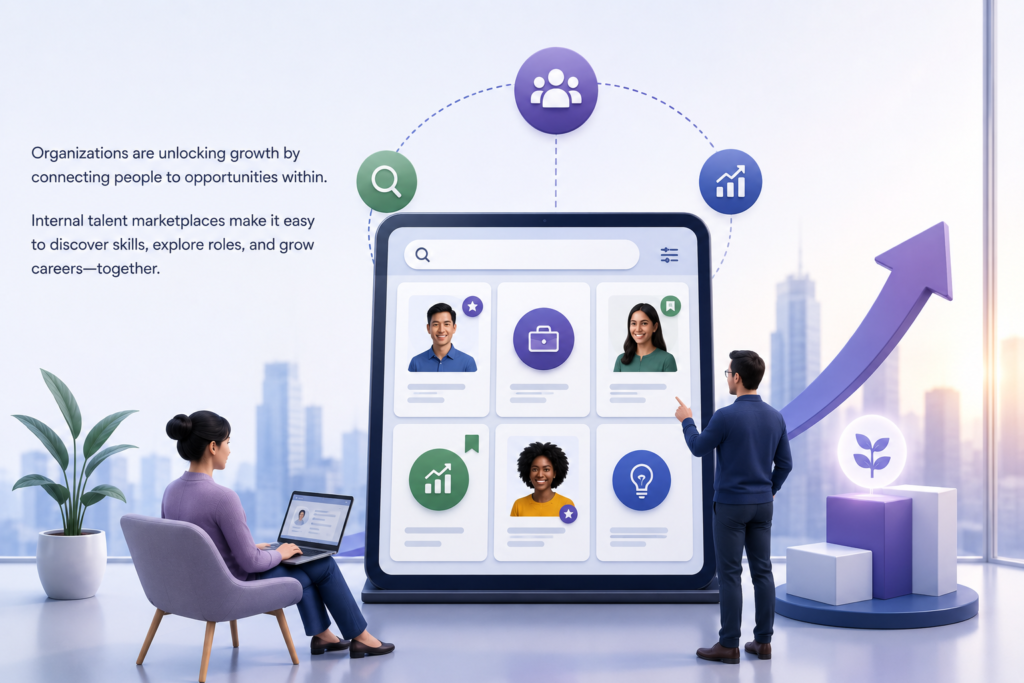

In today’s business environment, organizations are facing an unprecedented challenge: finding the right talent at the right time. While many companies continue to invest heavily in external hiring, a growing number of forward-thinking organizations are discovering that some of their best talent is already within their workforce.
This shift has given rise to Internal Talent Marketplaces (ITMs)—technology-enabled platforms that connect employees with internal opportunities such as projects, gigs, mentoring programs, learning experiences, and full-time roles. These marketplaces are transforming how companies manage talent, develop skills, and prepare for the future of work.
What Is an Internal Talent Marketplace?
An internal talent marketplace is a digital platform that matches employees’ skills, aspirations, and experiences with organizational opportunities. Similar to how external job marketplaces connect employers with candidates, internal talent marketplaces help organizations identify and deploy talent already available within their workforce.
Rather than relying solely on managers to identify talent, these platforms use data, skills mapping, and artificial intelligence to recommend opportunities that align with employee capabilities and career goals.
The result is a more dynamic, transparent, and agile workforce.
Why Internal Talent Marketplaces Are Gaining Momentum
Several factors are driving the adoption of internal talent marketplaces across industries.
1. Skills Shortages Are Increasing
Organizations worldwide are struggling to find critical skills in areas such as digital transformation, artificial intelligence, cybersecurity, analytics, and sustainability. Hiring externally is often expensive, time-consuming, and highly competitive.
Internal talent marketplaces enable companies to uncover hidden skills within their existing workforce and deploy employees where they are needed most.
2. Employees Want Career Mobility
Today’s workforce expects more than a paycheck. Employees seek growth opportunities, skill development, and meaningful career progression.
When employees feel stuck in their current roles, they are more likely to seek opportunities elsewhere. Internal talent marketplaces provide visibility into career options across the organization, helping employees grow without leaving the company.
3. Business Agility Has Become Essential
Market conditions can change rapidly. Organizations need the ability to quickly redeploy talent to support new initiatives, strategic priorities, and emerging business needs.
Internal talent marketplaces create workforce flexibility by enabling employees to move across teams, functions, and projects more efficiently.
4. Technology Makes It Possible
Advancements in AI, skills intelligence, and workforce analytics have made talent matching significantly more effective. Modern platforms can identify transferable skills, recommend learning paths, and connect employees with opportunities they may never have discovered on their own.
Benefits for Organizations
. Improved Talent Retention
Employees who see opportunities for growth within the organization are more likely to stay. Internal mobility has become a critical retention strategy, particularly among high-performing employees.
. Better Utilization of Skills
Many organizations possess valuable skills that remain hidden because traditional talent management systems focus primarily on job titles rather than capabilities.
Talent marketplaces help uncover these skills and put them to productive use.
. Reduced Recruitment Costs
Filling positions internally can significantly reduce hiring costs, onboarding expenses, and time-to-productivity compared to recruiting external candidates.
. Faster Workforce Reskilling
As business requirements evolve, organizations need employees to develop new capabilities quickly. Internal marketplaces can connect learning opportunities directly to emerging business needs, accelerating reskilling efforts.
. Increased Workforce Agility
Companies can rapidly assemble project teams, address resource gaps, and respond to market changes by leveraging talent already available within the organization.
Benefits for Employees
The rise of internal talent marketplaces is not only beneficial for employers—it also empowers employees.
. Greater Career Visibility
Employees gain access to opportunities across departments, business units, and geographic locations that may previously have been invisible.
. Skill Development
Participation in projects, temporary assignments, and cross-functional initiatives allows employees to acquire new skills and broaden their experience.
. Increased Engagement
When employees have more control over their career journey, engagement levels often improve. People are more motivated when they can actively shape their professional growth.
. Expanded Professional Networks
Working on cross-functional projects helps employees build relationships throughout the organization, enhancing collaboration and future career opportunities.
. The Role of HR and Leadership
The success of an internal talent marketplace depends on more than technology. Organizational culture plays a critical role.
HR leaders must shift from managing jobs to managing skills. This requires building a skills-based workforce strategy, encouraging internal mobility, and creating systems that reward talent sharing rather than talent hoarding.
Leaders must also embrace a mindset that prioritizes organizational success over departmental ownership of talent. Managers who support employee growth and mobility contribute to stronger workforce capabilities and long-term business performance.
. Challenges to Overcome
Despite their benefits, internal talent marketplaces are not without challenges.
Some managers may resist losing high-performing employees to other teams. Employees may hesitate to pursue opportunities if they fear negative reactions from their supervisors. Additionally, inaccurate skills data can limit the effectiveness of talent matching.
Organizations must address these barriers through clear communication, leadership support, transparent processes, and a culture that celebrates internal movement.
The Future of Talent Management
The future of work is increasingly skills-driven, flexible, and employee-centric. Internal talent marketplaces represent a significant evolution in how organizations identify, develop, and deploy talent.
Rather than viewing workforce planning as a static process, organizations are beginning to treat talent as a dynamic resource that can move where it creates the most value.
Companies that embrace this approach will be better positioned to address skills shortages, improve employee retention, accelerate innovation, and build resilient workforces capable of adapting to constant change.
Conclusion
The rise of internal talent marketplaces reflects a broader transformation in talent management. As organizations compete for scarce skills and employees seek greater career mobility, the ability to connect people with opportunities from within has become a strategic advantage.
By unlocking hidden talent, fostering continuous learning, and enabling workforce agility, internal talent marketplaces are helping organizations create a more engaged, adaptable, and future-ready workforce. For business leaders and HR professionals, the question is no longer whether internal talent marketplaces matter—but how quickly they can be implemented to drive sustainable growth and competitive advantage.