
For decades, the role of Chief Human Resources Officers (CHROs) centered around managing talent, strengthening culture, and ensuring workforce stability. But in today’s era of rapid technological advancements, shifting business models, economic uncertainty, and evolving employee expectations, stability alone is no longer enough. The most successful organizations are those that can continuously adapt, and CHROs are becoming the architects of that adaptability.
Organizational adaptability is the ability of a company to anticipate change, respond quickly to disruption, and transform without losing momentum. It requires more than agile processes or new technologies; it demands a workforce and culture designed to embrace learning, experimentation, and constant evolution.
Moving Beyond Change Management
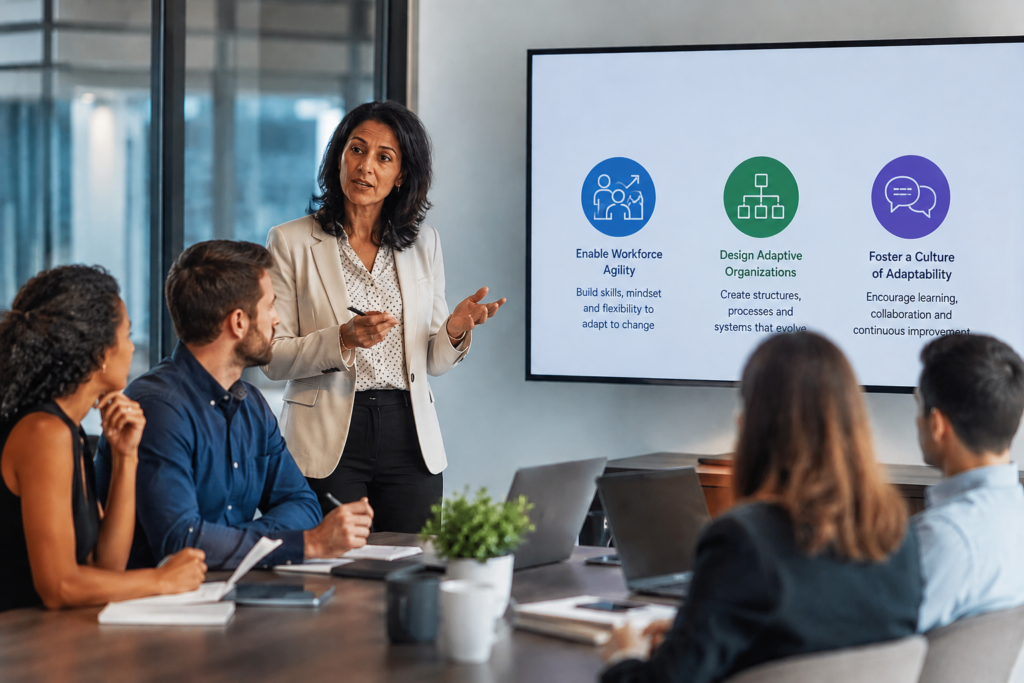
Traditional change management often focuses on helping employees transition through specific transformations. The modern CHRO’s challenge is much larger: creating an organization where change is a natural and ongoing capability.
This means cultivating a mindset where employees are comfortable with ambiguity, leaders encourage innovation, and teams are empowered to make decisions quickly. Organizations that develop this muscle are better prepared to navigate market disruptions and seize emerging opportunities.
Creating a Culture of Continuous Learning
Skills are becoming obsolete faster than ever before. The organizations that thrive will be those that make learning a continuous part of the employee experience.
CHROs must lead the shift from periodic training programs to a culture of lifelong learning. By investing in upskilling, reskilling, and knowledge-sharing, they can ensure that employees remain equipped for future roles, technologies, and business challenges.
Designing Flexible Talent Strategies
The future workforce will not be defined by traditional job structures alone. Organizations increasingly rely on diverse talent models—including full-time employees, gig workers, specialists, and AI-enabled tools—to meet changing business demands.
CHROs need to develop workforce strategies that prioritize skills, mobility, and flexibility. This includes enabling internal talent marketplaces, encouraging cross-functional experiences, and redefining career growth beyond linear promotion paths.
Building Adaptive Leadership
An adaptable organization requires adaptable leaders. Leaders must learn to make decisions with incomplete information, lead through uncertainty, and inspire teams during periods of transformation.
CHROs play a critical role in developing leadership capabilities such as resilience, emotional intelligence, collaboration, and a growth mindset—qualities that determine how effectively organizations can evolve.
Leveraging Data for Faster Decisions
Workforce analytics and AI-driven insights are enabling CHROs to predict skill gaps, understand employee sentiment, and make proactive talent decisions.
By embracing data-driven HR practices, CHROs can move from reacting to change to anticipating it, helping organizations remain ahead of workforce and market shifts.
The New Measure of HR Success
The future will not reward organizations that are simply efficient; it will reward those that are adaptable. The CHRO’s success will increasingly be measured not only by employee engagement or talent acquisition metrics but by how effectively the organization can learn, pivot, and grow in the face of continuous change.
As businesses enter a world where disruption is the norm, CHROs have a new mandate: not just to manage people, but to build organizations that are resilient, agile, and ready for whatever comes next.