
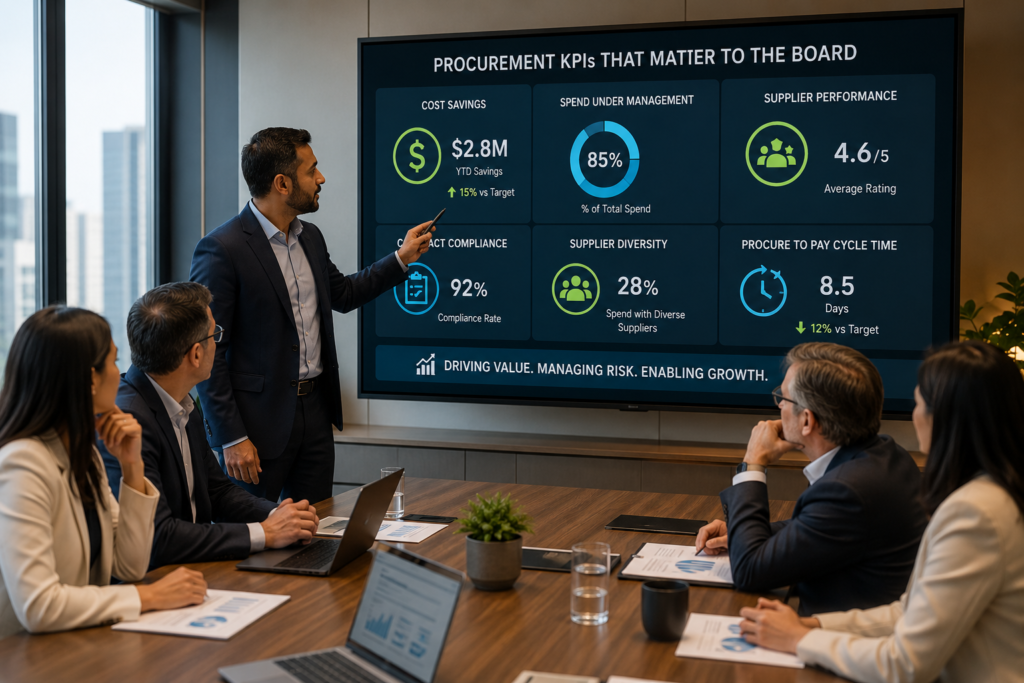

Boardrooms no longer view procurement as a function that simply negotiates better prices. Today, procurement has become a strategic driver of profitability, resilience, sustainability, and long-term business growth. As organizations navigate economic uncertainty, supply chain disruptions, inflation, and evolving regulatory requirements, boards expect procurement leaders to provide measurable business value—not just operational metrics.
Traditional procurement metrics such as purchase order cycle time or the number of suppliers managed remain important for operational teams, but they rarely resonate with board members. Directors are more interested in understanding how procurement contributes to financial performance, risk reduction, innovation, and competitive advantage.
For Chief Procurement Officers (CPOs), the challenge is no longer collecting data—it’s presenting the right Key Performance Indicators (KPIs) that align procurement outcomes with business strategy.
Here’s a closer look at the procurement KPIs that truly matter in the boardroom.
1. Cost Savings and Cost Avoidance
Cost savings remains one of procurement’s most visible contributions, but boards increasingly distinguish between negotiated savings and sustainable financial impact.
Cost savings measure direct reductions in spending through negotiations, supplier consolidation, or strategic sourcing. Cost avoidance, meanwhile, captures expenses prevented through proactive procurement decisions, such as locking in long-term contracts before price increases or redesigning sourcing strategies.
Rather than reporting isolated percentages, procurement leaders should demonstrate how these savings contribute to EBITDA, operating margins, or overall profitability.
Board Question:
“How much value did procurement create for the business this quarter?”
2. Procurement ROI
Boards want to understand whether procurement investments are delivering measurable returns.
Procurement Return on Investment (ROI) compares procurement-generated financial benefits against the department’s operating costs, including technology investments, personnel, consulting, and process improvements.
A strong procurement ROI demonstrates that procurement is not merely a cost center but a value-generating business function.
Example:
- Procurement operating cost: ₹10 crore
- Value delivered: ₹120 crore
- Procurement ROI: 12x
This type of business-focused reporting immediately captures board attention.
3. Spend Under Management
Spend under management measures the percentage of organizational spending actively governed by procurement policies, contracts, and supplier strategies.
A higher percentage indicates greater visibility, improved compliance, stronger negotiations, and reduced spending leakage.
Organizations with mature procurement functions often manage more than 80–90% of addressable spend.
Boards appreciate this KPI because unmanaged spend often represents hidden financial and operational risk.
4. Supplier Risk Exposure
Supply chain disruptions have elevated supplier risk to a board-level concern.
Modern procurement teams continuously monitor suppliers across multiple dimensions:
- Financial health
- Geographic concentration
- Political risks
- Cybersecurity maturity
- ESG compliance
- Operational resilience
- Dependency on single-source suppliers
Instead of reporting supplier counts, procurement leaders should communicate overall organizational risk exposure and mitigation progress.
This KPI directly supports enterprise risk management.
5. Supplier Performance Score
Supplier relationships significantly influence quality, delivery reliability, innovation, and customer satisfaction.
Leading procurement teams evaluate suppliers using balanced scorecards covering:
- On-time delivery
- Product quality
- Contract compliance
- Responsiveness
- Innovation contribution
- Sustainability performance
Boards increasingly expect procurement to identify strategic suppliers who create competitive advantage—not merely low-cost vendors.
6. Working Capital Impact
Procurement has a direct influence on organizational cash flow.
Key indicators include:
- Payment terms optimization
- Inventory reduction
- Days Payable Outstanding (DPO)
- Supply chain financing adoption
Boards closely monitor working capital because it affects liquidity, shareholder returns, and investment capacity.
Procurement leaders should clearly quantify how sourcing strategies improve cash flow while maintaining healthy supplier relationships.
7. Contract Compliance
Negotiating favorable contracts delivers little value if business units fail to follow them.
Contract compliance measures:
- Percentage of purchases through approved contracts
- Maverick spending reduction
- Policy adherence
- Contract utilization
Higher compliance improves cost control, reduces legal risks, and strengthens supplier partnerships.
For boards, this KPI reflects governance effectiveness.
8. Procurement Cycle Time
While operational metrics alone rarely reach board discussions, procurement cycle time becomes important when it directly affects business agility.
Reducing sourcing cycle times enables organizations to:
- Launch products faster
- Respond quickly to market opportunities
- Improve internal customer satisfaction
- Accelerate innovation
Boards increasingly value speed as a competitive differentiator.
9. Sustainability and ESG Procurement Metrics
Environmental, Social, and Governance (ESG) reporting has become a strategic priority.
Procurement plays a significant role through responsible sourcing practices.
Key board-level ESG metrics include:
- Sustainable sourcing percentage
- Carbon emissions from suppliers
- Supplier diversity
- Ethical sourcing compliance
- Human rights audits
- Circular procurement initiatives
These indicators increasingly influence investor confidence and regulatory compliance.
10. Innovation Contribution
Progressive procurement teams actively contribute to innovation by collaborating with suppliers.
Innovation KPIs may include:
- Revenue generated from supplier innovations
- Number of joint innovation projects
- New products enabled by supplier partnerships
- Process improvements delivered through suppliers
Rather than viewing suppliers solely as vendors, boards increasingly recognize them as innovation partners.
11. Digital Procurement Adoption
Digital transformation has become essential for procurement excellence.
Boards often monitor:
- Automated procurement transactions
- AI-enabled sourcing decisions
- E-procurement adoption rates
- Contract automation
- Spend analytics maturity
Higher digital adoption improves visibility, compliance, decision-making, and scalability.
12. Value Beyond Savings
The most mature procurement organizations measure broader business impact beyond negotiated discounts.
This includes:
- Revenue enablement
- Business continuity
- Risk mitigation
- Sustainability outcomes
- Customer satisfaction improvements
- Operational resilience
Boards increasingly evaluate procurement based on enterprise value creation rather than purchasing efficiency alone.
Present KPIs in Business Language
One common mistake procurement teams make is reporting operational statistics instead of business outcomes.
For example:
Instead of saying:
- Procurement processed 4,500 purchase orders.
Say:
- Procurement improved sourcing efficiency, reducing operational costs by 12% while supporting a 20% faster product launch cycle.
Similarly, instead of reporting:
- Supplier onboarding reduced from 30 to 18 days.
Frame it as:
- Faster supplier onboarding enabled quicker market entry and accelerated revenue generation.
The language of the boardroom is growth, profitability, resilience, governance, and shareholder value—not transactional efficiency.
Building an Executive Procurement Dashboard
A board-ready procurement dashboard should be concise, strategic, and outcome-focused. It should highlight:
| KPI | Why the Board Cares |
|---|---|
| Cost Savings & Avoidance | Improves profitability and margins |
| Procurement ROI | Demonstrates business value |
| Spend Under Management | Enhances financial control |
| Supplier Risk | Protects business continuity |
| Supplier Performance | Ensures operational excellence |
| Working Capital Impact | Improves cash flow |
| Contract Compliance | Strengthens governance |
| Procurement Cycle Time | Increases business agility |
| ESG Procurement Metrics | Supports sustainability goals |
| Innovation Contribution | Drives competitive advantage |
| Digital Procurement Adoption | Enables scalable growth |
| Value Beyond Savings | Aligns procurement with enterprise strategy |