
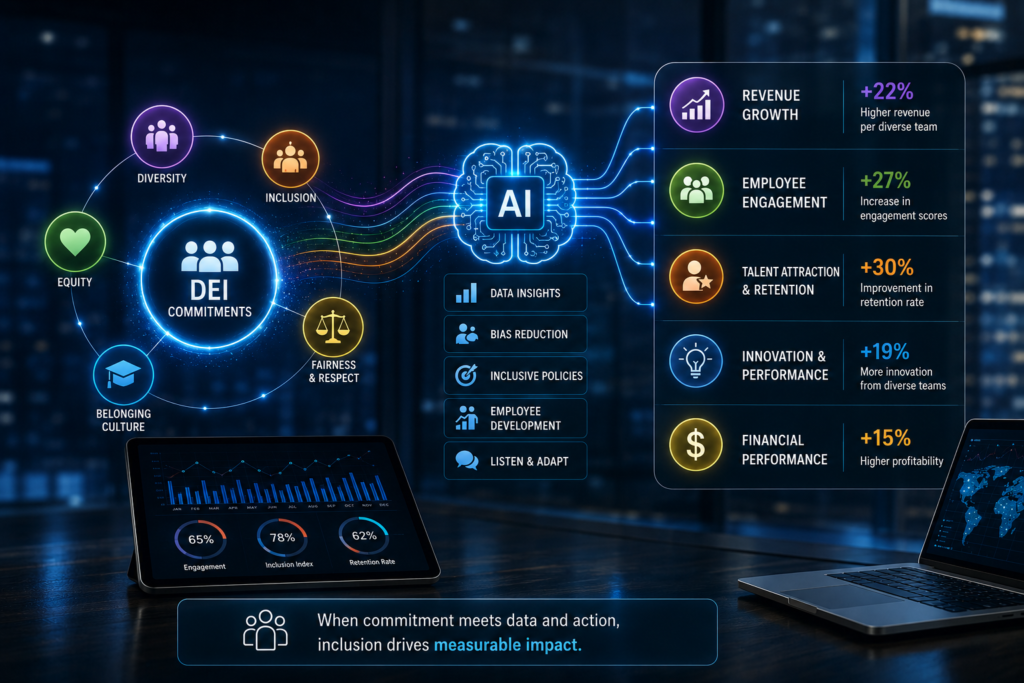

For the past several years, Diversity, Equity, and Inclusion (DEI) has been a strategic priority for organizations worldwide. Companies have invested in hiring initiatives, leadership pledges, employee resource groups (ERGs), unconscious bias training, and inclusive workplace policies. While these efforts have generated awareness and improved representation in many organizations, business leaders are increasingly asking an important question:
How do we measure whether DEI is truly creating business value?
In today’s evolving business landscape, organizations can no longer rely solely on intent or public commitments. Investors, employees, customers, and boards expect evidence that DEI initiatives contribute to innovation, productivity, employee engagement, customer satisfaction, and long-term business growth.
The future of DEI lies not in doing more activities—but in delivering measurable outcomes.
Why DEI Needs a Business Lens
DEI has often been positioned as a people initiative or a corporate responsibility program. While these remain important aspects, organizations that treat DEI as a standalone HR function often struggle to sustain momentum.
Business leaders are now recognizing that inclusion influences nearly every organizational outcome:
- Better decision-making through diverse perspectives
- Higher employee engagement and retention
- Improved collaboration across teams
- Stronger employer branding
- Greater innovation and creativity
- Better understanding of diverse customer markets
When these outcomes are measured consistently, DEI becomes a business enabler rather than simply a compliance exercise.
Moving Beyond Representation Metrics
Many organizations still measure DEI success primarily through workforce demographics.
Questions such as:
- How many women were hired?
- What percentage of leadership belongs to underrepresented groups?
- How diverse is the hiring pipeline?
These metrics are important—but they only tell part of the story.
Representation answers who is present.
Business impact answers how inclusion influences performance.
Organizations should expand their measurement framework to include:
Employee Experience
Measure whether employees genuinely feel included, respected, and empowered to contribute.
Useful indicators include:
- Inclusion survey scores
- Psychological safety
- Employee engagement
- Internal mobility
- Participation in leadership programs
- Retention across demographic groups
A diverse workforce without an inclusive culture often results in higher turnover and lower engagement.
Connect DEI with Talent Outcomes
The strongest DEI strategies are closely integrated with talent management.
Key questions include:
- Are promotions equitable?
- Are performance ratings consistent across employee groups?
- Who receives high-visibility projects?
- Are leadership development opportunities equally accessible?
- Are succession pipelines truly diverse?
Analyzing these metrics helps organizations identify hidden barriers that traditional diversity reports often miss.
When career progression becomes more equitable, organizations strengthen leadership pipelines and improve retention of high-performing talent.
Measure Innovation, Not Just Inclusion
One of the greatest business benefits of diversity is innovation.
Research consistently suggests that teams with varied perspectives are better equipped to solve complex problems, challenge assumptions, and generate creative solutions.
Organizations can measure innovation through metrics such as:
- Cross-functional collaboration
- New product launches
- Patent filings
- Idea generation programs
- Customer-driven innovations
- Speed of problem-solving
While innovation depends on many factors, inclusive cultures create environments where employees are more likely to contribute ideas confidently.
Link DEI to Customer and Market Success
Today’s customers expect organizations to understand increasingly diverse markets.
Inclusive teams often bring deeper insights into customer needs, cultural preferences, and emerging market opportunities.
Business metrics may include:
- Customer satisfaction across different market segments
- Market expansion success
- Product adoption among diverse customer groups
- Brand perception
- Customer loyalty
Organizations that mirror the diversity of their customer base are often better positioned to design products and experiences that resonate with broader audiences.
Build Accountability into Leadership
One of the biggest shifts in mature DEI programs is moving accountability beyond HR.
Business leaders should own measurable inclusion outcomes just as they own financial or operational goals.
This can include:
- Inclusive hiring goals
- Team engagement scores
- Leadership diversity
- Retention improvements
- Mentorship participation
- Sponsorship outcomes
When managers are evaluated on how they build inclusive teams, DEI becomes embedded into everyday leadership rather than remaining an annual initiative.
Use Data to Drive Continuous Improvement
Modern HR analytics make it possible to monitor DEI with greater precision than ever before.
Organizations should regularly analyze:
- Hiring trends
- Promotion rates
- Compensation equity
- Learning participation
- Performance ratings
- Attrition patterns
- Employee feedback
Rather than collecting data for reporting purposes alone, organizations should use insights to identify root causes and continuously refine their talent strategies.
The goal is not perfect numbers—but informed decision-making.
Foster Inclusion Through Everyday Experiences
Policies matter, but employees experience inclusion through everyday interactions.
Organizations should examine questions such as:
- Are all voices heard during meetings?
- Do hybrid employees receive equal opportunities?
- Are managers providing equitable feedback?
- Is recognition distributed fairly?
- Are flexible work policies applied consistently?
Small daily experiences collectively shape organizational culture more than annual DEI campaigns.
The Role of CHROs
Chief Human Resources Officers play a critical role in transforming DEI from a values-based initiative into a measurable business strategy.
This requires partnering closely with business leaders, finance teams, analytics functions, and operational managers to establish clear objectives and track progress.
Leading organizations are increasingly asking business-focused questions such as:
- Which inclusion initiatives improve retention?
- Which leadership behaviors increase engagement?
- How does inclusive leadership affect team performance?
- Which talent programs deliver measurable career advancement?
- What business outcomes improve as inclusion scores rise?
These insights help position HR as a strategic contributor to organizational performance rather than solely a support function.
Looking Ahead
The conversation around DEI is evolving. Success is no longer defined by the number of initiatives launched or policies introduced. Instead, organizations are being evaluated on the tangible value their inclusion efforts create for employees, customers, and the business.
Companies that embed DEI into leadership accountability, talent strategy, innovation, and decision-making will be better equipped to attract top talent, foster collaboration, and adapt to changing market demands.
Ultimately, moving from DEI commitments to measurable business outcomes is not about replacing purpose with performance. It is about demonstrating that inclusive workplaces are not only the right thing to build—they are also stronger, more resilient, and better positioned for sustainable growth.