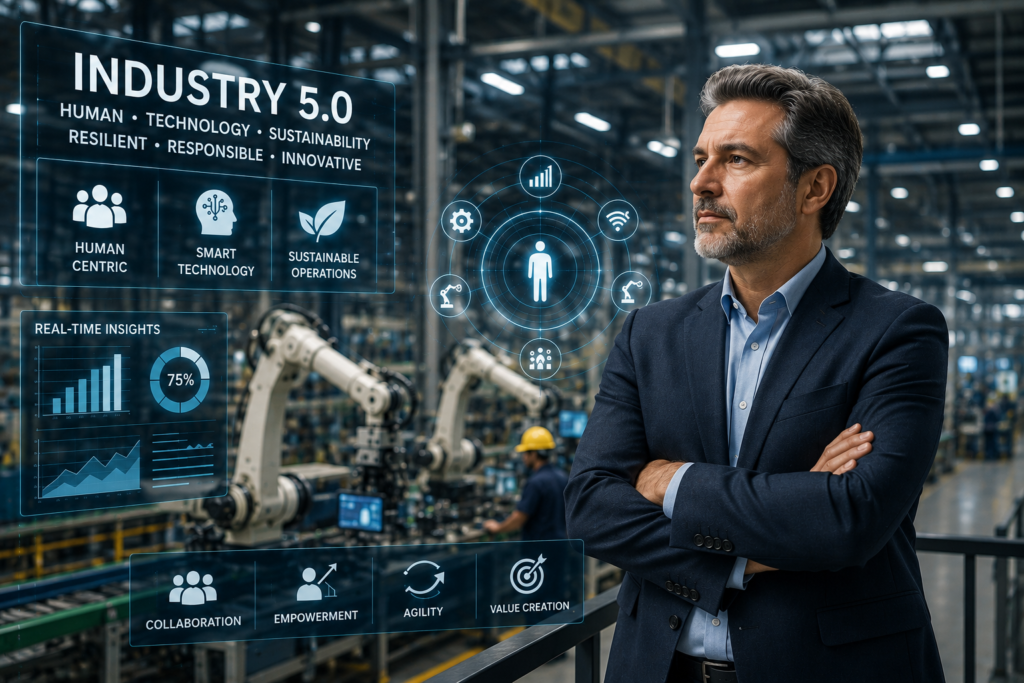

The manufacturing industry is entering a new phase of transformation. After years of embracing automation, robotics, artificial intelligence (AI), and Industrial Internet of Things (IIoT) under Industry 4.0, organizations are now preparing for Industry 5.0—an era where technology and human expertise work together to create smarter, more sustainable, and resilient manufacturing ecosystems.
Unlike Industry 4.0, which primarily focused on efficiency and automation, Industry 5.0 places equal emphasis on people, sustainability, and resilience. This shift demands a new kind of leadership—one that balances advanced technologies with human creativity, innovation, and ethical decision-making.
Manufacturing leaders are no longer responsible only for improving production metrics. They must now create organizations where people and intelligent machines collaborate to drive long-term business value.
Understanding Industry 5.0
Industry 5.0 is the next evolution of manufacturing that combines human intelligence with advanced technologies such as:
- Artificial Intelligence (AI)
- Collaborative Robots (Cobots)
- Machine Learning
- Digital Twins
- Industrial IoT
- Edge Computing
- Predictive Analytics
- Advanced Robotics
- Sustainable Manufacturing Technologies
The objective is not to replace human workers but to enhance their capabilities through intelligent automation and digital collaboration.
The result is manufacturing that is:
- More personalized
- More flexible
- More sustainable
- More resilient
- More human-centric
The Changing Role of Manufacturing Leaders
Leadership in Industry 5.0 extends beyond operational excellence. Today’s manufacturing executives must become transformation leaders capable of guiding people through continuous technological change.
Instead of managing factories alone, leaders must manage ecosystems of employees, machines, suppliers, and digital technologies.
Successful leaders will focus on:
- Innovation
- Workforce empowerment
- Sustainability
- Customer-centric manufacturing
- Digital transformation
- Continuous learning
Human-Centric Manufacturing Takes Center Stage
One of the defining characteristics of Industry 5.0 is putting people back at the center of manufacturing.
While automation handles repetitive and hazardous tasks, employees contribute through:
- Creative problem-solving
- Process innovation
- Product customization
- Strategic decision-making
- Customer engagement
Manufacturing leaders must create workplaces where technology enhances employee productivity rather than replacing human expertise.
Organizations that prioritize employee wellbeing often experience:
- Higher engagement
- Better retention
- Increased innovation
- Improved operational performance
AI Becomes a Leadership Tool
Artificial intelligence is transforming manufacturing leadership.
Modern manufacturing leaders rely on AI for:
- Demand forecasting
- Inventory optimization
- Predictive maintenance
- Production planning
- Quality inspection
- Risk management
- Supply chain visibility
However, leadership decisions should remain human-driven.
Industry 5.0 encourages leaders to use AI as an advisor—not as a replacement for strategic judgment.
The most successful organizations combine machine intelligence with human experience.
Collaborative Robots Redefine Factory Operations
Unlike traditional industrial robots that operate independently, collaborative robots—or cobots—work safely alongside human employees.
Cobots assist workers by handling repetitive, physically demanding, or precision-intensive tasks while employees focus on higher-value responsibilities.
Manufacturing leaders must prepare teams for this collaborative environment through:
- Reskilling initiatives
- Safety training
- Process redesign
- Cross-functional collaboration
The future factory is not fully automated—it is intelligently collaborative.
Sustainability Becomes a Leadership Priority
Environmental responsibility is no longer a compliance requirement—it is a business strategy.
Industry 5.0 encourages manufacturers to reduce environmental impact through:
- Energy-efficient production
- Circular manufacturing
- Waste reduction
- Smart resource utilization
- Renewable energy integration
- Carbon footprint monitoring
Customers, investors, and regulators increasingly expect organizations to demonstrate measurable sustainability outcomes.
Manufacturing leaders must embed Environmental, Social, and Governance (ESG) goals into business strategy rather than treating sustainability as a standalone initiative.
Resilience Is the New Competitive Advantage
Recent global disruptions exposed vulnerabilities in manufacturing supply chains.
Industry 5.0 emphasizes resilience through:
- Digital supply chains
- Real-time monitoring
- Predictive risk analytics
- Supplier diversification
- Localized manufacturing
- Smart inventory management
Leadership now requires anticipating disruptions before they occur.
Resilient manufacturers recover faster, minimize downtime, and maintain customer trust during uncertain times.
Data-Driven Decision Making
Manufacturing facilities generate enormous volumes of operational data.
Industry 5.0 leaders transform this data into actionable insights.
Real-time analytics enables executives to monitor:
- Machine performance
- Production efficiency
- Equipment health
- Workforce productivity
- Energy consumption
- Customer demand
- Supply chain performance
Rather than reacting to problems, leaders can proactively optimize operations before issues impact production.
Workforce Transformation Is Essential
Technology adoption succeeds only when employees possess the skills to leverage it effectively.
Manufacturing leaders must invest in continuous workforce development through:
- Digital literacy programs
- AI training
- Robotics certification
- Cybersecurity awareness
- Leadership development
- Data analytics education
Future-ready organizations prioritize lifelong learning instead of one-time training initiatives.
Employees who continuously upgrade their skills become valuable partners in digital transformation.
Personalization Is Reshaping Manufacturing
Consumers increasingly expect customized products without sacrificing speed or affordability.
Industry 5.0 enables mass personalization through:
- Flexible production lines
- AI-driven manufacturing
- Digital twins
- Smart automation
- Customer-driven production planning
Manufacturing leaders must build agile operations capable of delivering customized products at scale.
The ability to personalize efficiently will become a significant competitive differentiator.
Cybersecurity Requires Executive Attention
As factories become increasingly connected, cybersecurity becomes a strategic leadership concern.
Manufacturing leaders must safeguard:
- Production systems
- Industrial control systems
- Customer information
- Intellectual property
- Operational technology
- Supply chain networks
Cyber resilience is no longer solely an IT responsibility—it is a business imperative that requires executive oversight, robust governance, and ongoing employee awareness.
Characteristics of Successful Industry 5.0 Leaders
Tomorrow’s manufacturing leaders will possess a combination of technological understanding and human leadership skills.
Key characteristics include:
- Digital vision
- Strategic thinking
- Emotional intelligence
- Agility
- Innovation mindset
- Sustainability leadership
- Data literacy
- Change management expertise
- Cross-functional collaboration
- Commitment to continuous learning
The strongest leaders recognize that technology delivers value only when people are empowered to use it effectively.
Challenges on the Journey to Industry 5.0
Transitioning to Industry 5.0 is not without obstacles.
Common challenges include:
- Legacy infrastructure
- Skills shortages
- High implementation costs
- Cybersecurity risks
- Resistance to change
- Data integration complexities
- Regulatory compliance
Overcoming these challenges requires a clear transformation roadmap, executive sponsorship, and sustained investment in people and technology.
The Road Ahead
Industry 5.0 is not simply another technological upgrade—it represents a new philosophy of manufacturing. It shifts the focus from automation alone to creating intelligent, sustainable, and human-centered operations where technology amplifies human potential rather than replacing it.
Manufacturing leaders who embrace this mindset will be better equipped to navigate evolving market demands, supply chain disruptions, and workforce expectations. By investing in digital innovation, fostering collaboration between people and machines, and embedding sustainability into every decision, they can build organizations that are not only more efficient but also more adaptable and resilient.
The future of manufacturing belongs to leaders who understand that competitive advantage will come from the ability to combine advanced technology with human creativity, purpose, and responsible leadership. In the era of Industry 5.0, success will be defined not just by what factories produce, but by how they create value for people, businesses, and society.