
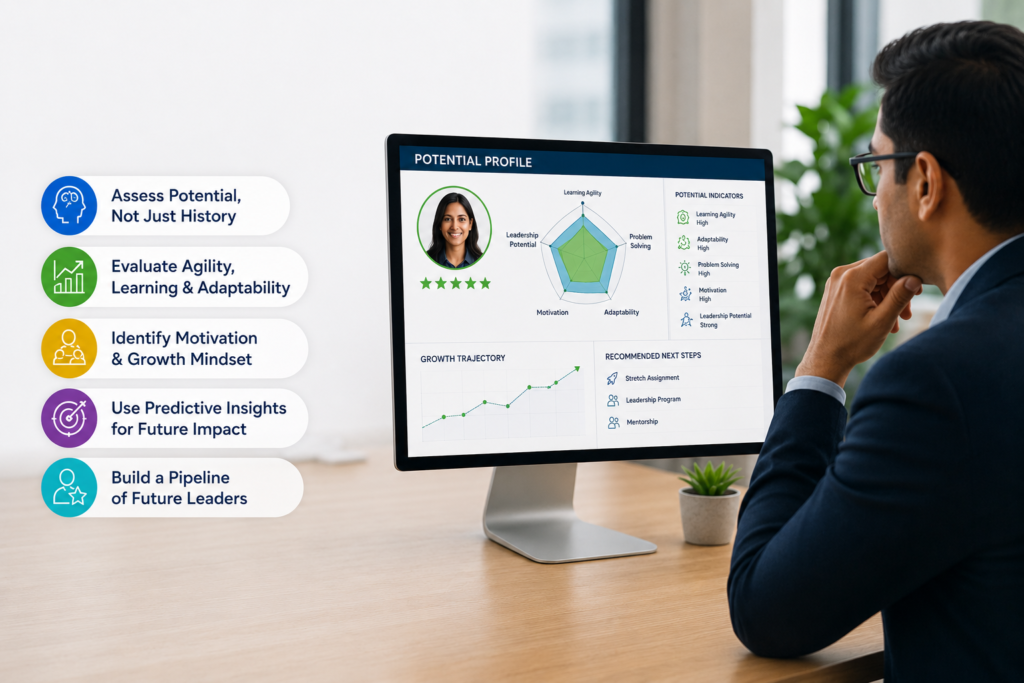

Why Future-Ready Organizations Need a New Talent Lens
For decades, performance has been the primary metric organizations have relied on to evaluate employees. Annual reviews, KPIs, productivity scores, and achievement records have traditionally determined promotions, leadership opportunities, and compensation.
While past performance remains an important indicator, it is no longer enough in today’s rapidly evolving business environment.
The pace of digital transformation, shifting market demands, and emerging technologies require organizations to identify not only who has performed well—but also who has the capability to grow, adapt, innovate, and lead through change.
This is where measuring human potential becomes a strategic advantage.
Modern HR leaders are shifting from evaluating historical success to predicting future impact. The organizations that master this transition will build stronger leadership pipelines, improve employee engagement, and stay ahead in an increasingly competitive talent landscape.
Understanding the Difference: Performance vs. Potential
Performance answers one question:
“How well has an employee delivered in their current role?”
Potential answers another:
“How much more can this individual contribute in the future?”
An employee may consistently exceed targets because they excel in a familiar environment. However, that does not necessarily mean they possess the adaptability, learning ability, or leadership mindset required for larger responsibilities.
Similarly, an employee with average current performance may possess exceptional growth potential if given the right opportunities and development.
Recognizing this distinction allows organizations to make smarter long-term talent decisions.
Why Measuring Potential Matters More Than Ever
Organizations are facing unprecedented challenges:
- Rapid technological disruption
- Evolving customer expectations
- Hybrid and remote work environments
- Leadership succession gaps
- Increasing demand for innovation
These challenges require employees who can continuously learn, solve unfamiliar problems, and embrace change.
Companies that focus only on historical achievements often overlook emerging leaders and future innovators.
By measuring potential, HR can identify individuals capable of driving the organization’s next phase of growth.
Key Indicators of Human Potential
Potential cannot be measured through a single performance rating. Instead, HR should evaluate a combination of behavioral and cognitive factors.
1. Learning Agility
Employees with high potential learn quickly from new experiences.
They:
- Adapt rapidly
- Seek feedback
- Apply new knowledge effectively
- Remain curious
Learning agility is often one of the strongest predictors of future leadership success.
2. Growth Mindset
Individuals with a growth mindset believe abilities can be developed through effort and continuous learning.
They are more willing to:
- Accept challenges
- Learn from failures
- Experiment with new ideas
- Continuously improve
These employees typically evolve faster than those focused solely on maintaining current performance.
3. Adaptability
Business priorities change frequently.
Employees with high potential demonstrate resilience when faced with uncertainty.
They embrace change instead of resisting it and remain productive during transitions.
4. Leadership Capability
Leadership isn’t defined by job title.
Potential leaders naturally:
- Influence others
- Build trust
- Take ownership
- Inspire collaboration
- Make sound decisions
Identifying these qualities early helps organizations build stronger succession pipelines.
5. Emotional Intelligence
High-potential employees often possess strong emotional intelligence.
They:
- Understand others
- Manage emotions effectively
- Handle conflict professionally
- Build meaningful relationships
As organizations become increasingly collaborative, emotional intelligence becomes a critical success factor.
6. Innovation and Problem Solving
Rather than simply executing assigned tasks, high-potential employees proactively identify opportunities for improvement.
They question assumptions, generate new ideas, and solve complex problems creatively.
Modern HR Tools for Measuring Potential
Today’s HR leaders have access to advanced methods that go beyond traditional appraisals.
Competency Assessments
Evaluate employees against future leadership competencies rather than current responsibilities.
These assessments measure communication, strategic thinking, collaboration, innovation, and adaptability.
Psychometric Assessments
Validated assessments provide insights into:
- Personality
- Cognitive ability
- Decision-making style
- Motivation
- Leadership preferences
When used responsibly, they help predict future performance in evolving roles.
360-Degree Feedback
Feedback from managers, peers, direct reports, and cross-functional stakeholders provides a broader understanding of an employee’s leadership and collaboration capabilities.
This approach minimizes bias associated with manager-only evaluations.
Talent Review Discussions
Leadership teams should conduct regular talent reviews focused on questions like:
- Who demonstrates leadership potential?
- Who consistently learns new skills?
- Who adapts quickly?
- Who is ready for expanded responsibilities?
These discussions create a balanced view beyond numerical ratings.
Internal Mobility and Stretch Assignments
Potential becomes visible when employees face unfamiliar challenges.
Giving employees cross-functional projects, temporary leadership opportunities, and strategic initiatives helps reveal their readiness for larger roles.
Using AI Responsibly in Talent Identification
Artificial Intelligence is transforming talent management by analyzing workforce data to identify hidden patterns.
AI can help HR:
- Predict future leadership potential
- Identify skill gaps
- Recommend personalized learning paths
- Detect employees at risk of disengagement
- Support succession planning
However, AI should complement—not replace—human judgment.
Ethical use of AI requires transparency, fairness, and continuous monitoring to minimize bias.
Creating a Culture That Unlocks Potential
Measuring potential is only the first step.
Organizations must also create environments where employees can realize that potential.
HR leaders can achieve this by:
- Encouraging continuous learning
- Investing in mentoring programs
- Offering leadership development initiatives
- Promoting internal career mobility
- Recognizing effort alongside outcomes
- Supporting innovation and experimentation
When employees believe the organization invests in their future, engagement and retention naturally improve.
The Business Benefits
Organizations that prioritize potential experience measurable advantages:
- Stronger succession planning
- Better leadership readiness
- Higher employee engagement
- Increased innovation
- Improved workforce agility
- Reduced external hiring costs
- Greater retention of top talent
Rather than reacting to talent shortages, these organizations proactively build future leaders from within.