
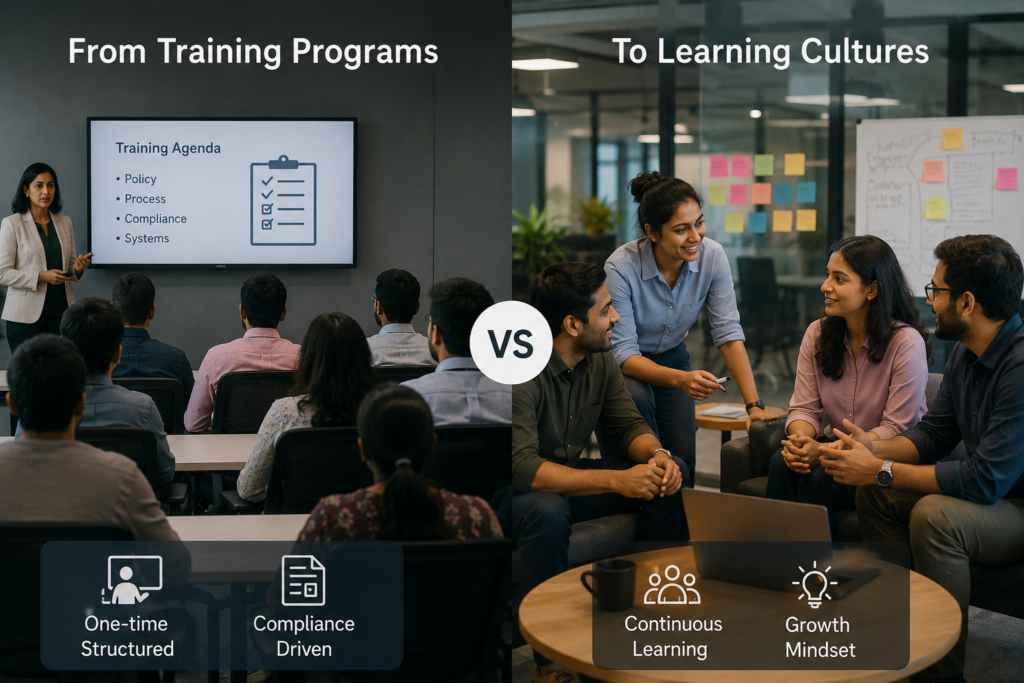

In today’s business environment, where skills become outdated faster than ever and change is the only constant, organizations can no longer rely on periodic training programs to prepare their workforce for the future. While training remains important, it is no longer sufficient.
The organizations that consistently outperform their competitors are those that have transformed learning from an event into a culture—one where curiosity, experimentation, and continuous development become part of everyday work.
For CHROs, this represents one of the most significant leadership opportunities of the decade.
The Shift from Training to Continuous Learning
Traditional corporate learning often revolves around scheduled workshops, annual compliance sessions, and classroom-based programs. Employees attend, complete assessments, receive certificates, and return to work.
But learning doesn’t end when a course does.
Modern workplaces demand continuous skill development because technology, customer expectations, regulations, and business models are evolving simultaneously. Employees need access to learning at the moment they need it—not months later through a scheduled program.
The question has changed from “How many employees completed training?” to “How quickly can our workforce learn something new and apply it?”
Why Learning Culture Matters More Than Ever
Organizations with strong learning cultures enjoy several competitive advantages:
- Employees adapt faster to market changes.
- Innovation becomes more frequent because people are encouraged to experiment.
- Internal mobility improves as employees continuously build new capabilities.
- Engagement increases when people see clear opportunities for growth.
- Retention strengthens because learning remains one of the top drivers of employee satisfaction.
In a world where talent shortages continue across industries, developing existing employees is often more effective than constantly searching for new ones.
The CHRO’s Expanding Role
Building a learning culture is no longer solely the responsibility of Learning & Development teams.
CHROs are increasingly expected to embed learning into every stage of the employee lifecycle—from onboarding and performance management to leadership development and succession planning.
This means shifting focus from delivering courses to creating environments where learning happens naturally every day.
Five Priorities for CHROs
1. Make Learning Part of Daily Work
Employees rarely have hours available for classroom sessions. Learning must fit naturally into the workflow through microlearning, coaching conversations, project-based experiences, and peer knowledge sharing.
Development should happen while work gets done—not separate from it.
2. Reward Curiosity, Not Just Performance
Many organizations recognize outcomes but overlook learning behaviors.
Celebrating employees who explore new ideas, acquire new skills, mentor colleagues, or experiment with different approaches reinforces the message that continuous growth is valued.
Recognition shapes culture.
3. Empower Managers as Learning Leaders
Employees often learn more from their managers than from formal training.
Managers should be equipped to provide coaching, regular feedback, stretch assignments, and career guidance. Developing coaching capabilities across leadership teams can significantly improve learning outcomes.
4. Personalize Learning Experiences
No two employees have identical career aspirations or skill gaps.
AI-powered learning platforms now enable personalized development journeys based on individual roles, competencies, career goals, and business priorities. Personalized learning increases relevance, engagement, and knowledge retention.
The future belongs to learning that adapts to people—not people adapting to rigid learning programs.
5. Measure Learning by Business Impact
Learning success should extend beyond completion rates.
CHROs should track metrics such as:
- Internal promotions
- Skill acquisition
- Productivity improvements
- Innovation outcomes
- Employee mobility
- Retention of high performers
- Leadership readiness
When learning contributes directly to business performance, it becomes a strategic investment rather than a cost center.
Technology Enables—Culture Sustains
Digital learning platforms, AI coaches, virtual classrooms, and learning experience platforms have transformed how employees access knowledge.
However, technology alone cannot create a learning culture.
Culture is built when leaders openly discuss their own learning journeys, encourage experimentation, normalize mistakes as opportunities to grow, and allocate time for development despite business pressures.
Employees follow what leaders demonstrate—not merely what policies recommend.
The Future Belongs to Learning Organizations
As automation continues to reshape jobs, competitive advantage will increasingly depend on how quickly organizations can learn and reinvent themselves.
The companies that thrive won’t necessarily have the most talented people today—they’ll have the people who can learn the fastest tomorrow.
For CHROs, the challenge is no longer to deliver more training programs.
It is to create workplaces where learning is continuous, curiosity is encouraged, knowledge is shared freely, and growth becomes part of the organizational identity.
Because in the future of work, learning isn’t just an HR initiative.
It is the foundation of business resilience, innovation, and long-term success.