
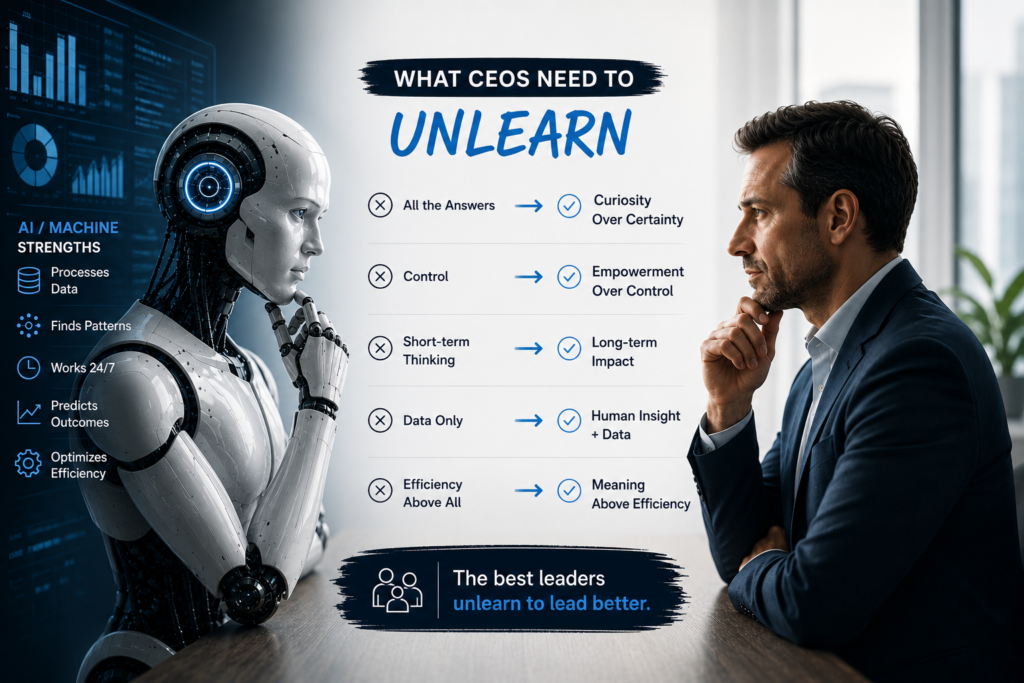

Artificial Intelligence is no longer sitting at the edge of business strategy discussions — it has moved directly into the boardroom. Across industries, AI is changing how organizations hire, market, forecast, innovate, and make decisions. Yet while companies are racing to adopt new technologies, many leaders are facing a less obvious challenge: not learning something new, but unlearning what once made them successful.
The playbook that built high-performing organizations in the last two decades may not guarantee success in the next one. Leadership in the age of AI demands a fundamental shift in mindset. The CEOs who thrive will not simply be the ones who understand technology best; they will be the ones willing to abandon outdated leadership assumptions.
The Real Challenge Isn’t AI — It’s Leadership Adaptation
Most discussions around AI focus on technology adoption: Which tools should we use? How do we automate processes? How can AI improve productivity?
These are important questions, but they are not the most critical ones.
The more pressing question is:
Are leaders ready to rethink how they lead?
History shows that major technological shifts rarely fail because of the technology itself. They fail because organizations continue operating with old mental models while the environment around them changes.
Today’s CEOs are entering an era where speed matters more than certainty, collaboration matters more than hierarchy, and adaptability matters more than control.
To succeed, there are several things leaders may need to unlearn.
1. Unlearn the Need to Have All the Answers
Traditional leadership often rewarded certainty.
CEOs were expected to be decisive, confident, and authoritative. Their value frequently came from experience and expertise. The assumption was simple: senior leaders know more than everyone else.
AI disrupts this model.
Technology is evolving too quickly for any individual leader to remain the smartest person in every room. New tools, business models, and market changes emerge faster than one person can fully understand.
The most effective leaders today are not answer providers.
They are question creators.
Instead of saying:
“I know the direction.”
Modern leaders increasingly ask:
“What are we missing?”
“What assumptions should we challenge?”
“What insights can technology and people uncover together?”
Curiosity is becoming more valuable than certainty.
2. Unlearn Leadership by Control
For decades, leadership often meant maintaining oversight and controlling outcomes.
Processes were built around supervision. Information moved upward. Decisions moved downward.
AI changes that equation.
Organizations now have access to real-time data, predictive analytics, and automated insights. Employees at every level can access information that was once available only to leadership teams.
As information becomes more democratized, excessive control becomes a bottleneck.
High-performing CEOs increasingly focus on:
- Creating systems rather than controlling people
- Empowering teams to make informed decisions
- Building accountability without micromanagement
- Encouraging experimentation
The future leader acts less like a commander and more like an architect.
3. Unlearn the Idea That Efficiency Is Everything
For years, organizations celebrated optimization.
Reduce costs. Increase output. Streamline processes.
AI certainly accelerates efficiency. It can automate repetitive tasks, process massive amounts of data, and reduce operational friction.
But there is a danger in becoming obsessed with efficiency alone.
Efficiency can improve what already exists.
Innovation creates what comes next.
Some of the most transformative ideas in business did not emerge from efficiency metrics. They emerged from creativity, experimentation, and unconventional thinking.
If AI handles repetitive work, leaders must shift human energy toward:
- Strategic thinking
- Creativity
- Relationship building
- Innovation
- Problem solving
The question moves from:
“How do we work faster?”
to:
“How do we think better?”
4. Unlearn Hierarchies Built Around Information
Traditional organizational structures were often based on information flow.
Managers gathered information. Leaders interpreted it. Teams executed instructions.
AI reduces information barriers dramatically.
Insights can now be generated instantly. Teams can analyze customer behavior, predict trends, and make data-driven decisions independently.
This creates a leadership shift:
Value no longer comes from possessing information.
Value comes from interpreting information and creating meaning.
The CEO of the future becomes a connector — aligning people, insights, and purpose.
5. Unlearn Fear of Failure
Rapid technological change creates uncertainty.
Many leaders respond by becoming more cautious. They delay decisions, seek perfect strategies, and wait for complete clarity.
But AI evolves too quickly for perfection.
Organizations that succeed are increasingly operating through experimentation.
Small pilots. Quick testing. Continuous learning.
Instead of asking:
“What if we fail?”
Leaders are asking:
“What can we learn quickly?”
Failure is becoming less about mistakes and more about feedback.
6. Unlearn the Separation Between Human Skills and Technology Skills
Many leaders still think in terms of two separate categories:
- Technical capabilities
- Human capabilities
The future does not operate in separate categories.
As AI handles analytical and repetitive functions, deeply human skills become more valuable, not less.
These include:
- Empathy
- Communication
- Trust building
- Ethical judgment
- Adaptability
- Emotional intelligence
Ironically, the more technology advances, the more leadership becomes human.
Employees do not simply need technological direction.
They need meaning, clarity, and confidence during change.
The CEOs Who Will Win Tomorrow
The age of AI is not replacing leadership.
It is redefining it.
Tomorrow’s successful CEOs may not necessarily be those with the largest budgets, the strongest technical backgrounds, or the most advanced tools.
They may be the leaders willing to challenge their own assumptions.
The competitive advantage of the future is unlikely to come from AI alone.
It will come from leaders who know what to let go of.
Because sometimes the greatest act of leadership is not learning something new.
It is having the courage to unlearn what no longer works.
Final Thought
AI will continue transforming industries at extraordinary speed. Technology will evolve, business models will shift, and markets will become more complex.
The question for CEOs is no longer:
“How do we adopt AI?”
The real question is:
“What leadership habits are we still holding onto that belong to a different era?”