
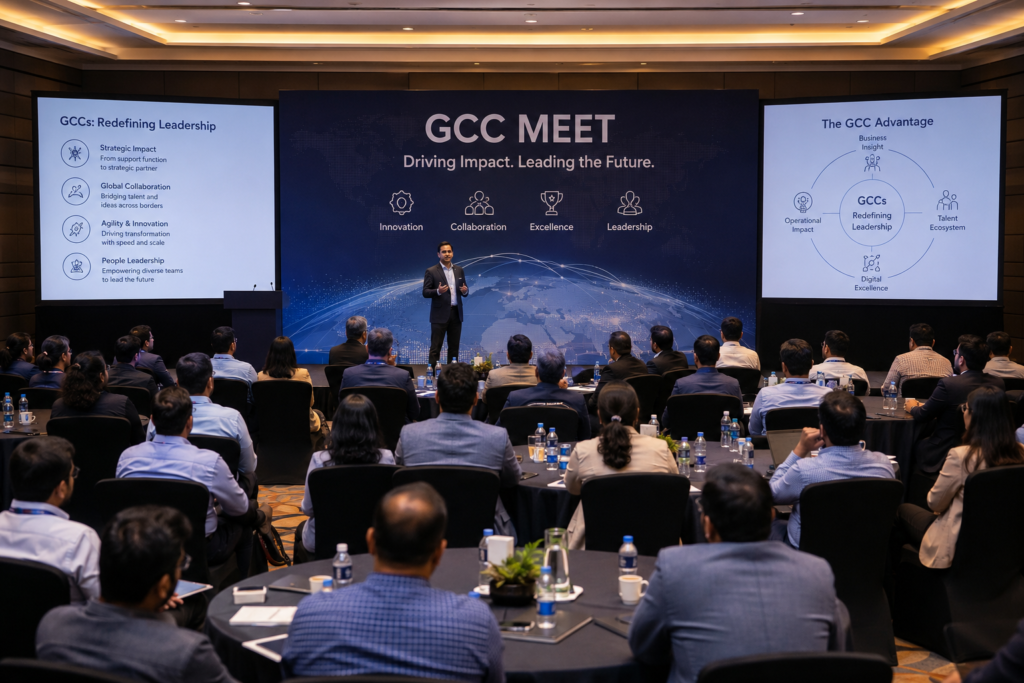

Over the past decade, Global Capability Centers (GCCs) have undergone a remarkable transformation. Once viewed primarily as cost-efficient back-office operations, GCCs have evolved into strategic hubs that drive innovation, digital transformation, product development, customer experience, and enterprise-wide decision-making.
India, home to more than 1,700 GCCs, is at the forefront of this evolution. As multinational organizations continue to expand their GCC footprint, leadership expectations within these centers are changing dramatically. Today’s GCC leaders are no longer just operational managers—they are business strategists, innovation champions, talent architects, and global influencers.
The future of leadership is increasingly being shaped inside GCCs.
The Evolution of GCCs
Traditional GCCs were established to deliver shared services such as finance, HR, IT support, and customer operations. Their primary objective was operational efficiency and cost optimization.
Today’s GCCs, however, are responsible for:
- Digital product engineering
- Artificial Intelligence and Machine Learning initiatives
- Data analytics and business intelligence
- Cybersecurity
- Cloud transformation
- Research and development
- Supply chain optimization
- Global procurement
- Customer experience innovation
With these expanded responsibilities comes a new leadership mandate.
Leadership Has Shifted from Execution to Enterprise Influence
Earlier, GCC leaders focused on delivering projects on time while maintaining operational excellence.
Now they are expected to:
- Shape global business strategies
- Drive innovation across business units
- Influence executive decisions
- Lead enterprise-wide digital transformation
- Build future-ready organizations
Leadership has become far more strategic than operational.
Rather than asking, “How do we deliver?” modern GCC leaders ask:
“How do we create competitive advantage?”
Innovation Has Become a Leadership Responsibility
Modern GCCs are increasingly becoming innovation engines for global enterprises.
Many organizations now develop their flagship products, AI platforms, automation frameworks, and analytics capabilities directly within their GCCs.
As a result, leaders must cultivate environments where innovation becomes part of everyday work.
This involves:
- Encouraging experimentation
- Promoting cross-functional collaboration
- Supporting rapid prototyping
- Creating psychological safety
- Rewarding creative thinking
Leadership today means enabling innovation rather than controlling execution.
GCC Leaders Must Manage Global Stakeholders
Unlike traditional leadership roles confined to a single geography, GCC leaders operate within complex international ecosystems.
On any given day, they may collaborate with:
- Global CEOs
- Product teams in Europe
- Engineering teams in the US
- Operations leaders in Asia-Pacific
- Regional business heads
- External technology partners
Success increasingly depends on influence rather than authority.
Building trust across cultures, communicating effectively, and aligning diverse stakeholders have become essential leadership skills.
Talent Has Become the Biggest Competitive Advantage
Technology alone no longer differentiates GCCs.
Talent does.
The competition for AI specialists, cloud architects, cybersecurity experts, product managers, and digital engineers has intensified globally.
Leaders must therefore focus on:
- Building strong employer brands
- Upskilling employees continuously
- Creating internal career mobility
- Developing leadership pipelines
- Improving employee engagement
- Retaining critical talent
Leadership is becoming deeply people-centric.
AI Is Changing What Leaders Need to Lead
Artificial Intelligence is reshaping how GCCs operate.
Routine activities are increasingly automated, allowing teams to focus on higher-value work.
This changes leadership priorities.
Instead of supervising repetitive tasks, leaders now spend more time:
- Solving strategic problems
- Coaching teams
- Driving innovation
- Managing change
- Encouraging learning
- Making data-driven decisions
The emphasis shifts from managing work to enabling knowledge workers.
Cross-Functional Leadership Is Becoming Essential
Today’s business challenges rarely fit neatly into one department.
Digital transformation, customer experience, cybersecurity, and sustainability require collaboration across multiple functions.
GCC leaders must therefore excel at leading interdisciplinary teams.
Successful leaders bring together:
- Engineering
- HR
- Finance
- Procurement
- Operations
- Product Management
- Data Science
- Security
This collaborative approach accelerates innovation while improving business outcomes.
Decision-Making Must Be Faster
Business cycles continue to shorten.
Organizations can no longer wait weeks for approvals or lengthy governance processes.
Modern GCC leaders must:
- Make decisions using real-time data
- Empower teams
- Reduce bureaucracy
- Encourage ownership
- Balance speed with governance
Agility has become a defining leadership characteristic.
Leadership Is Becoming More Customer-Centric
Many GCCs now directly influence customer-facing products and services.
This means leaders must understand:
- Customer expectations
- Market trends
- Product strategy
- User experience
- Business outcomes
Instead of measuring only operational KPIs, leadership success is increasingly tied to customer satisfaction, innovation impact, and revenue contribution.
Future GCC Leaders Will Build Learning Organizations
Technology evolves faster than traditional organizational structures.
The most successful GCCs continuously learn, adapt, and reinvent themselves.
Leaders must create cultures where:
- Learning is continuous
- Curiosity is encouraged
- Experimentation is celebrated
- Failure becomes a learning opportunity
- Skills evolve alongside technology
Organizations that learn faster will innovate faster.
The Rise of Purpose-Driven Leadership
Employees increasingly seek meaningful work, flexibility, and opportunities to grow.
Modern GCC leaders are expected to provide more than career progression—they must foster a sense of purpose.
This includes:
- Creating inclusive workplaces
- Promoting employee well-being
- Supporting flexible work models
- Encouraging diversity
- Building ethical AI practices
- Leading with transparency
Purpose has become a business imperative rather than a cultural initiative.
Preparing Leaders for the Next Generation of GCCs
As GCCs continue evolving into strategic global business hubs, leadership development must keep pace.
Organizations should invest in leaders who can:
- Think strategically
- Lead digital transformation
- Build high-performing global teams
- Drive innovation
- Influence without authority
- Navigate ambiguity
- Leverage AI responsibly
- Foster continuous learning
These capabilities will define the next generation of GCC leadership.