
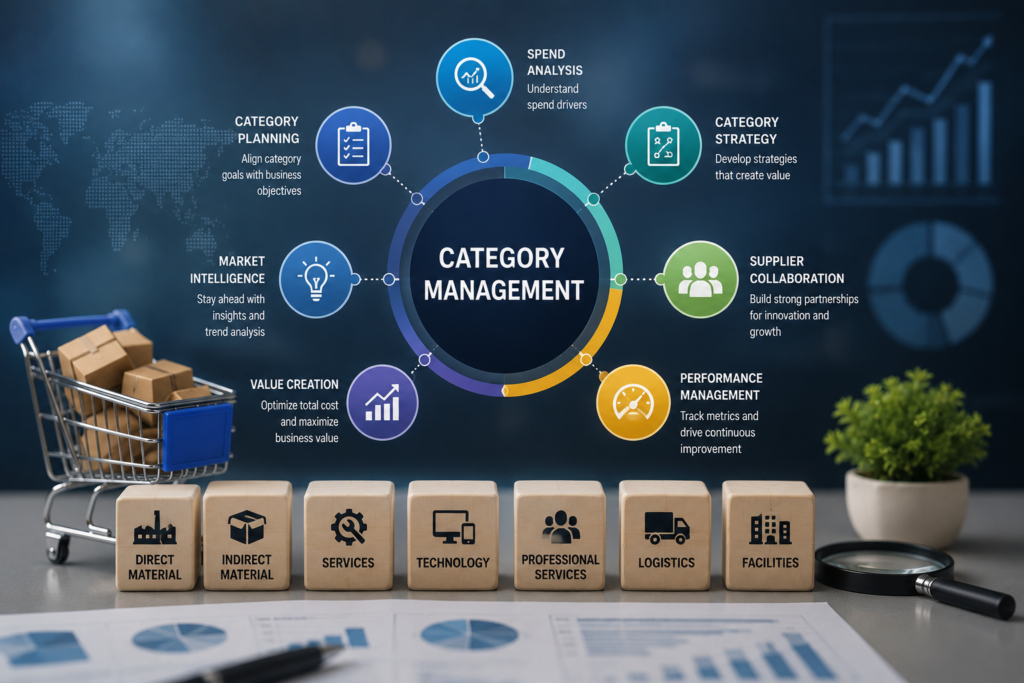

For years, category management was primarily viewed as a procurement discipline focused on reducing costs, consolidating suppliers, and negotiating better contracts. While these objectives remain important, today’s business environment demands much more. Global supply chain disruptions, digital transformation, sustainability expectations, geopolitical uncertainty, and rapidly changing customer demands are reshaping how organizations manage spending categories.
The future of category management is no longer about simply buying smarter—it’s about enabling business growth, innovation, resilience, and competitive advantage.
Organizations that embrace next-generation category management will transform procurement from a support function into a strategic business partner capable of driving enterprise-wide value.
Why Traditional Category Management Is No Longer Enough
The procurement landscape has changed dramatically over the past decade.
Organizations now operate in a world where supply risks emerge overnight, regulations evolve continuously, customer expectations shift rapidly, and technology changes purchasing behaviors faster than ever before.
Traditional category management often focused on:
- Annual sourcing cycles
- Historical spend analysis
- Supplier consolidation
- Cost reduction targets
- Reactive procurement decisions
While these practices remain relevant, they are insufficient for today’s dynamic business environment.
Future-ready organizations require category strategies that are agile, data-driven, predictive, and closely aligned with business objectives.
The Shift Toward Data-Driven Decision Making
Data is becoming the foundation of modern category management.
Instead of relying solely on historical procurement data, organizations are combining multiple data sources, including:
- Spend analytics
- Market intelligence
- Supplier performance metrics
- Risk indicators
- ESG data
- Demand forecasts
- Commodity pricing trends
- External economic signals
Advanced analytics allows procurement leaders to anticipate market shifts before they impact operations.
For example, rather than reacting to rising raw material costs, category managers can identify early warning signals, explore alternative sourcing options, and negotiate proactively.
The result is faster, more informed decision-making with lower business risk.
AI Will Redefine Category Management
Artificial Intelligence is rapidly becoming one of the biggest game changers for procurement.
Rather than replacing category managers, AI enhances their ability to make strategic decisions.
AI-powered platforms can:
- Analyze millions of spend records in seconds
- Identify hidden savings opportunities
- Predict supplier risks
- Recommend sourcing strategies
- Detect contract leakage
- Forecast price fluctuations
- Benchmark supplier performance
- Automate routine procurement analysis
This automation allows category managers to spend less time gathering data and more time developing long-term business strategies.
The future role of category managers will increasingly focus on insight generation rather than transactional execution.
Category Managers Will Become Business Advisors
Tomorrow’s category managers won’t simply manage suppliers.
They will partner with business leaders across finance, operations, manufacturing, IT, HR, marketing, and product development.
Instead of asking:
“How do we reduce spend?”
They will ask:
- How can procurement accelerate innovation?
- Which suppliers can help launch new products?
- Where can we reduce supply chain risks?
- How can procurement improve sustainability performance?
- Which sourcing decisions create long-term competitive advantage?
This evolution transforms procurement into a strategic growth function.
Sustainability Will Become a Core Category Strategy
Environmental, Social, and Governance (ESG) objectives are increasingly influencing procurement decisions.
Future category strategies will evaluate suppliers not only on cost and quality but also on:
- Carbon emissions
- Ethical sourcing
- Diversity and inclusion
- Circular economy practices
- Waste reduction
- Responsible manufacturing
- Compliance with sustainability regulations
Organizations that integrate sustainability into category management can strengthen brand reputation, reduce regulatory risk, and meet stakeholder expectations.
Sustainable sourcing is becoming a competitive advantage rather than merely a compliance requirement.
Supplier Relationships Will Become More Collaborative
Traditional procurement often emphasized aggressive negotiations and price competition.
The future favors strategic supplier partnerships.
Organizations increasingly recognize that their suppliers are valuable sources of innovation, technology, expertise, and resilience.
Leading companies are investing in:
- Joint innovation programs
- Supplier development initiatives
- Shared digital platforms
- Long-term strategic agreements
- Collaborative demand planning
- Risk-sharing models
These partnerships help organizations respond more effectively to market disruptions while accelerating innovation.
Digital Procurement Ecosystems Will Replace Manual Processes
Category management is becoming increasingly digital.
Cloud procurement platforms now integrate:
- Spend management
- Supplier relationship management
- Contract lifecycle management
- Procurement analytics
- Risk monitoring
- eSourcing
- AI assistants
- Workflow automation
Instead of working across disconnected spreadsheets and emails, procurement teams gain real-time visibility across the entire sourcing lifecycle.
This improves collaboration, governance, and operational efficiency.
Risk Management Will Be Embedded into Every Category Strategy
Recent global events have highlighted the importance of supply chain resilience.
Future category management will continuously monitor risks such as:
- Supplier financial health
- Geopolitical instability
- Natural disasters
- Cybersecurity threats
- Regulatory changes
- Capacity constraints
- Logistics disruptions
Rather than responding to crises after they occur, procurement teams will use predictive risk intelligence to prepare contingency plans well in advance.
Resilience will become just as important as cost optimization.
Skills That Future Category Managers Need
Technology alone cannot transform category management.
The people leading these initiatives must develop broader capabilities.
Future category managers will require expertise in:
- Strategic thinking
- Data analytics
- AI-enabled decision making
- Financial analysis
- Stakeholder management
- Supplier collaboration
- Sustainability
- Risk management
- Negotiation
- Change leadership
Soft skills will become just as valuable as technical procurement knowledge.
Organizations that invest in capability building will be better positioned to adapt to changing business needs.
Measuring Value Beyond Savings
The success of category management has traditionally been measured by negotiated savings.
However, future procurement leaders will evaluate success using broader business outcomes such as:
- Revenue enablement
- Innovation delivered
- Supplier performance
- Risk reduction
- Sustainability impact
- Supply continuity
- Speed to market
- Business agility
- Customer satisfaction
- Total value creation
This broader perspective positions procurement as a strategic contributor to enterprise performance rather than a cost center.