
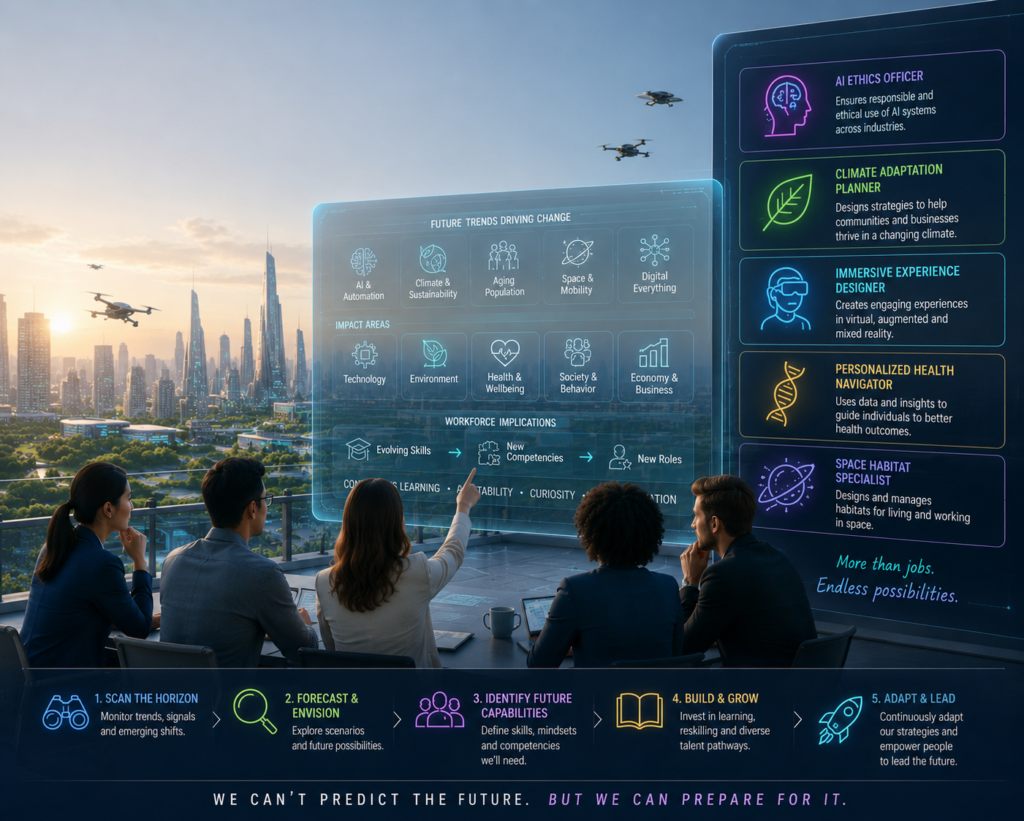

The world of work is evolving faster than ever before. Technological advancements, artificial intelligence, automation, sustainability initiatives, and changing business models are creating entirely new categories of jobs that were unimaginable just a decade ago. Roles such as AI Ethics Specialists, Digital Twin Engineers, Sustainability Analysts, Prompt Engineers, and Human-Machine Collaboration Managers have emerged as organizations adapt to a rapidly changing environment.
For business leaders, this presents a unique challenge: how do you plan a workforce for jobs that do not yet exist?
The Traditional Workforce Planning Model Is No Longer Enough
Historically, workforce planning relied heavily on historical data, existing organizational structures, and predictable business growth. Companies would forecast future hiring needs based on past trends and known skill requirements.
Today, that approach is becoming increasingly ineffective. Industries are being disrupted faster than organizations can update job descriptions. New technologies can create demand for entirely new skill sets overnight, while making certain existing roles obsolete.
As a result, organizations must shift from planning for specific roles to planning for capabilities and adaptability.
Focusing on Skills Instead of Job Titles
Future-ready workforce planning begins with identifying critical skills rather than fixed positions. While job titles may change, foundational capabilities such as critical thinking, problem-solving, digital literacy, data analysis, collaboration, creativity, and adaptability remain valuable across industries.
Organizations that map and understand their current skill inventory gain greater visibility into workforce strengths and gaps. This enables leaders to redeploy talent more effectively as new opportunities emerge.
The question is no longer, “What jobs will we need in five years?” Instead, it becomes, “What capabilities will help us succeed regardless of how the market changes?”
Building a Culture of Continuous Learning
One of the most effective ways to prepare for unknown future roles is to cultivate a learning-oriented culture. Employees who continuously upgrade their skills are more likely to transition successfully into emerging roles.
Organizations should invest in:
- Digital learning platforms
- AI-assisted training programs
- Cross-functional projects
- Leadership development initiatives
- Upskilling and reskilling pathways
- Industry certifications and micro-credentials
Continuous learning transforms workforce planning from a hiring challenge into a talent development strategy.
Leveraging Workforce Intelligence and Predictive Analytics
Modern workforce planning increasingly relies on data-driven insights. Advanced analytics can help organizations identify emerging skill trends, forecast talent shortages, and understand how automation may impact specific functions.
By combining labor market intelligence with internal workforce data, organizations can make informed decisions about hiring, reskilling, and succession planning.
Predictive workforce analytics allows leaders to prepare for future demands before they become urgent talent shortages.
Creating Agile Talent Ecosystems
The future workforce will extend beyond traditional full-time employees. Organizations are increasingly drawing talent from a mix of permanent staff, contractors, freelancers, consultants, gig workers, and strategic partners.
This broader talent ecosystem provides flexibility when responding to emerging business needs and accessing specialized skills that may not yet exist internally.
Companies that embrace agile talent models can adapt more quickly as new opportunities and challenges arise.
Strengthening Leadership for Uncertainty
Future workforce planning is not just an HR responsibility—it is a leadership imperative. Leaders must develop the ability to navigate ambiguity, anticipate disruption, and make talent decisions without complete information.
Successful organizations encourage leaders to think beyond current organizational structures and prepare teams for multiple future scenarios. Scenario-based planning helps organizations remain resilient regardless of how markets, technologies, or customer expectations evolve.
The Future Belongs to Adaptable Organizations
No company can accurately predict every job that will emerge over the next decade. However, organizations can prepare by building adaptable workforces, investing in learning, embracing data-driven planning, and focusing on skills rather than static roles.
Workforce planning for jobs that do not yet exist is ultimately about creating an organization capable of evolving alongside change. Companies that prioritize agility and continuous development today will be best positioned to thrive in the future of work.
The organizations that win tomorrow will not necessarily be those with the most talent today—but those that can continuously develop the talent they need for the opportunities of tomorrow.