
For decades, the workforce has been defined by people—their skills, experiences, relationships, and ability to create value. Today, a new category of workers is entering the workplace: AI agents. Unlike traditional software tools that simply follow instructions, AI agents can make decisions, complete complex tasks, learn from interactions, and collaborate with humans. This transformation is giving rise to the agentic workforce, where humans and intelligent AI agents work side by side.
As organizations embrace this new reality, the role of Human Resources is set to undergo one of the most significant transformations in its history. HR leaders will no longer manage only employees; they will also be responsible for designing systems where human talent and AI agents collaborate effectively, ethically, and productively.
From Workforce Planning to Human-AI Workforce Design
Traditional workforce planning focused on questions like: How many people do we need? What skills should we hire for? How do we develop and retain talent?
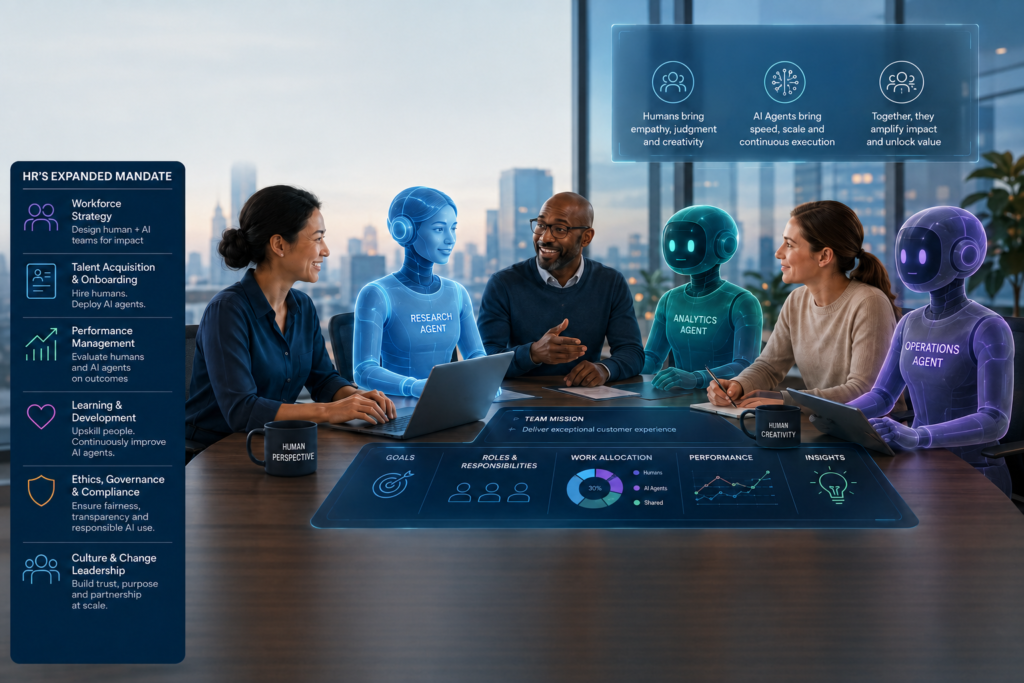
In the era of agentic AI, HR will ask a broader set of questions: Which tasks should be performed by humans? Which can be delegated to AI agents? How do we create teams where both complement each other?
The future workforce will likely include “digital colleagues” handling activities such as data analysis, report generation, customer support, scheduling, coding, research, and administrative processes, while humans focus on areas that require creativity, emotional intelligence, strategic judgment, leadership, and complex decision-making.
Redefining Roles and Job Structures
The rise of AI agents will accelerate the shift from rigid job descriptions toward dynamic, skill-based work models. Employees may no longer be defined only by their job titles but by the unique capabilities they bring to collaboration with AI.
A marketing professional, for example, may work alongside AI agents that analyze market trends, generate campaign ideas, and optimize customer insights. A procurement manager may leverage AI agents to monitor supplier risks, analyze contracts, and identify cost-saving opportunities.
HR will need to redesign roles, create new competency frameworks, and identify the human skills that become increasingly valuable in an AI-powered workplace.
Managing AI Agents Like a New Workforce Category
While AI agents are not employees, organizations will need governance frameworks to manage their performance, access, responsibilities, and risks. HR, together with technology and business leaders, may play a central role in answering questions such as:
- What level of autonomy should an AI agent have?
- Who is accountable for decisions made by AI?
- How should AI performance and reliability be measured?
- What ethical guidelines should govern AI behavior?
- How do we ensure transparency and trust among employees?
This creates a new HR responsibility: developing policies for human-AI collaboration, much like organizations once created policies for remote work, data privacy, and digital transformation.
Building AI Readiness Across the Workforce
The success of an agentic workforce will depend not only on technology but on people’s ability to work effectively with AI. HR will become the driver of AI literacy, helping employees understand how to collaborate with AI agents, evaluate their outputs, and use them responsibly.
Future-ready organizations will invest in continuous learning programs focused on AI collaboration, critical thinking, digital ethics, adaptability, and problem-solving. The most valuable employees will not be those who compete with AI, but those who know how to direct, supervise, and enhance it.
Maintaining Human Connection in an AI-Driven Workplace
As AI becomes more involved in daily work, organizations must ensure that technology does not replace the human elements that define great workplaces—trust, empathy, creativity, and meaningful relationships.
HR will have a critical responsibility in preserving company culture, supporting employee well-being, and ensuring that AI enhances human potential rather than diminishing it. The future workplace will not be about humans versus AI; it will be about creating the best possible partnership between the two.
Conclusion
The rise of the agentic workforce marks the beginning of a new chapter in work. Just as HR once adapted to globalization, digital transformation, and remote work, it must now evolve to manage a blended workforce of humans and AI agents.
The organizations that succeed will be those that move beyond seeing AI merely as a tool and begin designing workplaces where human creativity and machine intelligence complement each other. In this future, HR will become the architect of human-AI collaboration—ensuring that technology drives productivity while people continue to drive purpose, innovation, and culture.