
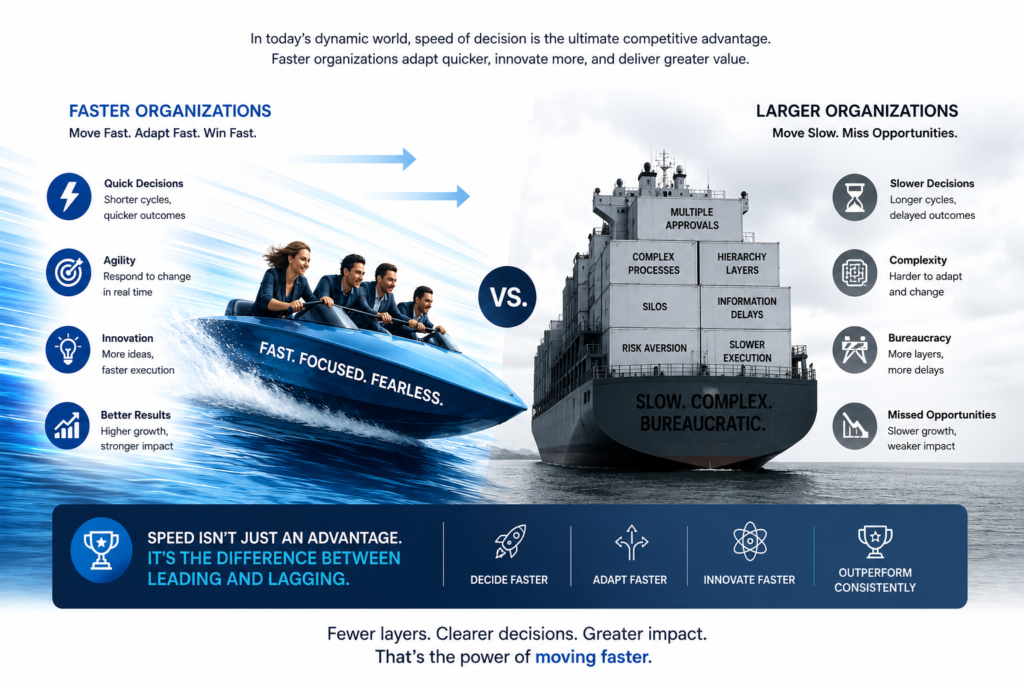

In today’s hypercompetitive business environment, success is no longer determined by the size of an organization—it is determined by the speed at which it makes decisions. Markets evolve overnight, customer preferences shift rapidly, and technological disruptions emerge without warning. In such an environment, organizations that can assess information, make confident decisions, and execute quickly consistently outperform larger competitors weighed down by bureaucracy.
This competitive advantage is known as decision velocity—the ability of an organization to make high-quality decisions at speed. While scale still offers advantages, speed has become the defining characteristic of modern business success.
What Is Decision Velocity?
Decision velocity refers to how quickly an organization can move from identifying an opportunity or problem to making a decision and implementing action.
It is not about making rushed or careless choices. Instead, it is about reducing unnecessary delays while maintaining decision quality.
Organizations with high decision velocity:
- Respond faster to market changes
- Launch products more quickly
- Resolve customer issues faster
- Adapt to disruptions effectively
- Empower employees to act confidently
In contrast, organizations with slow decision-making often lose opportunities before decisions are even finalized.
Why Bigger Isn’t Always Better
Large organizations possess significant resources, experienced talent, and established processes. However, these strengths can become weaknesses when excessive layers of approval slow progress.
Common barriers include:
- Multiple approval levels
- Departmental silos
- Risk-averse cultures
- Excessive reporting
- Decision ownership confusion
By the time a decision reaches execution, competitors may have already captured the opportunity.
Today’s startups often outperform industry giants not because they have larger budgets—but because they make decisions in days rather than months.
The Cost of Slow Decision-Making
Slow decisions affect every aspect of business performance.
Missed Market Opportunities
Customer trends change rapidly.
Organizations that delay launching products or responding to customer feedback often lose market share to faster competitors.
Reduced Innovation
Innovation requires experimentation.
If every new idea needs months of approval, employees become reluctant to propose bold initiatives.
Eventually, innovation becomes incremental rather than transformational.
Employee Frustration
Employees become disengaged when decisions remain pending for weeks.
Talented professionals want autonomy and clarity—not endless meetings with no conclusions.
Fast decision-making builds accountability and ownership.
Poor Customer Experience
Customers expect quick responses.
Whether resolving complaints, approving requests, or delivering services, delays directly affect customer satisfaction and loyalty.
Why Decision Velocity Creates Competitive Advantage
Organizations with faster decision cycles gain multiple advantages.
Faster Innovation
Rapid decisions allow companies to:
- Test new ideas quickly
- Learn from failures sooner
- Improve products continuously
- Scale successful initiatives rapidly
Instead of waiting for perfect information, they learn through action.
Greater Organizational Agility
Business conditions rarely remain stable.
Organizations with high decision velocity adapt more effectively during:
- Economic uncertainty
- Supply chain disruptions
- Regulatory changes
- Competitive threats
- Technology shifts
Agility becomes a strategic capability rather than a reactive response.
Higher Employee Engagement
Empowered employees feel trusted.
When managers encourage teams to make informed decisions independently, organizations experience:
- Greater accountability
- Improved morale
- Faster execution
- Better collaboration
- Increased innovation
Employees become problem-solvers instead of approval seekers.
Improved Customer Responsiveness
Fast decisions lead to:
- Faster service recovery
- Quicker product improvements
- Personalized customer experiences
- Better issue resolution
Customers notice responsiveness more than organizational size.
Characteristics of High-Velocity Organizations
Successful organizations intentionally design systems that support quick decision-making.
Clear Decision Ownership
Every major decision has a clearly identified owner.
Instead of involving everyone, organizations define:
- Who decides
- Who provides input
- Who approves
- Who executes
Clear accountability eliminates confusion.
Data-Driven Decision Culture
High-performing organizations rely on data rather than hierarchy.
Leaders ask:
- What does the data suggest?
- What are customers telling us?
- What risks are measurable?
Objective insights reduce unnecessary debates.
Decentralized Authority
Not every decision needs executive approval.
Leading organizations empower frontline teams to make operational decisions within predefined boundaries.
This significantly reduces bottlenecks.
Shorter Meeting Cycles
Meetings exist to decide—not merely discuss.
Organizations with high decision velocity:
- Set decision deadlines
- Limit attendees
- Share information beforehand
- End meetings with clear action items
Every meeting should move work forward.
Technology as a Decision Accelerator
Digital transformation has dramatically increased decision speed.
Modern organizations leverage:
- AI-powered analytics
- Real-time dashboards
- Predictive forecasting
- Workflow automation
- Digital collaboration platforms
Instead of waiting weeks for reports, leaders access live insights instantly.
Technology doesn’t replace human judgment—it enhances it by providing faster, more accurate information.
Leadership’s Role in Decision Velocity
Leaders shape organizational speed.
Effective leaders avoid becoming decision bottlenecks.
Instead, they:
- Build trust across teams
- Delegate authority
- Encourage experimentation
- Accept calculated risks
- Learn from mistakes quickly
They understand that perfect decisions made too late are often less valuable than good decisions made on time.
Building a Culture of Fast Decisions
Improving decision velocity requires intentional cultural change.
Organizations can begin by:
- Eliminating unnecessary approval layers
- Defining clear decision rights
- Encouraging cross-functional collaboration
- Investing in real-time data visibility
- Rewarding action and learning—not just flawless execution
- Reviewing delayed decisions to identify bottlenecks
- Creating psychological safety for responsible risk-taking
The objective isn’t reckless speed but consistent, informed action.
Balancing Speed with Quality
Fast decisions should never compromise strategic thinking.
Organizations must distinguish between:
- Reversible decisions, which can be made quickly and adjusted later.
- Irreversible decisions, which require more rigorous analysis and broader input.
This distinction helps teams move rapidly where appropriate while applying greater diligence to high-impact choices.
The Future Belongs to Fast Movers
As AI, automation, and digital ecosystems continue to reshape industries, competitive advantage will increasingly depend on how quickly organizations can sense change and respond.
Decision velocity is becoming a core business capability—one that influences innovation, customer satisfaction, employee engagement, and financial performance. Companies that cultivate empowered teams, streamline governance, and embrace data-driven decision-making will be better positioned to capitalize on opportunities before competitors do.
In a world where change is constant, speed is no longer just an operational metric—it is a strategic differentiator. The organizations that consistently outperform won’t necessarily be the largest or the oldest. They will be the ones that decide, adapt, and act with confidence while others are still waiting for approval.