
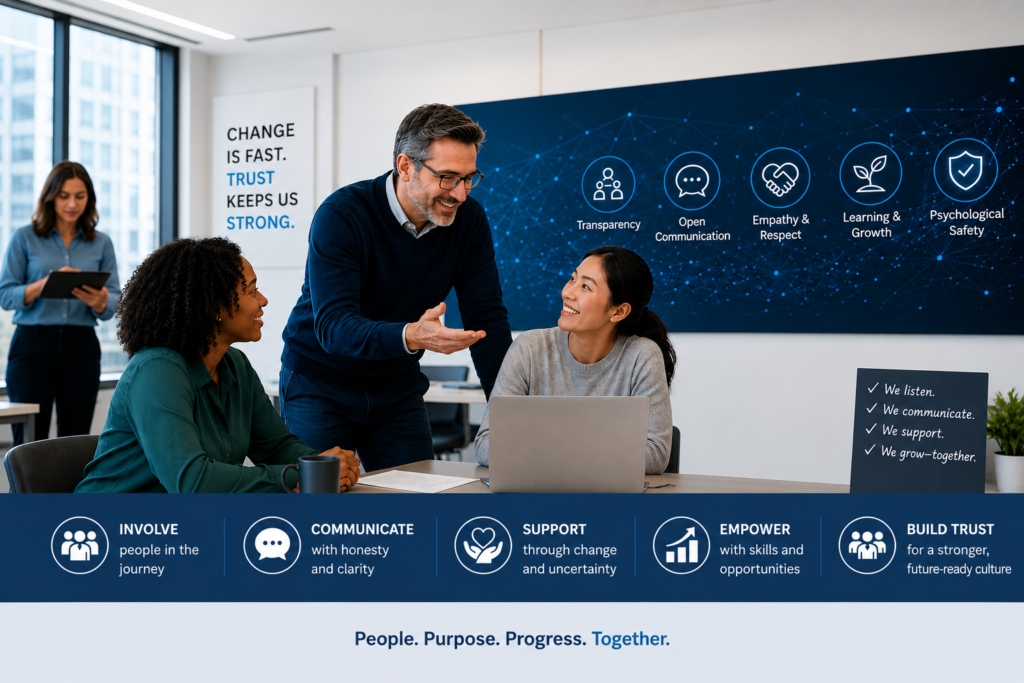

Technology is transforming organizations at an unprecedented pace. Artificial intelligence, automation, cloud computing, advanced analytics, and digital collaboration tools are reshaping how businesses operate and compete. While these innovations create new opportunities for growth and efficiency, they also introduce uncertainty for employees.
Many workers today are asking critical questions: Will my role change? Will automation replace my job? What skills will I need in the future? How will my organization support me through this transition?
In periods of rapid technological change, workforce trust becomes one of an organization’s most valuable assets. Companies that successfully build and maintain trust are more likely to achieve higher employee engagement, smoother technology adoption, stronger retention, and better business outcomes. Those that fail to do so often face resistance, anxiety, and declining morale.
The challenge for leaders is no longer simply implementing new technologies—it is ensuring people remain confident, informed, and empowered throughout the transformation journey.
Why Trust Matters More Than Ever
Technology-driven transformation affects employees on both professional and personal levels. New systems alter workflows, redefine responsibilities, and sometimes eliminate traditional ways of working. Without trust, employees may perceive these changes as threats rather than opportunities.
Trust serves as the foundation that enables organizations to:
- Accelerate technology adoption
- Reduce resistance to change
- Improve collaboration across teams
- Increase employee engagement
- Strengthen organizational resilience
- Foster innovation and experimentation
When employees trust leadership, they are more willing to embrace uncertainty and participate actively in transformation initiatives.
The Trust Gap in Digital Transformation
One of the biggest mistakes organizations make is focusing solely on technology implementation while neglecting the human side of change.
Employees often experience a trust gap when:
- Leadership communication is unclear or inconsistent
- Future workforce plans remain undisclosed
- AI and automation initiatives lack transparency
- Skill development opportunities are limited
- Decisions appear to prioritize efficiency over people
This gap can quickly lead to fear, misinformation, and disengagement.
Organizations that proactively address these concerns build stronger relationships with employees and create a culture where change is viewed as progress rather than disruption.
Communicate Early, Often, and Transparently
Transparency is the cornerstone of workforce trust.
Employees do not expect leaders to have all the answers immediately, but they do expect honesty about what is changing and why.
Effective communication should include:
- The business reasons behind technological investments
- Expected benefits for customers and employees
- Potential impacts on roles and workflows
- Timelines for implementation
- Available support and training resources
Leaders should also create opportunities for two-way dialogue. Town halls, Q&A sessions, employee forums, and feedback channels allow workers to voice concerns and feel heard.
Open communication reduces uncertainty and prevents rumors from filling information gaps.
Position Technology as an Enabler, Not a Threat
Employees are more likely to trust transformation efforts when technology is presented as a tool that enhances human capabilities rather than replaces them.
Instead of emphasizing cost reduction and automation alone, organizations should highlight how technology can:
- Eliminate repetitive tasks
- Improve productivity
- Enable more meaningful work
- Support better decision-making
- Create opportunities for career growth
When employees understand how technology can improve their work experience, adoption becomes significantly easier.
The narrative should focus on augmentation rather than replacement whenever possible.
Invest in Continuous Learning
Trust grows when employees believe their organization is investing in their future.
Rapid technological change requires continuous skill development. Companies that prioritize reskilling and upskilling demonstrate a long-term commitment to workforce success.
Key initiatives include:
- Digital skills training programs
- AI literacy workshops
- Leadership development initiatives
- Cross-functional learning opportunities
- Career mobility pathways
Employees who feel equipped to succeed in a changing environment are more likely to embrace innovation and less likely to fear it.
Learning investments signal that people remain central to the organization’s growth strategy.
Involve Employees in the Transformation Process
Trust cannot be built through top-down directives alone.
Organizations achieve better outcomes when employees actively participate in transformation efforts. Involving workers in technology selection, process redesign, pilot programs, and feedback initiatives creates a sense of ownership.
Employees often possess valuable operational insights that leadership may overlook. Their involvement helps identify challenges early and improves implementation effectiveness.
When people help shape change, they become advocates rather than critics.
Demonstrate Ethical and Responsible Technology Use
As AI adoption accelerates, employees are increasingly concerned about privacy, fairness, and decision-making transparency.
Organizations must establish clear guidelines regarding:
- Data privacy and protection
- AI governance
- Ethical technology practices
- Responsible automation policies
- Human oversight mechanisms
Employees need confidence that technology will be used responsibly and that critical decisions affecting their careers will not be delegated entirely to algorithms.
Trust increases when organizations prioritize ethical considerations alongside innovation.
Equip Managers to Lead Through Change
Frontline managers play a crucial role in building workforce trust.
Employees often rely on their immediate leaders for guidance, reassurance, and clarification during periods of uncertainty. If managers lack information or confidence, trust can quickly erode.
Organizations should prepare managers to:
- Communicate change effectively
- Address employee concerns
- Support skill development
- Foster team resilience
- Encourage open dialogue
Strong managers serve as trust multipliers throughout the organization.
Measure and Act on Employee Sentiment
Building trust is not a one-time initiative. It requires ongoing assessment and improvement.
Organizations should regularly evaluate workforce sentiment through:
- Employee engagement surveys
- Pulse checks
- Feedback platforms
- Focus groups
- Leadership listening sessions
Collecting feedback is only the first step. Acting on insights demonstrates that employee voices genuinely influence organizational decisions.
Trust deepens when people see tangible responses to their concerns.
The Future of Trust-Centered Transformation
The pace of technological change will continue to accelerate. AI, automation, and emerging technologies will redefine industries, business models, and workforce expectations.
In this environment, technology itself will not determine organizational success. The differentiator will be how effectively leaders bring people along on the journey.
Companies that prioritize transparency, learning, inclusion, and ethical innovation will cultivate stronger workforce trust and achieve more sustainable transformation outcomes.
Conclusion
Rapid technological change presents both opportunities and challenges. While organizations race to adopt new technologies, leaders must remember that transformation is ultimately about people.
Building workforce trust requires clear communication, continuous learning, employee involvement, ethical technology practices, and empathetic leadership. When employees feel informed, valued, and supported, they are far more likely to embrace change and contribute to organizational success.
The most successful organizations of the future will not simply be the ones with the most advanced technology—they will be the ones that earn and maintain the trust of their workforce throughout every stage of transformation.