
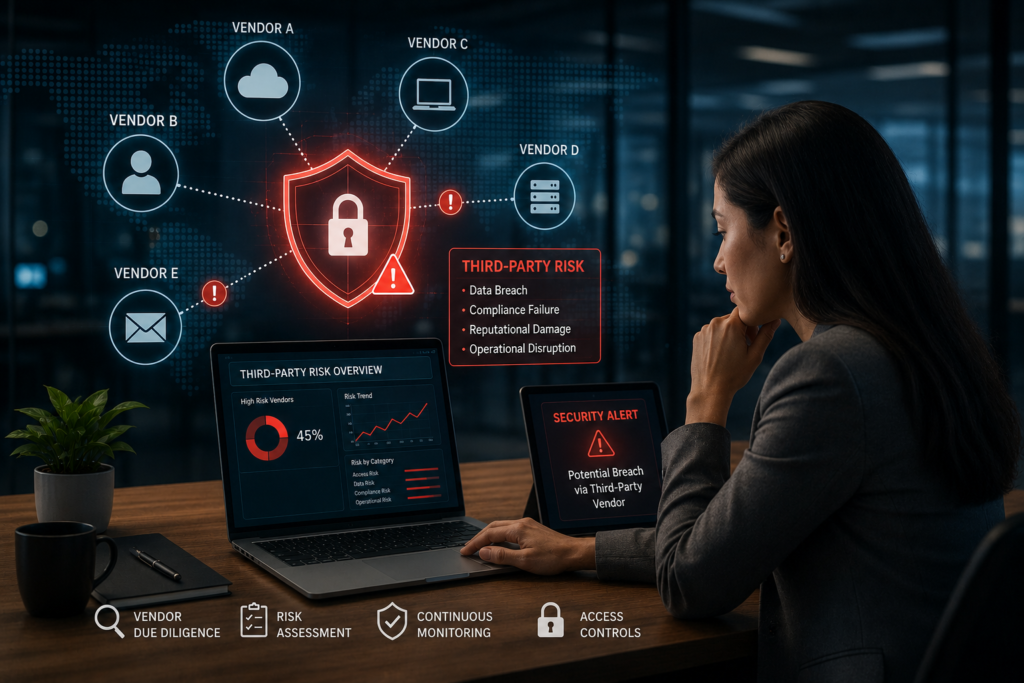

In today’s interconnected business environment, organizations rarely operate in isolation. From cloud service providers and software vendors to logistics partners, consultants, and outsourcing firms, third-party vendors play a vital role in business operations. While these partnerships drive efficiency, innovation, and scalability, they also introduce significant cybersecurity risks that many organizations underestimate.
Cybercriminals increasingly target third-party vendors because they often provide an indirect path to larger organizations with stronger security controls. As a result, third-party vendor management has become a critical component of every organization’s cybersecurity strategy.
Why Third-Party Vendors Are a Growing Cybersecurity Concern
Modern organizations rely on dozens—or even hundreds—of external vendors for essential services. Many of these vendors have access to sensitive business information, customer data, financial records, or internal systems.
A single security weakness in a vendor’s environment can expose an entire supply chain to cyberattacks.
Recent years have seen several high-profile breaches where attackers exploited trusted third-party relationships to gain unauthorized access to enterprise networks, demonstrating that cybersecurity is only as strong as the weakest link in the vendor ecosystem.
Common Cybersecurity Risks in Third-Party Vendor Management
1. Data Breaches
Vendors often process confidential business information, including customer records, employee data, intellectual property, and financial information.
If a vendor experiences a breach due to weak security controls, your organization’s sensitive information may also be compromised.
2. Supply Chain Attacks
Supply chain attacks occur when attackers compromise a vendor’s software, services, or infrastructure before targeting downstream customers.
Since organizations trust their vendors, malicious updates or compromised software can spread quickly across multiple businesses.
3. Excessive Access Permissions
Many vendors receive access to internal systems for support, maintenance, or operational purposes.
However, excessive privileges or poorly managed access rights increase the likelihood of unauthorized access if vendor credentials are stolen or misused.
Organizations should always follow the principle of least privilege.
4. Weak Vendor Security Practices
Not all vendors maintain the same level of cybersecurity maturity.
Common weaknesses include:
- Poor password management
- Lack of multi-factor authentication (MFA)
- Unpatched systems
- Weak endpoint protection
- Insufficient employee security training
- Inadequate incident response capabilities
Even a small vendor with limited resources can become an entry point for sophisticated attackers.
5. Regulatory and Compliance Risks
Organizations remain responsible for protecting customer and employee data—even when it is handled by third parties.
A vendor’s failure to comply with regulations such as GDPR, HIPAA, ISO 27001, PCI DSS, or local data protection laws can result in financial penalties, legal liabilities, and reputational damage.
6. Insider Threats
Third-party employees may intentionally or unintentionally expose sensitive information.
Accidental errors, phishing attacks, stolen credentials, or malicious insiders can all lead to data loss or operational disruption.
Business Impact of Third-Party Cybersecurity Incidents
A compromised vendor can have far-reaching consequences beyond the immediate security breach.
Potential impacts include:
- Financial losses
- Operational downtime
- Regulatory penalties
- Customer trust erosion
- Brand reputation damage
- Intellectual property theft
- Legal disputes
- Business interruption
In today’s digital economy, reputation can take years to build but only minutes to damage.
Best Practices for Managing Third-Party Cybersecurity Risks
Conduct Thorough Vendor Risk Assessments
Before onboarding a vendor, evaluate their cybersecurity posture.
Assess factors such as:
- Security certifications
- Compliance standards
- Security policies
- Past breach history
- Data handling practices
- Business continuity plans
- Cyber insurance coverage
Vendor due diligence should become a standard part of procurement.
Classify Vendors by Risk Level
Not every vendor poses the same level of risk.
Segment vendors based on:
- Data sensitivity
- System access
- Business criticality
- Regulatory impact
High-risk vendors should receive more frequent assessments and monitoring.
Include Strong Security Requirements in Contracts
Vendor agreements should clearly define cybersecurity responsibilities.
Contracts should include:
- Security standards
- Incident reporting timelines
- Data protection obligations
- Audit rights
- Encryption requirements
- Compliance expectations
- Subcontractor management rules
- Business continuity obligations
Clear contractual obligations reduce ambiguity during security incidents.
Implement Continuous Vendor Monitoring
Cybersecurity is not a one-time assessment.
Organizations should continuously monitor vendors for:
- Security ratings
- Vulnerability disclosures
- Breach notifications
- Compliance status
- Threat intelligence
- Security performance metrics
Continuous monitoring helps identify emerging risks before they escalate.
Enforce Zero Trust Principles
Never assume a vendor is automatically trustworthy simply because they have an existing relationship.
Adopt Zero Trust practices by:
- Verifying every access request
- Using multi-factor authentication
- Limiting privileged access
- Segmenting networks
- Monitoring user activity
- Regularly reviewing permissions
Trust should always be verified—not assumed.
Prepare Incident Response Plans
Organizations should establish clear processes for responding to vendor-related cybersecurity incidents.
Incident response plans should define:
- Communication channels
- Escalation procedures
- Vendor responsibilities
- Recovery processes
- Regulatory reporting requirements
- Customer communication strategies
Preparedness significantly reduces response time during an actual breach.
Promote Security Awareness Across the Vendor Ecosystem
Cybersecurity is a shared responsibility.
Organizations should encourage vendors to:
- Conduct employee awareness training
- Run phishing simulations
- Follow secure development practices
- Patch systems promptly
- Report suspicious activity immediately
Strong collaboration creates a more resilient supply chain.
The Role of Procurement in Cybersecurity
Procurement teams are increasingly becoming frontline contributors to cybersecurity risk management.
Beyond evaluating pricing and service quality, procurement professionals now assess vendor security capabilities, ensure contractual compliance, collaborate with IT and legal teams, and monitor ongoing vendor performance.
Cybersecurity considerations should be integrated into every stage of the procurement lifecycle—from vendor selection to contract renewal.
Emerging Trends in Third-Party Risk Management
As cyber threats evolve, organizations are adopting more advanced approaches to vendor risk management, including:
- AI-powered vendor risk assessments
- Continuous security rating platforms
- Automated compliance monitoring
- Real-time threat intelligence integration
- Cybersecurity scorecards
- Predictive risk analytics
- Shared supply chain security frameworks
These technologies enable organizations to identify vulnerabilities faster and respond proactively.