
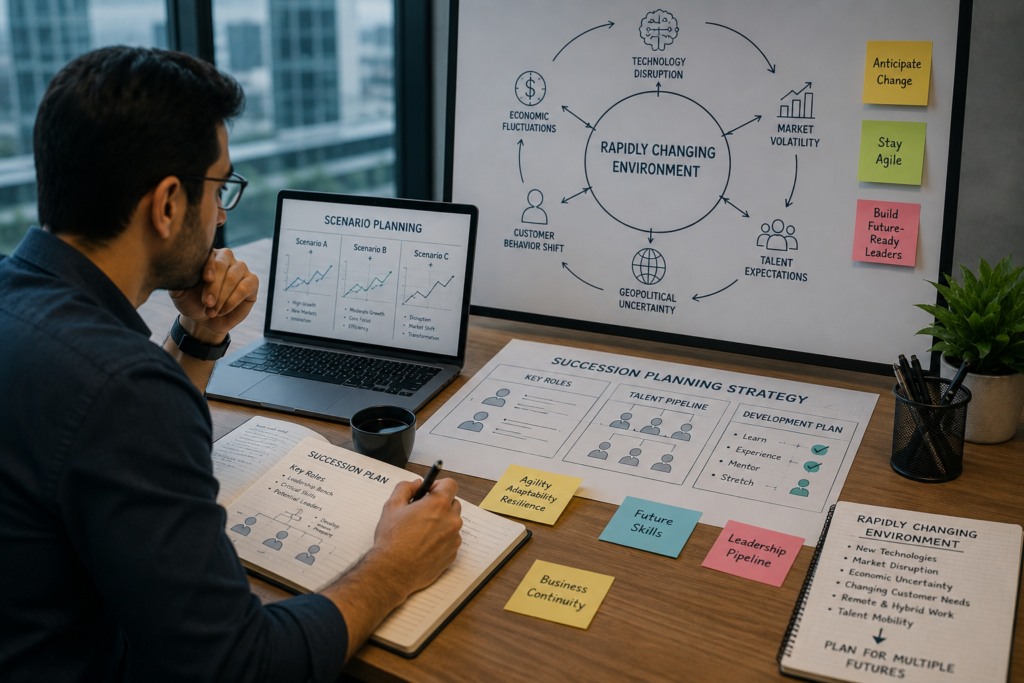

Why Future-Ready Organizations Can No Longer Afford to Leave Leadership Continuity to Chance?
The business landscape has never been more unpredictable. Digital transformation, artificial intelligence, shifting workforce expectations, economic volatility, geopolitical uncertainty, and changing customer demands are reshaping industries at an unprecedented pace. Organizations are expected to evolve continuously while maintaining business continuity and competitive advantage.
In this environment, one question has become increasingly important for business leaders:
Is your organization prepared if a critical leader leaves tomorrow?
Succession planning is no longer just an HR process focused on replacing retiring executives. It has evolved into a strategic business imperative that ensures organizations have the leadership capability, critical skills, and talent pipeline needed to thrive amid constant change.
Companies that treat succession planning as an ongoing business strategy—not a once-a-year exercise—are significantly better positioned to navigate disruption, sustain growth, and build organizational resilience.
The New Reality of Leadership Continuity
Traditional succession planning assumed stable organizational structures and predictable career paths. Leaders spent decades in one company, promotions followed established hierarchies, and successors could be identified years in advance.
Today’s workplace tells a different story.
Organizations face:
- Higher executive turnover
- Increased competition for leadership talent
- Rapid emergence of new business models
- Evolving leadership competencies
- Hybrid and global workforces
- AI-driven transformation requiring new capabilities
A successor identified five years ago may no longer possess the skills needed for tomorrow’s challenges.
As business priorities evolve faster than ever, succession planning must become dynamic, data-driven, and aligned with future organizational needs rather than historical structures.
Why Succession Planning Matters More Than Ever
1. Reduces Business Risk
Unexpected departures of senior leaders can disrupt operations, delay strategic initiatives, and create uncertainty among employees, customers, and investors.
A strong succession plan minimizes these risks by ensuring qualified leaders are ready to step into critical roles with minimal disruption.
2. Builds Organizational Resilience
Organizations that consistently develop internal talent recover more quickly from leadership transitions.
Instead of scrambling to fill vacancies externally, they have capable individuals prepared to lead immediately.
Resilience is no longer just about technology or financial strength—it is equally about leadership readiness.
3. Preserves Institutional Knowledge
Experienced leaders possess valuable organizational knowledge that extends beyond technical expertise. They understand company culture, stakeholder relationships, customer expectations, and strategic history.
Succession planning enables structured knowledge transfer before key leaders exit.
Without deliberate planning, organizations risk losing years of expertise overnight.
4. Strengthens Employee Engagement
Employees are more likely to remain with organizations where they see clear career growth opportunities.
When high-potential talent understands that leadership development is taken seriously, engagement and retention improve significantly.
Succession planning demonstrates that the organization invests in long-term employee success.
5. Supports Strategic Growth
Business expansion often requires leaders with new capabilities rather than simply more experience.
Whether entering new markets, launching digital initiatives, or integrating acquisitions, organizations need leaders prepared for future business challenges—not just today’s responsibilities.
Moving Beyond Replacement Planning
Many organizations still confuse succession planning with replacement planning.
Replacement planning asks:
“Who takes over if someone leaves?”
Succession planning asks:
“How do we continuously build leadership capability for the future?”
The distinction is critical.
Effective succession planning focuses on:
- Developing leadership pipelines
- Building future-ready capabilities
- Identifying high-potential talent early
- Creating multiple successors for key roles
- Preparing leaders for emerging business needs
Rather than identifying a single replacement, organizations should cultivate a diverse bench of capable leaders.
Characteristics of Modern Succession Planning
Focus on Skills Rather Than Job Titles
As roles evolve rapidly, leadership readiness should be assessed through skills and competencies rather than tenure or position.
Future leaders need capabilities such as:
- Strategic thinking
- Digital literacy
- AI fluency
- Change management
- Cross-functional collaboration
- Emotional intelligence
- Innovation leadership
- Inclusive leadership
These competencies will remain valuable even as organizational structures change.
Use Workforce Analytics
Technology has transformed succession planning from intuition-based decision-making into evidence-based talent management.
Organizations increasingly use data to identify:
- Leadership potential
- Readiness levels
- Performance trends
- Learning agility
- Career aspirations
- Retention risks
- Internal mobility patterns
People analytics helps HR leaders make more objective succession decisions while reducing bias.
Develop Leaders Continuously
Leadership readiness cannot be achieved through occasional training programs.
High-potential employees require ongoing development through:
- Stretch assignments
- Cross-functional projects
- International exposure
- Executive mentoring
- Coaching
- Leadership simulations
- Job rotations
Real leadership capability develops through practical experience rather than classroom instruction alone.
Build Diverse Leadership Pipelines
Organizations with diverse leadership teams consistently outperform peers across innovation, decision-making, and financial performance.
Succession planning should intentionally expand leadership opportunities across gender, ethnicity, age, geography, and professional backgrounds.
A broader talent pool strengthens organizational adaptability and reflects increasingly diverse markets and workforces.
The Role of Technology in Succession Planning
Artificial intelligence and talent intelligence platforms are changing how organizations identify and develop future leaders.
Modern HR technology can:
- Map organizational skills
- Identify leadership potential
- Predict flight risk
- Recommend personalized learning
- Track readiness for critical roles
- Highlight succession gaps
- Support scenario planning
Rather than replacing human judgment, AI enhances decision-making by providing deeper workforce insights.
The result is a more proactive and agile succession strategy.
Common Challenges Organizations Face
Despite recognizing its importance, many companies struggle with succession planning.
Common obstacles include:
- Overreliance on external hiring
- Lack of executive ownership
- Inconsistent talent reviews
- Limited visibility into employee skills
- Leadership bias in identifying successors
- Insufficient development opportunities
- Poor documentation of succession plans
Addressing these challenges requires succession planning to become a shared responsibility between HR and business leaders.
Best Practices for Future-Ready Succession Planning
Organizations looking to strengthen leadership continuity should focus on several priorities:
- Align succession planning with business strategy.
- Identify critical roles, not just senior positions.
- Evaluate future leadership capabilities rather than current performance alone.
- Invest consistently in leadership development.
- Review succession plans regularly as business needs evolve.
- Encourage internal mobility across functions.
- Use workforce data to support talent decisions.
- Measure succession readiness using clear metrics.
- Foster inclusive leadership pipelines.
- Make succession planning an ongoing business conversation rather than an annual HR exercise.
The CHRO’s Expanding Role
Today’s CHRO is no longer simply managing talent processes.
They are shaping the organization’s future leadership capability.
Modern CHROs are expected to:
- Advise CEOs and boards on leadership risks
- Build future-ready talent strategies
- Drive leadership development initiatives
- Leverage people analytics for succession decisions
- Promote inclusive talent pipelines
- Prepare organizations for workforce transformation
Succession planning has become one of the most strategic responsibilities within the HR function.