
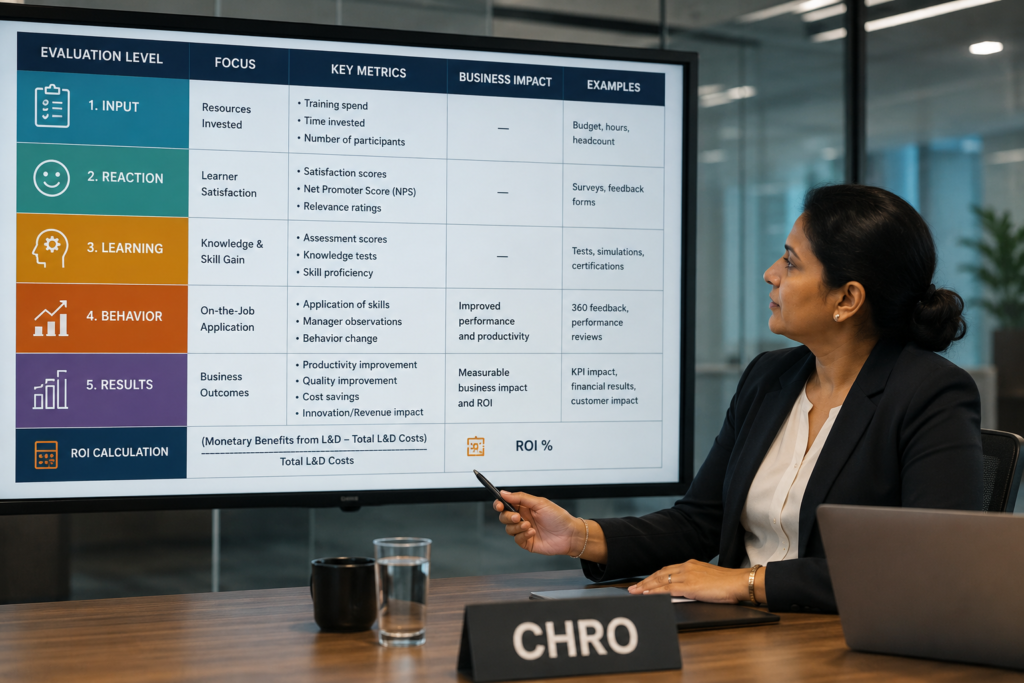

For years, Learning and Development (L&D) success was measured by familiar numbers—training hours completed, participation rates, course completion percentages, and learner satisfaction scores. While these metrics provide useful operational insights, they reveal very little about what truly matters to business leaders: Did learning improve performance? Did it contribute to business growth? Was the investment worth it?
As organizations continue to invest significantly in upskilling, reskilling, and leadership development, the conversation around L&D is evolving. CEOs, CFOs, and CHROs increasingly expect learning initiatives to demonstrate measurable business value rather than simply report activity.
Today, measuring the Return on Investment (ROI) of Learning and Development is no longer optional—it is essential for aligning talent development with organizational strategy.
Why Measuring ROI Matters
Learning is one of the largest investments within HR budgets. Organizations dedicate considerable resources to learning platforms, instructors, content creation, certifications, coaching, and employee time. Without a structured way to evaluate outcomes, these investments risk becoming cost centers instead of strategic growth drivers.
Measuring ROI enables organizations to:
- Align learning programs with business objectives
- Identify high-impact initiatives and eliminate ineffective ones
- Optimize future L&D investments
- Strengthen executive confidence in learning strategies
- Demonstrate HR’s contribution to business performance
More importantly, ROI shifts L&D conversations from “How many people completed the training?” to “How has the business improved because of the training?”
Moving Beyond Traditional Learning Metrics
Completion rates and learner feedback are valuable indicators of engagement, but they should never be mistaken for business impact.
Modern organizations should evaluate learning across multiple dimensions:
1. Learning Adoption
Measure participation, course completion, knowledge retention, and learner engagement.
Questions to ask:
- Did employees complete the program?
- Was the content relevant?
- Did knowledge improve?
2. Behavioral Change
The real test begins after training ends.
Organizations should assess whether employees are applying newly acquired skills in their day-to-day work.
Examples include:
- Managers conducting better performance conversations
- Sales teams adopting new selling techniques
- Engineers implementing new technologies
- Leaders demonstrating stronger coaching behaviors
Behavioral change often indicates whether learning has successfully transferred into workplace practice.
3. Business Performance
The strongest ROI comes from measurable improvements in business outcomes.
Depending on the program, organizations can track metrics such as:
- Sales growth
- Customer satisfaction scores
- Productivity improvements
- Reduction in operational errors
- Faster project delivery
- Improved quality metrics
- Reduced compliance violations
- Increased innovation output
Learning should always connect to business performance indicators.
Building an Effective ROI Framework
Leading organizations are adopting structured approaches that evaluate learning before, during, and after implementation.
Step 1: Define Business Objectives
Every learning initiative should begin with a clear business problem.
Instead of saying:
“We want leadership training.”
Ask:
“We want to reduce manager attrition by improving leadership effectiveness.”
Instead of:
“We need AI training.”
Ask:
“We want teams to automate manual processes and improve productivity.”
Clear objectives make ROI measurable.
Step 2: Establish Baseline Metrics
Organizations must understand where they currently stand before launching training.
Baseline data may include:
- Current productivity
- Employee engagement
- Sales performance
- Customer complaints
- Time-to-productivity
- Employee turnover
- Internal promotion rates
Without baseline data, measuring improvement becomes difficult.
Step 3: Track Leading and Lagging Indicators
Leading indicators show whether learning is progressing successfully.
Examples:
- Participation rates
- Skill assessments
- Knowledge retention
- Certification completion
Lagging indicators demonstrate business impact.
Examples:
- Revenue growth
- Cost reduction
- Customer retention
- Employee performance ratings
- Internal mobility
Both perspectives are necessary for a comprehensive evaluation.
Step 4: Quantify Financial Impact
Where possible, convert improvements into financial value.
For example:
- Reduced onboarding time saves productivity costs.
- Lower employee turnover reduces recruitment expenses.
- Better customer service improves retention and lifetime value.
- Increased sales capability generates higher revenue.
Even conservative financial estimates can help executives understand the economic value of learning investments.
Leveraging Data and Technology
Today’s learning ecosystem provides richer insights than ever before.
Organizations can integrate data from:
- Learning Management Systems (LMS)
- HR Information Systems (HRIS)
- Performance management platforms
- Employee engagement surveys
- Sales and CRM systems
- Workforce analytics tools
AI-powered analytics can further identify learning patterns, predict skill gaps, and recommend personalized learning journeys while correlating development activities with business outcomes.
Rather than relying on isolated metrics, organizations should build connected dashboards that link learning with talent and business performance.
Common Challenges in Measuring ROI
Despite growing emphasis on measurement, many organizations struggle to establish direct links between learning and business results.
Some common challenges include:
- Multiple factors influencing business outcomes
- Delayed impact of learning initiatives
- Difficulty measuring behavioral change
- Inconsistent data across systems
- Lack of executive alignment on success metrics
The solution is not to seek perfect attribution but to establish credible evidence showing learning’s contribution to organizational performance.
The Expanding Role of CHROs
CHROs are increasingly expected to position learning as a strategic investment rather than an HR activity.
This requires collaborating closely with business leaders to:
- Prioritize high-impact capability areas
- Define measurable success metrics
- Build robust analytics capabilities
- Regularly communicate learning outcomes to executives
When learning is directly connected to business priorities, it earns greater executive sponsorship and sustained investment.