
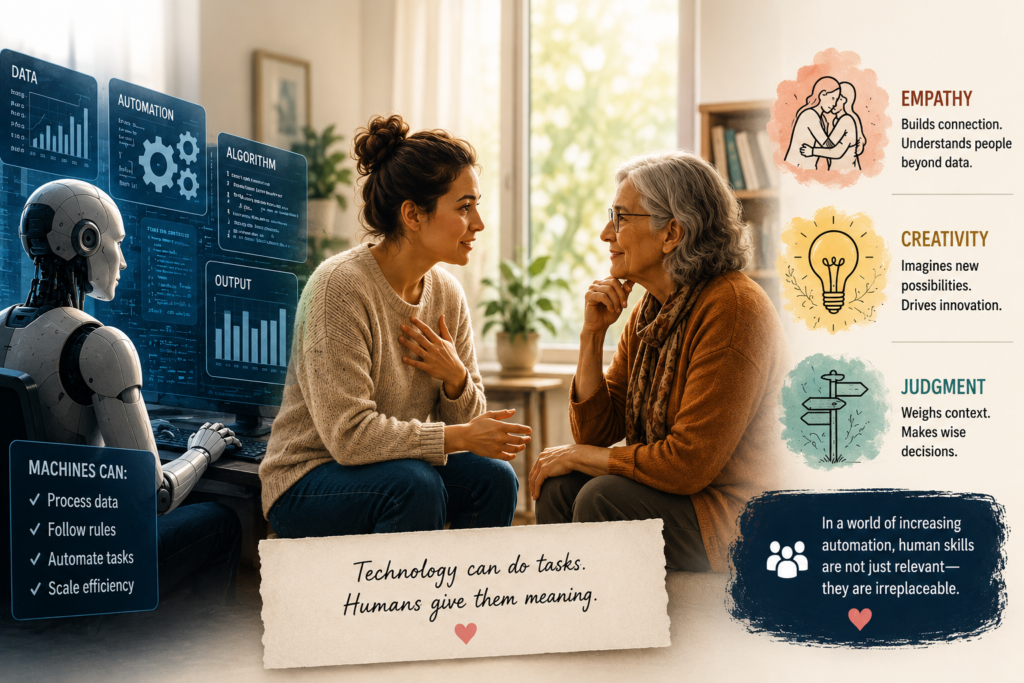

For years, the future of work conversation revolved around technology replacing human effort. Automation, artificial intelligence, and advanced analytics promised faster decisions, greater efficiency, and the ability to perform complex tasks at an unprecedented scale. While these technologies are undeniably transforming workplaces, they are also revealing an unexpected truth: the skills that make us most human are becoming our greatest professional advantage.
In an age where machines can process information, generate content, analyze data, and automate routine tasks, qualities such as empathy, creativity, critical thinking, and ethical judgment are no longer considered “soft skills.” They are emerging as essential power skills that determine how effectively organizations innovate, collaborate, and build lasting relationships.
The New Competitive Advantage Is Human
Technology can identify patterns, predict outcomes, and provide recommendations, but it lacks the ability to understand human emotions, navigate complex social dynamics, and apply context-driven wisdom. The most successful organizations of the future will not be those that simply adopt the most advanced technology, but those that combine technological capabilities with deeply human strengths.
For leaders, this means moving beyond hiring employees solely for technical expertise. The future workforce will need individuals who can ask better questions, challenge assumptions, interpret ambiguity, and make decisions that balance data with empathy and experience.
Empathy: The Foundation of Better Leadership
As workplaces become increasingly digital and distributed, meaningful human connections are becoming more valuable. Employees do not just seek efficient managers; they seek leaders who listen, understand their challenges, and create environments where they feel valued.
Empathetic leadership strengthens trust, improves collaboration, enhances employee well-being, and helps organizations navigate periods of uncertainty and change. In a world where AI can manage workflows, the ability to understand people may become one of leadership’s most important differentiators.
Creativity: The Skill That Drives Innovation
AI can generate thousands of possibilities, but creativity is about more than producing ideas—it is about connecting experiences, understanding human needs, and imagining solutions that have never existed before.
Organizations that encourage curiosity, experimentation, and diverse perspectives will be better equipped to solve emerging challenges. Creativity will not become less important because of AI; rather, AI will amplify the value of human imagination by freeing people from repetitive tasks and allowing them to focus on innovation.
Judgment: The Ability to Make the Right Decision
In a data-rich world, decision-making is becoming more complex, not less. Leaders are constantly faced with ethical dilemmas, competing priorities, and situations where there is no clear answer.
Good judgment requires context, values, emotional intelligence, and the ability to understand long-term consequences. While AI can support decisions with insights and recommendations, humans remain responsible for determining what is fair, appropriate, and aligned with organizational goals and societal expectations.
How HR Can Build Human-Centric Organizations
For CHROs and HR leaders, the rise of AI presents a unique opportunity to redefine talent strategies. The focus should shift from only developing technical capabilities to intentionally cultivating human skills.
Organizations can prepare their workforce by:
- Embedding empathy, communication, and collaboration into leadership development programs.
- Rewarding curiosity, experimentation, and creative problem-solving.
- Designing performance systems that value how outcomes are achieved, not just what is achieved.
- Encouraging employees to work alongside AI tools while strengthening uniquely human capabilities.
- Creating psychologically safe environments where diverse ideas and perspectives can thrive.
The Future Belongs to Human and Machine Collaboration
The workplace of the future will not be a contest between humans and machines—it will be a partnership. AI will enhance speed, efficiency, and intelligence, while humans will bring empathy, creativity, ethics, and judgment.
As technology continues to advance, the paradox is becoming clearer: the more automated the world becomes, the more valuable human qualities become. Organizations that invest in developing these capabilities today will be the ones that create stronger cultures, better leaders, and sustainable success in the future.
The future of work is not less human—it is more human than ever before.