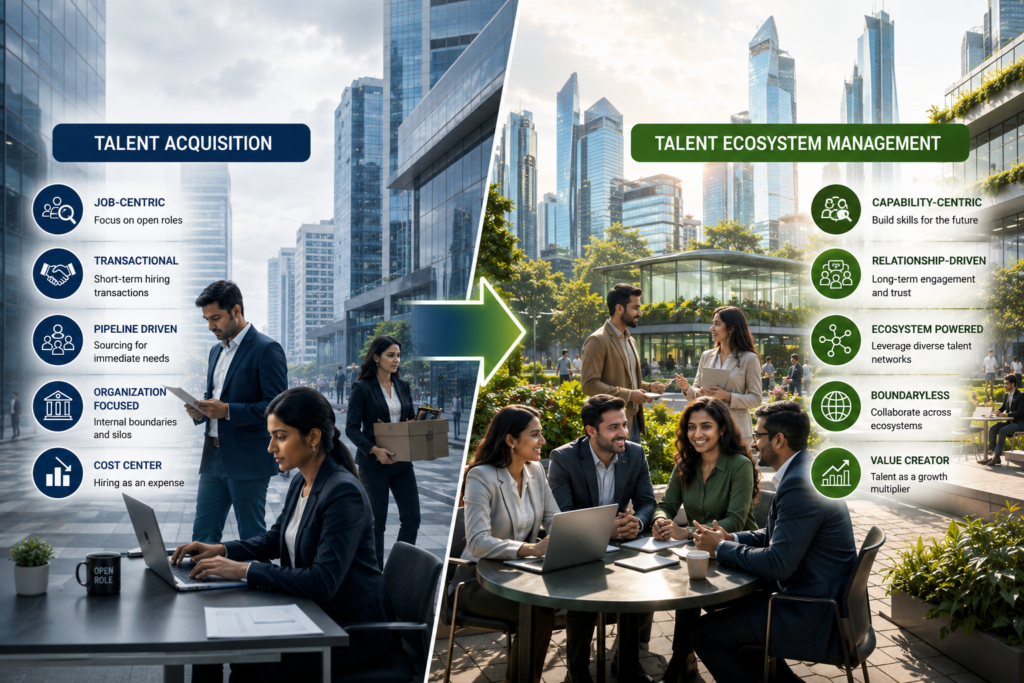

For decades, talent acquisition was largely viewed as a transactional function focused on sourcing, evaluating, and hiring candidates to fill open positions. Success was measured by metrics such as time-to-hire, cost-per-hire, and vacancy closure rates. While these measures remain important, the realities of today’s business environment have expanded the role of talent leaders far beyond recruitment.
Organizations are increasingly recognizing that sustainable growth depends not only on attracting talent but also on building, nurturing, and leveraging an interconnected talent ecosystem. As a result, the conversation is shifting from talent acquisition to talent ecosystem management—a broader, more strategic approach to workforce planning and capability development.
Why the Traditional Talent Acquisition Model Is No Longer Enough
Rapid technological advancements, evolving employee expectations, skills shortages, and changing workforce demographics have fundamentally altered how organizations access talent. Businesses can no longer rely solely on external hiring to meet workforce demands.
Critical skills are becoming obsolete faster than ever, while new competencies emerge continuously. In this environment, organizations need the ability to identify, develop, mobilize, and retain talent across multiple channels rather than depending exclusively on recruitment pipelines.
The challenge is no longer simply finding talent; it is creating a sustainable system that ensures the right skills are available when and where they are needed.
Understanding Talent Ecosystem Management
Talent ecosystem management refers to the strategic coordination of all talent sources that contribute to organizational success. This includes:
- Full-time employees
- Internal talent marketplaces
- Gig and freelance workers
- Contract professionals
- Alumni networks
- Academic institutions
- Strategic workforce partners
- Learning and development platforms
- Talent communities
Instead of treating these groups as separate entities, organizations are integrating them into a unified workforce strategy that supports agility and long-term business objectives.
The Rise of Skills-Based Workforce Planning
One of the defining characteristics of talent ecosystem management is the shift toward skills-based thinking.
Organizations are increasingly focusing on capabilities rather than job titles. By mapping workforce skills and identifying future requirements, companies can make better decisions about hiring, reskilling, upskilling, and workforce deployment.
This approach allows businesses to:
- Reduce dependence on external hiring
- Improve internal mobility
- Close skill gaps more effectively
- Increase workforce agility
- Enhance employee engagement and retention
The emphasis moves from “Who should we hire?” to “How can we access or develop the skills we need?”
Internal Mobility Becomes a Strategic Priority
Talent ecosystem management places significant emphasis on unlocking the potential of existing employees.
Forward-looking organizations are investing in internal talent marketplaces that connect employees with projects, stretch assignments, mentorship opportunities, and new career pathways. These platforms help businesses deploy talent dynamically while providing employees with greater visibility into growth opportunities.
Internal mobility not only reduces recruitment costs but also strengthens retention by demonstrating a commitment to career development.
Expanding Beyond Organizational Boundaries
Today’s talent ecosystem extends beyond the walls of the enterprise.
Companies are building stronger relationships with universities, professional communities, industry associations, and workforce partners to create continuous access to emerging talent. Alumni networks are being leveraged as valuable sources of future hires, brand advocates, and business partners.
At the same time, contingent workers and freelancers are becoming integral components of workforce strategies, allowing organizations to access specialized expertise quickly and efficiently.
The result is a more flexible and resilient talent model that can adapt to changing business needs.
The Role of Technology and AI
Technology serves as the foundation of modern talent ecosystem management.
Artificial intelligence, workforce analytics, skills intelligence platforms, and talent marketplaces provide organizations with deeper visibility into workforce capabilities and future talent needs. These tools enable leaders to make data-driven decisions regarding recruitment, development, succession planning, and workforce allocation.
Rather than managing talent through isolated systems, organizations are creating integrated talent architectures that connect hiring, learning, performance, and workforce planning.
What This Means for HR and Business Leaders
The evolution toward talent ecosystem management requires HR leaders to expand their focus from recruitment operations to workforce strategy.
Success will increasingly depend on the ability to:
- Build future-ready skill ecosystems
- Strengthen internal mobility frameworks
- Foster continuous learning cultures
- Develop strategic workforce partnerships
- Leverage workforce intelligence and analytics
- Create seamless experiences across all talent segments
Talent leaders must become ecosystem architects, ensuring that organizations can continuously access, develop, and deploy the capabilities required for future growth.