
In today’s business environment, competitive advantage is becoming increasingly temporary. New technologies emerge rapidly, customer expectations evolve continuously, and market disruptions can transform entire industries overnight. In such a landscape, the organizations that thrive are not necessarily the largest, the oldest, or even the most innovative—they are the ones that learn faster than everyone else.
The ability to learn, adapt, and apply new knowledge at speed has become a defining characteristic of successful companies. As management thinker Peter Senge once observed, “The only sustainable competitive advantage is an organization’s ability to learn faster than the competition.” That statement has never been more relevant.
Why Organizational Learning Matters More Than Ever
Historically, companies built competitive advantages through capital, infrastructure, patents, or market dominance. While these factors still matter, they are no longer sufficient to guarantee long-term success.
Digital transformation, artificial intelligence, automation, and global competition have shortened business cycles dramatically. What worked yesterday may become obsolete tomorrow. Organizations can no longer rely solely on past expertise; they must continuously develop new capabilities.
Companies that learn quickly can:
- Respond faster to market shifts.
- Adapt to customer needs more effectively.
- Innovate consistently.
- Reduce costly mistakes.
- Build stronger leadership pipelines.
- Stay ahead of emerging industry trends.
Learning is no longer an HR initiative—it is a strategic business capability.
The Difference Between Training and Learning
Many organizations invest heavily in training programs, yet struggle to become true learning organizations.
Training often focuses on delivering information. Learning focuses on changing behavior and improving decision-making.
A learning organization creates systems that encourage employees to:
- Experiment and test ideas.
- Share knowledge openly.
- Learn from failures.
- Challenge assumptions.
- Continuously improve processes.
The goal is not simply to provide courses but to create an environment where learning becomes part of everyday work.
Creating a Culture of Curiosity
The foundation of a fast-learning company is curiosity.
Organizations that outperform competitors encourage employees to ask questions, explore new approaches, and challenge conventional thinking.
Leaders play a critical role in shaping this culture. When executives openly seek feedback, admit mistakes, and demonstrate a willingness to learn, employees feel empowered to do the same.
Questions such as:
- What are we missing?
- What can we learn from competitors?
- How can we improve this process?
- What assumptions should we challenge?
become catalysts for innovation and growth.
Curiosity transforms organizations from reactive businesses into proactive learners.
Turning Data Into Organizational Intelligence
Modern companies generate enormous amounts of data. However, data alone does not create value.
The organizations that learn faster are those that convert information into actionable insights.
This requires:
- Real-time performance monitoring.
- Cross-functional data sharing.
- Predictive analytics.
- Customer feedback integration.
- Continuous measurement and improvement.
The objective is to create feedback loops that help teams make smarter decisions faster.
When insights move quickly across the organization, learning accelerates and competitive advantage grows.
Encouraging Experimentation Without Fear
Many companies claim to value innovation but unintentionally punish failure.
Employees become risk-averse when mistakes lead to blame rather than learning.
Fast-learning organizations view experimentation differently. They recognize that small failures often lead to significant breakthroughs.
Leading companies encourage teams to:
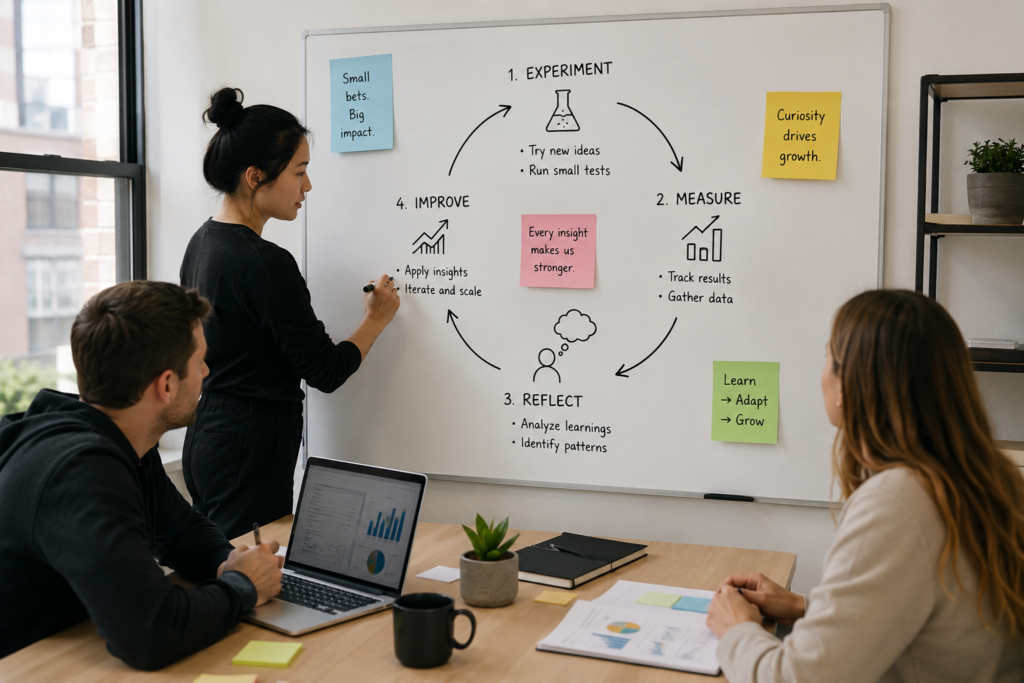
- Test new ideas quickly.
- Launch pilot programs.
- Measure outcomes objectively.
- Document lessons learned.
- Share findings across teams.
The focus shifts from avoiding mistakes to accelerating learning.
Organizations that experiment more often typically discover opportunities before their competitors.
Building Knowledge-Sharing Networks
One of the greatest barriers to organizational learning is knowledge trapped within departments or individuals.
When information remains siloed, companies repeatedly solve the same problems and miss opportunities to leverage collective expertise.
Successful organizations create mechanisms that facilitate knowledge sharing:
- Internal communities of practice.
- Cross-functional projects.
- Mentorship programs.
- Collaborative digital platforms.
- Leadership roundtables.
Knowledge becomes a shared asset rather than an individual possession.
The faster information flows across the organization, the faster the organization learns.
Developing Leaders as Learning Champions
Leadership behavior significantly influences organizational learning.
Employees pay close attention to what leaders prioritize. If leaders focus exclusively on short-term results, learning initiatives often lose momentum.
Learning-focused leaders:
- Encourage continuous development.
- Ask thoughtful questions.
- Promote diverse perspectives.
- Support experimentation.
- Invest in capability building.
They understand that developing people today creates stronger business outcomes tomorrow.
Organizations that consistently outperform competitors often have leaders who view learning as a strategic responsibility, not just an HR function.
Leveraging Technology to Accelerate Learning
Technology is transforming how organizations acquire and distribute knowledge.
Artificial intelligence, digital learning platforms, knowledge management systems, and collaboration tools enable learning at unprecedented speed.
Modern learning ecosystems can:
- Deliver personalized learning experiences.
- Recommend skill development opportunities.
- Capture institutional knowledge.
- Enable real-time collaboration.
- Support continuous upskilling.
However, technology should support a learning culture—not replace it.
The most effective organizations combine advanced technology with strong human-centered learning practices.
Measuring Learning Agility
What gets measured gets improved.
Organizations seeking to build learning advantages should track indicators such as:
- Skill development rates.
- Internal mobility metrics.
- Innovation outcomes.
- Employee adaptability scores.
- Knowledge-sharing participation.
- Learning application in business results.
Measuring learning effectiveness helps leaders understand whether investments are translating into organizational capability.
The goal is not simply learning activity but learning impact.
The Future Belongs to Fast Learners
As industries continue to evolve, the gap between fast-learning and slow-learning organizations will widen.
Companies that can rapidly absorb new information, develop new skills, and adapt to changing conditions will consistently outperform competitors.
The future will not be dominated by organizations that know the most today. It will belong to organizations that can learn the fastest tomorrow.
Building a company that learns faster than competitors requires commitment, leadership, cultural transformation, and continuous investment. Yet the rewards are substantial: greater resilience, stronger innovation, improved agility, and sustainable growth.
In a world defined by constant change, learning is no longer just a capability—it is the ultimate competitive advantage.