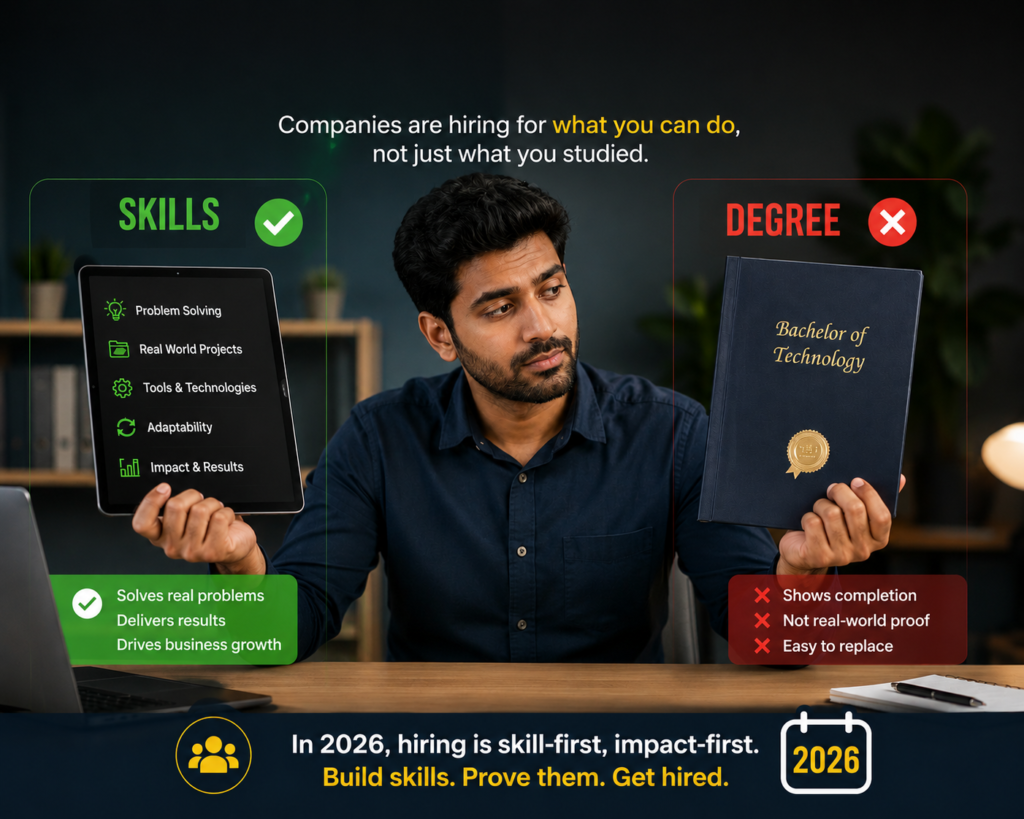

For decades, a college degree was considered the primary gateway to career opportunities. Employers relied heavily on academic qualifications as a benchmark for talent, capability, and potential. However, the hiring landscape in 2026 looks remarkably different. Organizations across industries are increasingly prioritizing skills, competencies, and practical experience over traditional degrees.
The shift is being driven by rapid technological advancements, changing business needs, and the growing demand for specialized expertise. In today’s competitive environment, what a candidate can do often matters more than where they studied.
The Rise of Skills-Based Hiring
Companies are realizing that degrees do not always guarantee job readiness. While formal education provides foundational knowledge, it may not fully equip candidates with the practical skills needed to excel in dynamic workplaces.
Skills-based hiring focuses on evaluating candidates based on their abilities, achievements, certifications, portfolios, and hands-on experience rather than solely on academic credentials. This approach enables organizations to identify talent that can deliver immediate value.
Why Employers Are Prioritizing Skills
1. Faster Technological Change
The pace of innovation has accelerated significantly. Fields such as artificial intelligence, cybersecurity, data analytics, cloud computing, and digital marketing evolve much faster than traditional academic curricula.
Employers need professionals who continuously update their skills and stay ahead of industry trends, regardless of their educational background.
2. Expanding Talent Pools
By focusing on skills instead of degrees, companies gain access to a wider and more diverse talent pool. Self-taught professionals, bootcamp graduates, freelancers, and career switchers can compete on equal footing with traditional degree holders.
This approach helps organizations fill critical talent gaps more effectively.
3. Better Prediction of Job Performance
Research and employer experiences increasingly show that demonstrated skills are often stronger indicators of workplace success than academic qualifications alone.
Practical assessments, project portfolios, certifications, and work samples provide tangible evidence of a candidate’s ability to perform specific tasks.
4. Reduced Hiring Bias
Skills-based hiring promotes fairness by emphasizing capability over pedigree. It minimizes the influence of factors such as university rankings or educational prestige, allowing organizations to focus on merit and potential.
5. Cost-Effective Recruitment
Hiring candidates who already possess job-ready skills can reduce onboarding time, training costs, and productivity gaps. Organizations can quickly integrate skilled professionals into critical projects and business functions.
The Growing Importance of Continuous Learning
In 2026, careers are no longer defined by a single degree earned years ago. Instead, professionals are expected to continuously learn, adapt, and reskill throughout their careers.
Micro-credentials, online certifications, industry-recognized courses, and hands-on projects have become valuable indicators of professional growth and expertise. Employers increasingly view lifelong learning as a competitive advantage.
What This Means for Job Seekers
Professionals seeking career growth should focus on building and showcasing relevant skills. Some effective ways include:
- Earning industry-recognized certifications
- Building a strong portfolio of projects
- Participating in internships and freelance assignments
- Developing expertise in emerging technologies
- Demonstrating problem-solving and leadership abilities
- Maintaining an active professional presence on platforms like LinkedIn
Candidates who can clearly demonstrate their impact and capabilities are more likely to stand out than those who rely solely on academic credentials.
The Future of Recruitment
The move toward skills-first hiring does not mean degrees have become irrelevant. Higher education still provides valuable knowledge, critical thinking abilities, and networking opportunities. However, degrees are increasingly becoming one factor among many rather than the primary hiring criterion.
Forward-thinking organizations are redesigning recruitment processes to assess real-world competencies, adaptability, and potential. As business challenges become more complex, employers need talent that can learn quickly, solve problems, and deliver results.
Conclusion
The hiring landscape in 2026 reflects a fundamental shift in how organizations define talent. Skills, adaptability, and practical experience are emerging as the most valuable currencies in the job market. Companies that embrace skills-based hiring gain access to broader talent pools, improve hiring outcomes, and build more agile workforces. For professionals, the message is clear: continuous learning and skill development are no longer optional—they are essential for long-term career succ