
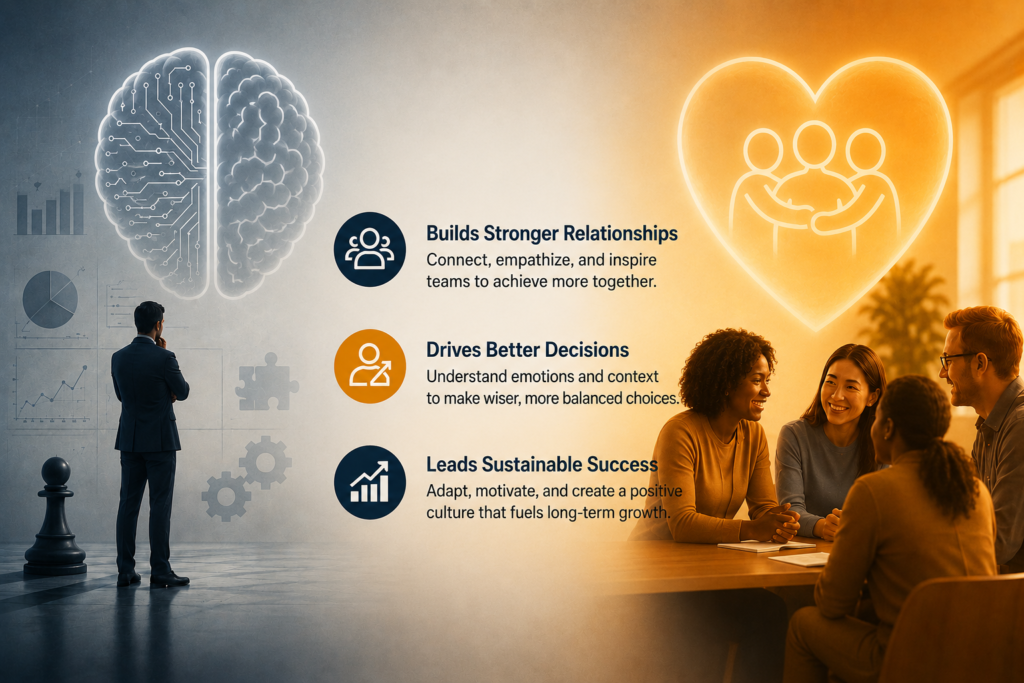

In today’s rapidly evolving business landscape, leadership is no longer defined solely by intelligence, technical expertise, or academic achievement. While a high IQ can help leaders solve complex problems and make analytical decisions, it is Emotional Intelligence (EQ) that increasingly determines how effectively they inspire teams, build trust, and lead organizations through change.
Modern workplaces are more diverse, dynamic, and people-driven than ever before. Leaders are not just expected to manage operations; they are expected to understand people, foster collaboration, and create environments where individuals can thrive. This is where emotional intelligence becomes a critical leadership skill.
Emotional intelligence refers to the ability to recognize, understand, and manage one’s own emotions while also understanding and influencing the emotions of others. Leaders with strong emotional intelligence possess self-awareness, empathy, adaptability, and strong interpersonal skills. These qualities enable them to connect with employees on a deeper level and build stronger relationships.
One of the biggest advantages of emotionally intelligent leaders is their ability to create trust. Employees are more likely to engage with leaders who listen, understand concerns, and communicate with authenticity. In challenging situations, emotionally intelligent leaders remain calm and composed, helping teams navigate uncertainty without losing confidence or motivation.
Additionally, organizations today face constant transformation—whether driven by technology, market shifts, or changing workforce expectations. Leaders with high EQ can manage change more effectively because they understand the human side of transitions. They recognize resistance, address concerns empathetically, and motivate teams toward a shared vision.
Research and workplace experiences increasingly suggest that people often leave managers, not companies. Employees value recognition, understanding, and meaningful communication. A leader with exceptional IQ may develop strategies, but a leader with strong emotional intelligence can inspire people to execute those strategies successfully.
The future of leadership belongs to those who can balance intelligence with empathy. Success is no longer measured only by what leaders know, but by how they make people feel, communicate vision, and create lasting impact.
As organizations continue to evolve, emotional intelligence is no longer a “soft skill.” It has become a leadership necessity and one of the strongest differentiators of truly successful modern leaders.