
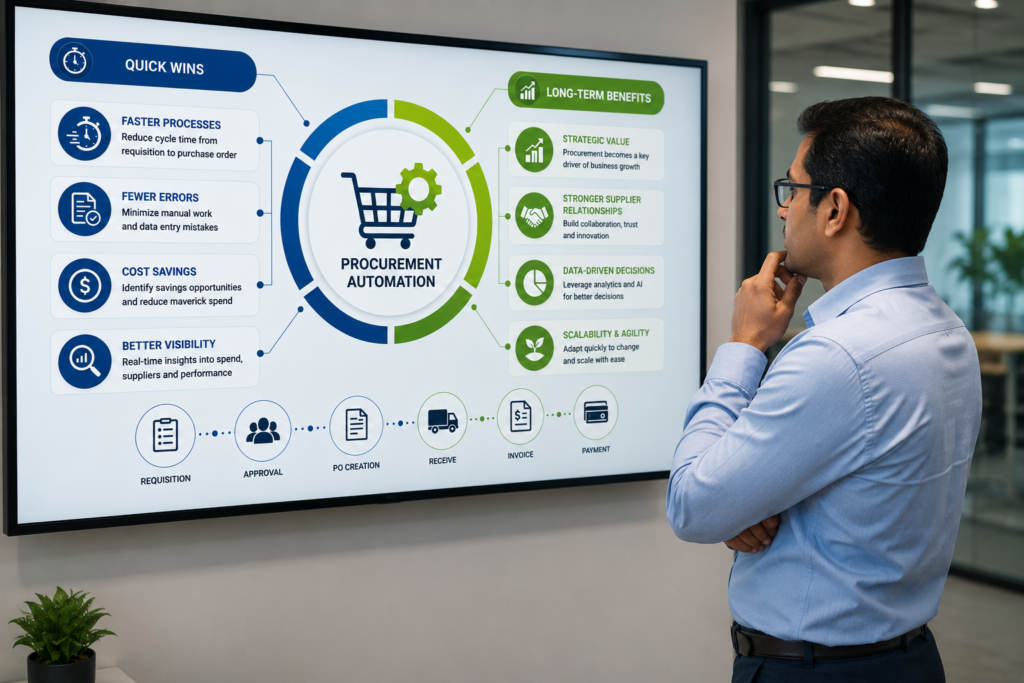

In today’s fast-paced business environment, procurement is no longer just about purchasing goods and services at the lowest price. It has evolved into a strategic function that drives cost optimization, supplier collaboration, compliance, and business resilience. However, many organizations still rely on manual procurement processes, spreadsheets, emails, and paper-based approvals that slow operations and increase risks.
Procurement automation is changing this landscape by digitizing repetitive tasks, improving visibility, and enabling smarter decision-making. Organizations that automate procurement not only realize immediate operational improvements but also unlock long-term strategic advantages that contribute directly to business growth.
Whether you’re a Chief Procurement Officer (CPO), procurement manager, finance leader, or CEO, understanding the quick wins and long-term benefits of procurement automation is essential for staying competitive.
What is Procurement Automation?
Procurement automation refers to the use of digital technologies and software to streamline procurement activities such as:
- Purchase requisitions
- Purchase order creation
- Supplier onboarding
- Vendor management
- Contract management
- Invoice processing
- Approval workflows
- Spend analysis
- Reporting and compliance
Modern procurement platforms integrate these processes into a centralized system, reducing manual intervention while improving speed, transparency, and accuracy.
Why Organizations Are Prioritizing Procurement Automation
Businesses today face several procurement challenges:
- Rising operational costs
- Supply chain disruptions
- Increasing supplier complexity
- Compliance requirements
- Budget constraints
- Manual errors
- Delayed approvals
- Limited spend visibility
Automation addresses these challenges by enabling procurement teams to work more efficiently while focusing on strategic initiatives rather than administrative tasks.
Quick Wins from Procurement Automation
One of the biggest advantages of procurement automation is that organizations can begin seeing measurable improvements shortly after implementation.
1. Faster Purchase Approval Cycles
Traditional procurement often involves lengthy email chains, paper approvals, and manual follow-ups.
Automated approval workflows:
- Route requests instantly
- Notify approvers automatically
- Escalate pending approvals
- Reduce approval bottlenecks
Result: Purchase cycles that previously took several days can often be completed within hours.
2. Reduced Manual Errors
Manual data entry often leads to:
- Duplicate purchase orders
- Incorrect pricing
- Wrong supplier selection
- Invoice mismatches
Automation minimizes human intervention by validating information automatically.
Benefits include:
- Improved data accuracy
- Fewer procurement disputes
- Better financial reporting
3. Better Spend Visibility
Many organizations struggle to understand where procurement budgets are being spent.
Automation provides:
- Real-time dashboards
- Category-wise spending
- Department-wise analysis
- Supplier-wise expenditure
- Budget tracking
This visibility enables procurement leaders to identify unnecessary spending almost immediately.
4. Improved Supplier Communication
Automated systems simplify supplier interactions by enabling:
- Digital RFQs
- Purchase order notifications
- Invoice submissions
- Delivery updates
- Performance tracking
This reduces communication delays and strengthens supplier relationships.
5. Faster Invoice Processing
Invoice processing is one of the most time-consuming procurement activities.
Automation helps by:
- Matching invoices with purchase orders
- Verifying receipts
- Detecting discrepancies
- Routing approvals automatically
Organizations often reduce invoice processing time from weeks to just a few days.
6. Increased Procurement Productivity
Instead of spending time on repetitive administrative work, procurement professionals can focus on:
- Strategic sourcing
- Supplier negotiations
- Cost optimization
- Risk management
- Market analysis
This significantly increases the value procurement teams deliver to the business.
Long-Term Benefits of Procurement Automation
While immediate operational improvements are valuable, the true power of procurement automation lies in its long-term strategic impact.
1. Significant Cost Savings
Automation reduces procurement costs through:
- Better supplier negotiations
- Reduced maverick spending
- Contract compliance
- Lower processing costs
- Improved spend analytics
Research consistently shows that organizations with mature procurement automation achieve substantial savings over time.
2. Stronger Supplier Relationships
Automation creates a more transparent procurement environment.
Suppliers benefit from:
- Faster payments
- Clear communication
- Predictable workflows
- Timely order updates
Satisfied suppliers are more likely to offer:
- Better pricing
- Priority service
- Flexible payment terms
- Collaborative innovation
3. Improved Compliance and Governance
Compliance becomes easier when procurement follows standardized digital workflows.
Automation ensures:
- Approval policies are followed
- Preferred suppliers are used
- Contract terms are enforced
- Complete audit trails are maintained
This reduces procurement risks and simplifies internal as well as external audits.
4. Enhanced Data-Driven Decision Making
Procurement automation generates valuable procurement intelligence.
Organizations gain insights into:
- Supplier performance
- Purchase trends
- Cost fluctuations
- Contract utilization
- Procurement KPIs
Leaders can make informed decisions based on real-time data rather than assumptions.
5. Greater Scalability
As businesses grow, procurement complexity increases.
Manual processes often become bottlenecks.
Automated procurement systems can scale effortlessly by handling:
- More suppliers
- More purchase requests
- Multiple business units
- Global procurement operations
This enables sustainable business growth without proportional increases in procurement headcount.
6. Better Risk Management
Modern procurement solutions continuously monitor procurement activities.
Organizations can identify:
- Supplier risks
- Delivery delays
- Contract expirations
- Price volatility
- Compliance violations
Early visibility enables proactive risk mitigation.
7. Improved Employee Experience
Employees often become frustrated with slow procurement processes.
Automation offers:
- User-friendly procurement portals
- Self-service purchasing
- Real-time request tracking
- Faster approvals
A smoother procurement experience improves overall employee satisfaction and productivity.
8. Sustainability and ESG Support
Organizations are increasingly expected to meet Environmental, Social, and Governance (ESG) goals.
Procurement automation supports sustainability by:
- Reducing paper usage
- Tracking supplier sustainability metrics
- Monitoring ethical sourcing
- Improving carbon reporting
- Supporting responsible procurement policies
Technologies Powering Procurement Automation
Modern procurement automation combines several advanced technologies.
These include:
- Artificial Intelligence (AI)
- Machine Learning
- Robotic Process Automation (RPA)
- Optical Character Recognition (OCR)
- Cloud Computing
- Predictive Analytics
- Electronic Signatures
- Supplier Portals
- API Integrations
Together, these technologies create intelligent procurement ecosystems capable of learning, predicting, and optimizing procurement decisions.
Common Challenges During Implementation
While procurement automation delivers substantial value, successful implementation requires careful planning.
Common challenges include:
- Resistance to change
- Legacy system integration
- Data migration
- Supplier adoption
- Employee training
- Process standardization
Organizations that invest in change management and stakeholder engagement typically achieve faster adoption and stronger outcomes.