
In a world where disruption has become the norm, the greatest risk for organizations is not a lack of knowledge—it is the inability to let go of outdated ways of thinking. The skills, processes, and strategies that drove success yesterday may become obstacles tomorrow. The companies that thrive in this environment are not just those that learn quickly, but those that master the ability to unlearn and relearn at speed.
For today’s leaders, building an adaptable culture is no longer a learning and development initiative; it is a strategic necessity.
Why Unlearning Has Become as Important as Learning
Organizations have traditionally celebrated expertise, experience, and established best practices. However, in a rapidly evolving landscape shaped by AI, automation, changing customer expectations, and new business models, yesterday’s expertise can quickly become outdated.
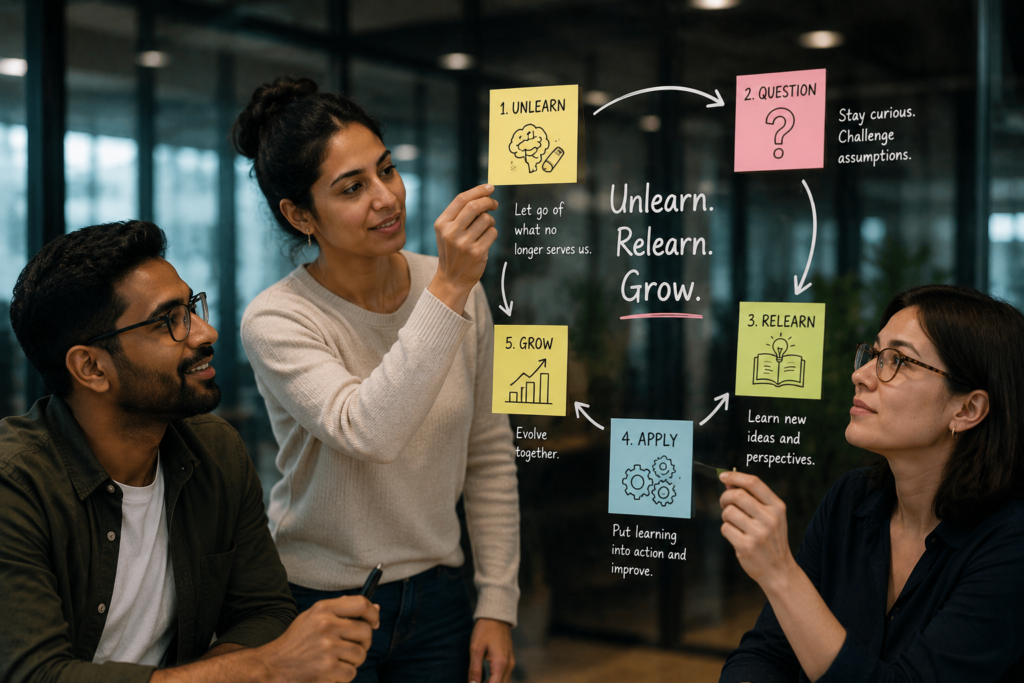
Unlearning does not mean disregarding experience. It means challenging assumptions, questioning routines, and creating space for new ideas. It requires employees and leaders alike to ask:
- Is this process still the most effective way to work?
- Are our existing skills aligned with future needs?
- What beliefs or habits are preventing innovation?
Companies that encourage such reflection create an environment where change is embraced rather than resisted.
The Role of Leadership in Creating a Relearning Mindset
A culture of continuous adaptation begins at the top. Leaders must demonstrate curiosity, humility, and a willingness to evolve. When leaders openly acknowledge that they do not have all the answers, they give employees permission to experiment and grow.
This involves:
- Rewarding learning agility, not just existing expertise.
- Celebrating intelligent failures that provide valuable insights.
- Encouraging employees to challenge traditional methods.
- Creating psychological safety where new perspectives are welcomed.
The strongest organizations are those where people are not afraid to say, “The way we have always done it may no longer be the best way.”
Moving Beyond Traditional Learning Models
The era of occasional training sessions and annual development plans is fading. Modern learning must be continuous, personalized, and embedded into everyday work.
Forward-looking organizations are adopting:
- AI-driven personalized learning journeys.
- Microlearning and on-demand skill development.
- Cross-functional projects that expose employees to new challenges.
- Internal talent mobility that allows employees to develop diverse capabilities.
The future of learning is not about accumulating more information—it is about staying adaptable.
Creating Systems That Support Rapid Adaptation
A culture of relearning cannot depend solely on individual motivation. Organizations must design systems that make adaptability part of everyday operations.
This includes:
- Regularly reviewing skills against emerging business needs.
- Updating policies and processes that no longer serve the organization.
- Encouraging knowledge sharing across teams.
- Measuring learning agility as a key capability for growth and leadership potential.
When adaptability becomes part of performance and decision-making, change becomes a habit rather than an event.
The Future Belongs to Adaptive Organizations
The most successful organizations of the next decade will not be those with the largest workforce or the longest history of expertise. They will be the ones capable of reinventing themselves repeatedly.
In the age of constant transformation, the ability to unlearn what no longer works and relearn what the future demands will become an organization’s greatest competitive advantage.
The question for leaders is no longer “How do we train our workforce?” but rather, “How quickly can our culture evolve when the world changes?