
For decades, succession planning was built on predictability. Organizations identified a few high-potential employees, prepared them to replace senior leaders, and followed a long-term roadmap for leadership transitions. However, in today’s rapidly evolving business landscape, where technology disruptions, shifting workforce expectations, and economic uncertainty are the norm, traditional succession planning is no longer enough.
The future demands a more dynamic, agile, and continuous approach to building leadership pipelines.
Why Traditional Succession Planning Is Losing Relevance
The old model of succession planning often relied on assumptions that no longer hold true. Careers are no longer linear, leadership requirements are constantly evolving, and organizations cannot accurately predict what skills they will need five or ten years from now.
Several factors are accelerating this shift:
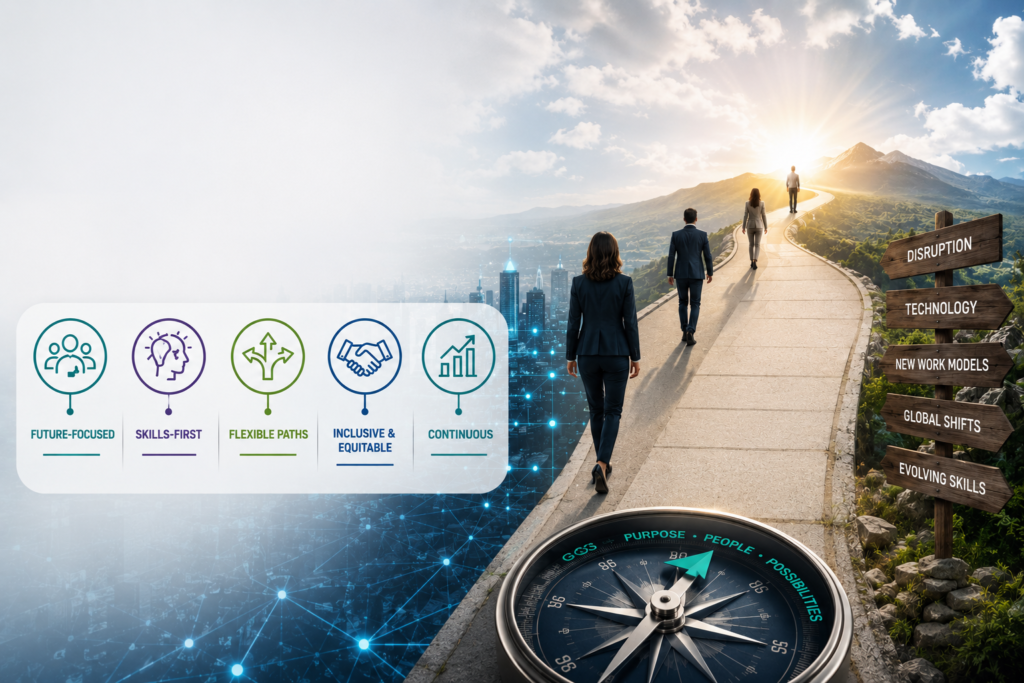
- Rapid technological advancements: Digital transformation, AI adoption, and automation are changing the capabilities leaders need.
- Changing workforce dynamics: Hybrid work, multi-generational teams, and evolving employee expectations require new leadership approaches.
- Business uncertainty: Market disruptions can create unexpected leadership gaps, demanding faster talent readiness.
Organizations must move from planning for a single successor to building a broad and adaptable leadership ecosystem.
From Replacement Planning to Leadership Readiness
Modern succession planning should not focus only on “who will take over a role.” Instead, the critical question should be: “Do we have the right capabilities ready to meet future challenges?”
Forward-thinking organizations are shifting towards:
1. Skills-Based Succession Planning
Rather than selecting successors based solely on current roles and experience, companies are assessing future-focused skills such as strategic thinking, adaptability, digital fluency, emotional intelligence, and the ability to lead through change.
2. Continuous Talent Assessment
Succession planning should become an ongoing process supported by regular talent reviews, performance insights, and potential assessments. Leaders need visibility into emerging talent across the organization—not just those already on a leadership track.
3. Expanding the Leadership Pipeline
The next generation of leaders can come from unexpected places. Organizations should create opportunities for diverse talent, cross-functional employees, and individuals with unconventional career paths to develop leadership capabilities.
4. Leveraging Data and AI for Better Decisions
Advanced analytics and AI-powered talent insights can help organizations identify skill gaps, predict leadership risks, and make more objective succession decisions.
The Role of HR in Building an Agile Succession Strategy
HR leaders must transition from managing succession plans as annual exercises to treating them as living strategies that evolve alongside business needs.
This includes:
- Aligning succession planning with business strategy and future capability requirements.
- Creating personalized development journeys for high-potential employees.
- Encouraging internal mobility and cross-functional experiences.
- Building a culture of continuous learning and leadership development.
HR’s role is no longer just to fill future vacancies—it is to ensure the organization always has a strong and adaptable leadership bench.
The Future of Succession Planning
In a world where change is constant, the best organizations will not simply identify future leaders—they will continuously develop leadership capability across the workforce.
The new era of succession planning is agile, skills-driven, data-informed, and inclusive. Companies that embrace this shift will be better prepared to navigate uncertainty, drive innovation, and maintain long-term business resilience.
The question for organizations is no longer, “Who is next in line?” but rather, “Are we continuously preparing the right talent for what comes next?”