
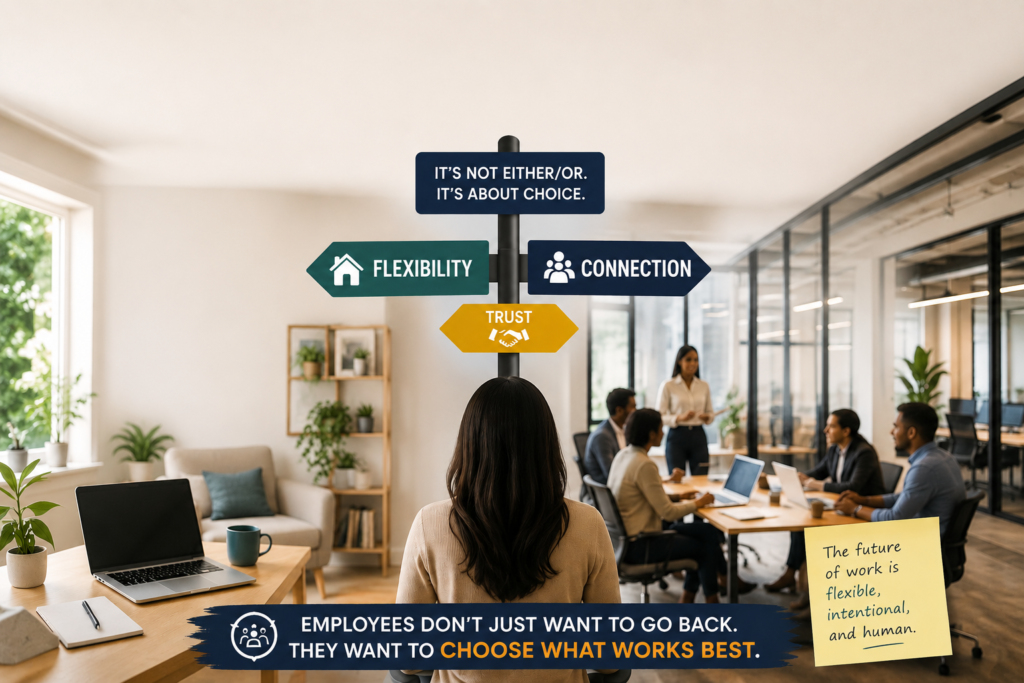

For years, the workplace has been at the center of one of the biggest debates in modern business: Should employees return to the office, continue working remotely, or embrace a hybrid model?
As organizations across industries redefine their workplace strategies, one thing has become increasingly clear—employees are not simply asking for remote work. They are asking for flexibility, trust, and a better work-life experience.
The return-to-office (RTO) conversation is no longer about where work happens. It is about how organizations create environments that enable productivity, collaboration, and employee well-being.
The Evolution of Workplace Expectations
Before 2020, office attendance was considered a standard requirement for most knowledge-based jobs. The pandemic changed that perception dramatically. Employees proved that productivity could be maintained, and in many cases improved, outside traditional office settings.
Today, employees evaluate employers based on factors beyond salary and benefits. Flexibility has become a critical component of the employee value proposition.
Workers are increasingly asking questions such as:
- Can I manage my work and personal commitments effectively?
- Does my employer trust me to deliver results?
- Is commuting worth the time and cost?
- Does the office genuinely add value to my work.
What Employees Actually Want
1. Flexibility Over Full Remote Work
Contrary to popular belief, many employees do not necessarily want to work remotely all the time. What they want is the ability to choose where they can perform their best work.
Hybrid work models continue to gain popularity because they provide the balance employees seek. Office days can be used for collaboration, innovation, and team-building, while remote days allow for focused work and personal flexibility.
2. Meaningful Reasons to Come to the Office
Employees are more willing to return to the workplace when there is a clear purpose behind it.
If office attendance consists primarily of virtual meetings that could have been conducted from home, employees often view commuting as unnecessary. However, when the workplace becomes a hub for brainstorming, mentoring, networking, and relationship-building, employees recognize its value.
The office must evolve from a place people have to be to a place they want to be.
3. Better Work-Life Integration
Long commutes, rigid schedules, and limited flexibility have become major concerns for today’s workforce.
Employees increasingly prioritize organizations that support work-life integration. Flexible schedules, outcome-based performance measurement, and employee well-being initiatives are often viewed as more valuable than traditional workplace perks.
4. Trust-Based Leadership
One of the strongest messages employees have communicated is the desire for trust.
Many workers believe performance should be measured by results rather than physical presence. Organizations that focus on outcomes instead of attendance often experience higher engagement, stronger morale, and increased retention.
Trust has become a key leadership competency in the future of work.
Why Some Leaders Want Employees Back
From a leadership perspective, the return-to-office push is driven by legitimate business concerns.
Many executives cite:
- Stronger collaboration and innovation
- Faster decision-making
- Enhanced company culture
- Improved onboarding experiences
- Greater opportunities for mentorship and development
These benefits are real and can be difficult to replicate entirely in remote environments.
The challenge is finding a balance between organizational goals and employee expectations.
The Rise of the Hybrid Workplace
The hybrid model has emerged as the preferred middle ground for many organizations.
It combines the collaborative benefits of office environments with the flexibility employees value. Successful hybrid strategies focus on outcomes, communication, and employee experience rather than rigid attendance policies.
Companies adopting thoughtful hybrid approaches are often seeing stronger employee satisfaction while maintaining productivity and business performance.
The Future of Work Is Choice
The return-to-office debate is not about winning an argument between remote and office work. It is about understanding what enables people to perform at their best.
Employees want flexibility, purpose, trust, and opportunities for meaningful collaboration. Organizations that listen to these expectations and design workplace strategies around them will be better positioned to attract, engage, and retain top talent.
As the future of work continues to evolve, the most successful companies will not be those that force employees back to old ways of working. They will be the ones that create workplaces—both physical and digital—that people genuinely want to be part of.
Final Thoughts
The question is no longer whether employees should return to the office. The real question is: What kind of workplace experience is worth returning to?
The organizations that answer this question effectively will define the next generation of work.